


- Name
- Atari 5200
- Abbreviation
- 5200
- Release Date
- October 1982
- Manufacturer
- Atari (Company)
- Launch price
- $269.99
- Install base
- 1,000,000
- Online service
- No
- Aliases
- Pam
Atari 5200
The Atari 5200 Supersystem was released in 1982, as a followup to the successful VCS/Atari 2600.
Platform Images Related Pages
Background
 In 1982, Atari (Company) introduced the Atari 5200 Supersystem to the gaming public. Still enjoying the massive success from their last home console, the Atari 2600 (Platform), Atari decided to produce a game system based on its popular line of 8-bit computers, which were also quickly becoming a popular gaming platform. Games could be ported very easily from the Atari 400/800 line of computers to the Atari 5200. In the eyes of Atari management, this would encourage third-party development for the 5200 system as their 8-bit computers already had a dedicated group of developers. However the design for various parts of the 5200 would not only differentiate the console from Atari's own product line (Atari 2600, Atari 400/800) but would also differentiate itself from its home console competition ( Intellivision (Platform)/ ColecoVision (Platform)).
Hardware
The largest difference between the 5200 from Atari's 8-bit computers and 2600 is the unique analog joystick. The controller allows for full 360-degree movement. Additionally, it has a second firing button and a keypad. The joystick does not self-center and is therefore prone to getting stuck, making it more difficult to play particular games such as Asteroids (Game).
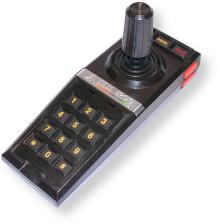 The 5200's keypad holds overlays, similar to the Intellivision's controller. Many Atari 5200 games came packed with overlays, as did third party games from Activision (Company) and CBS, while Parker Brothers packed only Frogger with an overlay. Brands other than CBS include an overlay holder on the cartridge back. Another innovative feature of the 5200 controllers was the inclusion of a pause button, making it one of the first consoles to allow users to pause the action at any point.
The controllers were prone to failure. This led to several third-party vendors (most notably Wico) to release third-party controllers of varying quality and devices that would allow the use of the 9-pin 2600 joysticks on the 5200.
Later, Atari would release a trackball controller, akin to the Marble Madness (Game) arcade controller. Reception for this controller (officially called the Trak-Ball Controller), like the console itself, was lukewarm. The controller was almost as big as the console and was inconsistent in tracking movement.
The original 5200 also came with a unique RF switch box that supplied power to the 5200 on the same cable that fed audio and video to the television. It reduced the number of cables running across users' floors, but was more expensive to manufacture and replace. The 5200 was incompatible with alternative adapters, making replacements hard to find. Atari released a revised 5200 system in 1983 which featured a built-in AC adapter port and could use a standard RF switch box. The revised 5200 also had two joystick ports, unlike the original that had four (like the Atari 400 and 800 computers).
The 5200's keypad holds overlays, similar to the Intellivision's controller. Many Atari 5200 games came packed with overlays, as did third party games from Activision (Company) and CBS, while Parker Brothers packed only Frogger with an overlay. Brands other than CBS include an overlay holder on the cartridge back. Another innovative feature of the 5200 controllers was the inclusion of a pause button, making it one of the first consoles to allow users to pause the action at any point.
The controllers were prone to failure. This led to several third-party vendors (most notably Wico) to release third-party controllers of varying quality and devices that would allow the use of the 9-pin 2600 joysticks on the 5200.
Later, Atari would release a trackball controller, akin to the Marble Madness (Game) arcade controller. Reception for this controller (officially called the Trak-Ball Controller), like the console itself, was lukewarm. The controller was almost as big as the console and was inconsistent in tracking movement.
The original 5200 also came with a unique RF switch box that supplied power to the 5200 on the same cable that fed audio and video to the television. It reduced the number of cables running across users' floors, but was more expensive to manufacture and replace. The 5200 was incompatible with alternative adapters, making replacements hard to find. Atari released a revised 5200 system in 1983 which featured a built-in AC adapter port and could use a standard RF switch box. The revised 5200 also had two joystick ports, unlike the original that had four (like the Atari 400 and 800 computers).
The Games
Far fewer games were released for the 5200 than that of competing consoles from and . Few third-party game developers adopted the console because the 2600 already had 20 million users while the 5200 struggled to maintain 1 million users. Also development for the 2600 was cheaper and didn't require newer technology. The few games that were released for the 5200 were mostly designed or produced in-house by Atari. The console's short life span, due in part to the infamous game crash of 1984, curbed further growth of the console's game library.
Reception and Market Failure
The Atari 5200 was not well received by consumers when it was released and was never able to completely recover from its lukewarm reception. Various design and technical flaws, which ranged from an unreliable controller to an unusual RF adapter, discouraged users from adopting the console. The 5200 was also incompatible with 2600 games, requiring users to buy a separate adapter to play their back catalog of 2600 games, which was not released until later in 1983. In 1984, Atari officially announced the system was discontinued upon the announcement of the 7800(which would not be released until two years later). Beyond the hardware, poor business decisions helped further seal the 5200's fate. First, Atari failed to motivate third-party development for the console. Second, Atari management decided to devote most of their resources to the already oversaturated 2600 market while leaving the 5200 idle. Before the system was discontinued, Atari Inc. originally planned on developing a smaller, cost-reduced version of the Atari 5200, which would have gotten rid of the controller storage bin. This prototype was internally referred to as the Atari 5100 and would have been a more simple and user friendly 5200, but the project was eventually canceled in 1984 when the 5200 was discontinued.
Technical Specifications
- CPU: Custom MOS 6502C @ 1.79 MHz
- RAM: 16 KB
- ROM: 2 KB on-board BIOS; 32 KB window for standard game cartridges
- Graphics: ANTIC and GTIA chips identical to those in Atari's 400/800 home computers
- Sound: 4-channel POKEY chip
- Screen Resolution: 320x192 resolution
- Size: 13" x 15" x 4.35"
Games view all →]
- 5200 Menu (Game)
- A.E. (Game)
- Adventure II (Game)
- Astro Chase (Game)
- Atlantis (Game)
- Attack of the Mutant Camels (Game)
- BC's Quest for Tires (Game)
- Ballblazer (Game)
- Beamrider (Game)
- Beef Drop (Game)
- Berzerk (Game)
- Blue Print (Game)
- Boulder Dash (Game)
- Boulderdash II: Rockford's Revenge (Game)
- Bounty Bob Strikes Back! (Game)
- Bristles (Game)
- Buck Rogers: Planet of Zoom (Game)
- Castle Blast (Game)
- Castle Crisis (Game)
- Centipede (Game)
- Chicken (Game)
- Choplifter! (Game)
- Claim Jumper (Game)
- Clowns & Balloons (Game)
- Combat II Advanced (Game)
- Congo Bongo (Game)
- Countermeasure (Game)
- Crystal Castles (Game)
- Defender (Game)
- Dig Dug (Game)
- Donkey Kong Jr. (Game)
- Final Legacy (Game)
- Frogger (Game)
- Frogger II: Threeedeep! (Game)
- Galaxian (Game)
- Gorf (Game)
- Gremlins (Game)
- Gyruss (Game)
- H.E.R.O. (Game)
- Haunted House II 3D (Game)
- Hopman (Game)
- James Bond 007 (Game)
- John Anderson's Rally Speedway (Game)
- Joust (Game)
- Jungle Hunt (Game)
- K-Razy Shootout (Game)
- Kaboom! (Game)
- Kangaroo (Game)
- Keystone Kapers (Game)
- Klax (Game)
- Koffi: Yellow Kopter (Game)
- Looney Tunes Hotel (Game)
- Madden Football (Game)
- Mario Bros. (Game)
- Megamania (Game)
- Meteorites (Game)
- Miner 2049er (Game)
- Missile Command (Game)
- Montezuma's Revenge (Game)
- Moon Patrol (Game)
- Mountain King (Game)
- Mr. Cool (Game)
- Mr. Do!'s Castle (Game)
- Ms. Pac-Man (Game)
- Pac-Man (Game)
- Pengo (Game)
- Pitfall II: Lost Caverns (Game)
- Pitfall! (Game)
- Pole Position (Game)
- Popeye (Game)
- Q*Bert (Game)
- QIX (Game)
- Quest for Quintana Roo (Game)
- RealSports Baseball (Game)
- RealSports Football (Game)
- RealSports Soccer (Game)
- RealSports Tennis (Game)
- Rescue on Fractalus! (Game)
- River Raid (Game)
- Robotron: 2084 (Game)
- Root Beer Tapper (Game)
- Space Dungeon (Game)
- Space Invaders (Game)
- Space Shuttle: A Journey into Space (Game)
- Star Raiders (Game)
- Star Trek: Strategic Operations Simulator (Game)
- Star Wars (Game)
- Star Wars: Return of the Jedi - Death Star Battle (Game)
- Super Breakout (Game)
- Super Cobra (Game)
- The Activision Decathlon (Game)
- The Dreadnaught Factor (Game)
- Vanguard (Game)
- Wizard of Wor (Game)
- Zaxxon (Game)
- Zenji (Game)
- Zone Ranger (Game)