Overview
Crazy Taxi is a franchise created by developer Hitmaker and published by Sega. The original was released in the arcades back in 1999 and gained some popularity. That popularity exploded once the game was ported to the Dreamcast in 2000, becoming one of the best selling games on the system. Since then, the original has been ported to several platforms as well as followed up with two original sequels..
History
The inspiration for Crazy Taxi was born from a traffic jam experienced by Kenji Kanno. He stated that during said traffic jam, he saw an empty lane and wanted to drive through it with a "Good feeling." He pitched the idea of a game where players assumed the role of a taxi driver to his development team, thought this was met with some resistance. However, the team was won over by Kenji’s idea that better player performance would be rewarded with more game time.
Crazy Taxi (1999)
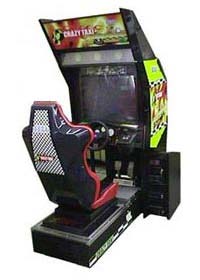 The arcade version.
A player earns fare by delivering customers to destinations, but can also do stunts to make extra cash. Boosting, drifting, near-missing, and hitting big-ass ramps can all be combo’d to earn a stunt multiplier, which is lost if the player collides with pedestrian traffic.
The difficulty of Crazy Taxi gradually increases as the player picks up more and more customers. The player will be given less and less time to drive customers to destinations, and traffic will steadily increase. This subtle shift in difficulty balanced out the mechanic of earning extra time for skilled play, it encouraged replay and thus, coin-feeding.
Gameplay aside, Crazy Taxi’s licensed soundtrack and in-game advertising was its definitive feature. A soundtrack consisting of three Bad Religion songs and three songs from The Offspring, and frequently visited destinations such as Pizza Hut and KFC, ensured that players of Crazy Taxi consumed a lot of punk rock and junk food.
Crazy Taxi 2 (2001)
![]() "Yah Yah Yah Yah Yah"
"Yah Yah Yah Yah Yah"![The]() The "Crazy Hop" really did change the strategy of the formula.
The "Crazy Hop" really did change the strategy of the formula.
Crazy Taxi 2 was the final Crazy Taxi game to be released on the Dreamcast, at that same time, the original game was ported on the PlayStation 2 and later on, the Gamecube. Every gameplay method that was feature in Crazy Taxi was in Crazy Taxi 2, with a new layer of depth added to the formula. Crazy Taxi 2 added four new cab drivers to chose from, the cab drivers from the original do return as unlockables.
Two new cities were created (heavily based on New York). A new gameplay element known as the "Crazy Hop" was added. The crazy hop is done with the push of a button, it helps the player in huge traffic jams that the player has trouble getting through. And the game gives the player the ability to pick up two to four costumers at once.
The way the both cities are structure defiantly makes good use of the crazy hop. There's a extensive amount of short-cuts that have to be taken in order to get to the desired location on time - which consist of jumping on roof-tops, though sometimes you will be jumping from one highway bridge, to another. When the player is driving to the destination, he or she must quickly examine the environment to know if there's a short-cut that can be taken. Certain short-cuts are pretty obvious, such as the arrow that naviagates you is pointing towards a short roof-top, but sometimes it can be a bit more complacated than that.
Multiple passengers can be picked up at once. Once the player does so, he or she must drop them off in different locations. The amount of money that increases for doing stunts will get multiply by the number of costumers the player has. But the player has to be careful on which location to head to first, he or she must keep in mind on which location is the closes first, and then do the same for the next locations. The new layer of depth does make Crazy Taxi 2 more difficult than the original.
Crazy Taxi 3: High Roller (2002)
 Crazy Taxi 3.
The third game added nothing new to the gameplay, and as a result, the critical reception was harsh on the third installment. The game was release on the Xbox, then later in the arcades, and it features the first two levels, music tracks, and cab drivers from previous iterations with the additions of a new city, Glitter Oasis (Based on Las Vagas), four new cab drivers, and more music tracks.
The first two levels from the previous games have been re-design. The graphics have bump up to look better. The West Coast level from the original do feature all the familiar landmarks that players will remember, but they have been reconstructed - some of the buildings look a bit different from the original, and new areas have also been added, the new West Coast level is much bigger than the original. The Small Apple level from the second game have also been re-design so much that it doesn't resemble the original the Small Apple from Crazy Taxi 2; the re-design version also takes place during the night time as well.
The game was originally known as Crazy Taxi Next. It was also going to feature an online mode, multiplayer, and a day and night cycle along with the contain that was in the final version.
Crazy Taxi: Catch a Ride (2003)
A Game Boy Advance version of the original Crazy Taxi was made, it was develop by Graphics State and Publish by THQ (Sega had no involvement). The game's environment was render in 3-D, while the cab and pedestrians were render in sprites, due to the limitation on the Game Boy Advance's hardware.
Crazy Taxi (Redemption Game 2003)
The redemption game version of Crazy Taxi.A Crazy Taxi redemption arcade game was made in 2003 by Sega's U.S division. The way the arcade cabinet is built, is it has a slop with a moving taxi cab in the middle, there are also eight targets at the far end which are the costumers. The rules of the game is the player drops a coin down the slop, and has the coin land on one of the eight targets to earn points.
Crazy Taxi: Fare Wars (2007)
A port of Crazy Taxi and Crazy Taxi 2 was created on the PSP. A multiplayer mode and the ability to customize the soundtrack was added. Several changes was made to both versions, all the in-game advertising was remove and so was the original soundtrack.
Other Media
The Crazy Taxi RC car.Sega made a deal with DSIToys to make RC cars based on the cabs from the game in 2003. Sega saw this as a way to branch the Crazy Taxi series outside of video games.
Controversy
Electronic Arts and Fox Entertainment created their own version of Crazy Taxi in the form of Simpsons: Road Rage in 2001. The critical reception of that game was poor, critics label it as a "Crazy Taxi rip-off." Soon Sega file a law-sue on Electronic Arts and Fox Entertainment for patent infringement. The case between Sega, Fox Entertainment, and Electronic Arts was settled for a unknown amount of money.
Appearances In Other Games
B.D Joe made his appearances as a playable racer in the game, Sonic & Sega All Stars Racing.
Log in to comment