


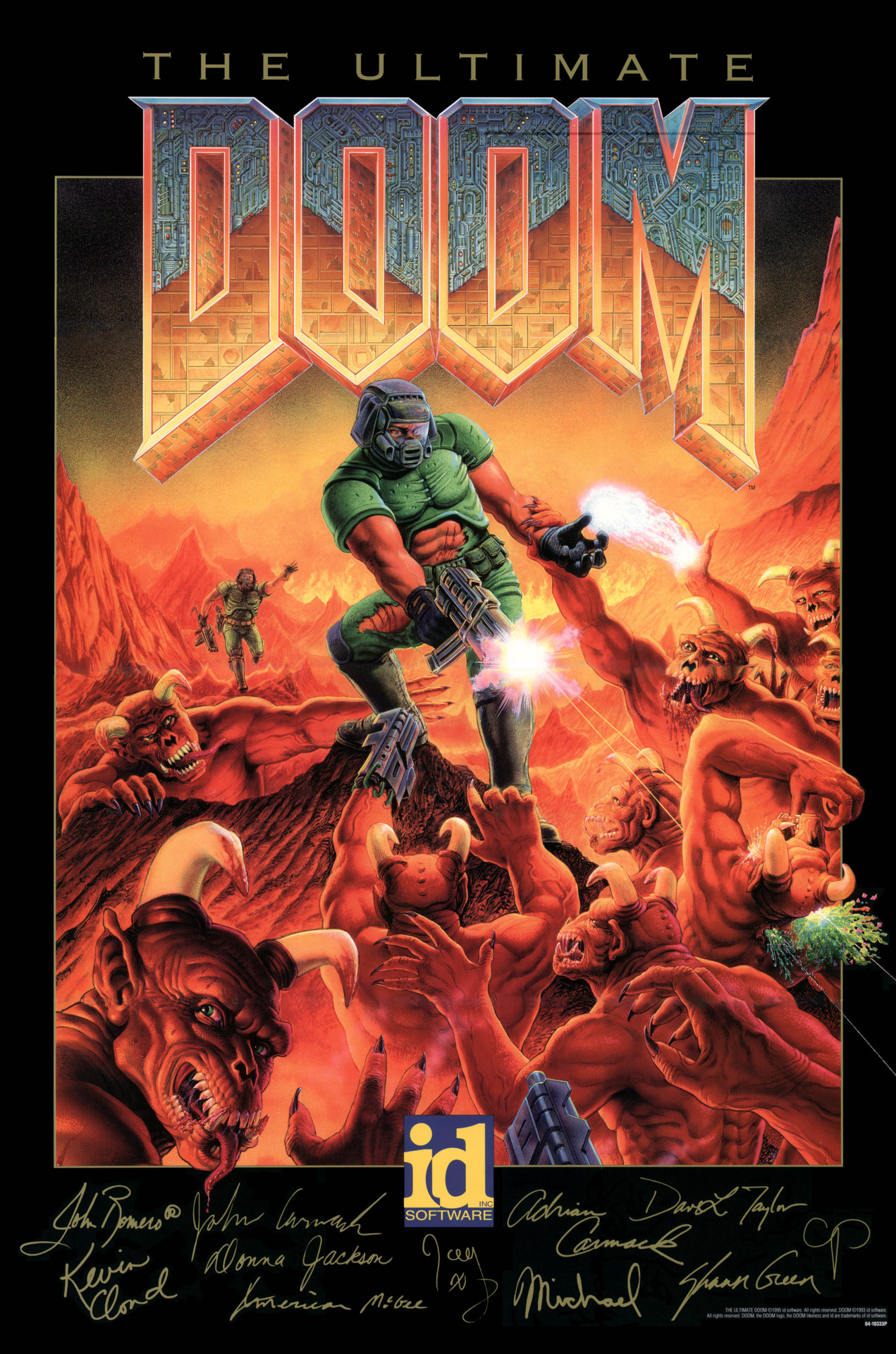

- Name
- id Software
- Abbreviation
- Founded
- 1 February 1991
- Location
- Mesquite,TX,USA
- Website
- http://www.idsoftware.com/
- Aliases
id Software
Mesquite,TX,USA
id Software is one of the highest regarded developers in the industry as being the creators of the First-Person Shooters. Popular series includes Wolfenstein, Doom, Quake and Rage.
Company Images Related Pages
Founding

id Software circa 1993
id Software's history starts at Softdisk, an Apple II (Platform) disk magazine company. At a board meeting at Softdisk in 1990, John Carmack (Person) introduced a groundbreaking technique to develop rapid side-scrolling graphics on a PC (Platform). Carmack and co-worker Tom Hall (Person) worked through the night developing a replica of the first level of Super Mario Bros. 3 using stock images from co-worker John Romero (Person)'s game, Dangerous Dave. When Romero saw Carmack and Hall's creation, he knew that Carmack had made something special.
Unknown to Softdisk, the three men designed a full carbon copy of Super Mario Bros. 3 on the PC, hoping to license the game to Nintendo (Company). Unfortunately, Nintendo turned down the trio. However, this caught the attention of Scott Miller (Person) of Apogee Software. Miller began to contact John Romero through a series of fan letters. Once Romero caught on, Miller realized this was necessary or Softdisk would become aware of the three. Miller suggested the three making shareware games to start out with. They "borrowed" the Softdisk computers and started development on platformer, Commander Keen (Game).
The game was released on December 14, 1990 and was published by Scott Miller's Apogee Software. Soon after this, Softdisk learned of the three's plans. However, they were able to reach an agreement. Carmack, Hall and Romero were able to get away with it and form their own studio if they provided a game for Softdisk every 2 months. The three agreed and on February 1, 1991, id Software was born.
History

Hovertank - id's first FPS game
id first sold their games in the same way they sold Commander Keen, through shareware distribution with Apogee Software. id would start by selling the first title of their trilogies through shareware than sell the next two via mail order. For Wolfenstein 3D (Game) and Doom (Game), distinct sequels were created for the retail market (based on the same engine and assets), but starting with Quake (Game) the more conventional retail model was adopted from the outset. id quickly became famous for their game engines which were frequently licensed to other developers. After the Keen engine, id would go on to develop the Wolfenstein 3D engine, the Wolfenstein 3D slopes engine, Doom engine, Quake, Quake II (Game) and Quake III engines, Doom 3 technology ( id Tech 4 (Concept)), the MegaTexture technology, and the upcoming id Tech 5 (Concept). Commander Keen was id's first big success. Commander Keen gained a cult following from the gamers and spawned a large series of titles. Wolfenstein 3D was their next big hit and essentially created the 3D first person shooter genre. Wolfenstein 3D was followed by its less successful prequel, Spear of Destiny (Game).
After Wolfenstein 3D, id launched its biggest hit yet, Doom. Doom had the best graphics of any PC game to date and garnered mainstream media attention based on its popularity and violent, dark imagery. Doom was followed by the just as successful Doom II, which was technically very similar to the original. 2 years later, id's next hit first person shooter was born, Quake. Quake featured an all new full 3D game engine and the groundbreaking ability to play deathmatch across the internet. Quake spawned three sequels in Quake II (Game), the online-focused Quake III: Arena and a direct follow-up to Quake II (Game), Quake 4 (Game). id allowed various developers to revisit their franchises with new adaptions on the series. The first of this was Return to Castle Wolfenstein (Game), developed by Gray Matter Interactive and Nerve Software.
Return to Castle Wolfenstein was the first Wolfenstein (Franchise) game with online multiplayer. The next published game was Wolfenstein: Enemy Territory, an online-only take on the Wolfenstein series developed by Splash Damage. It was soon revealed that this break was due to id's development on Doom 3 (Game) which was released in 2004. Doom 3 once again revolutionized graphics on a PC but received a mixed reception from series fans. id returned to production after Doom 3, collaborating with Raven Software (Company) for Quake 4 (Game), Fountainhead Studios' cell phone games Doom RPG and Orcs andamp;amp;amp; Elves, and finally, Splash Damage's Quake spin-off, Enemy Territory: Quake Wars. They have also released a heavily revised version of Quake 3 Arena as a browser-based game, Quake Live (Game).
In 2009, id Software released several of their classic games on the Apple's App Store with ports of Wolfenstein 3D, Doom and Rage. They also released new titles like Wolfenstein RPG (Game), Doom Resurrection (Game) and Doom II RPG (Game).
On October 4, 2011, id released its highly anticipated new IP called Rage (Game) that utilized the latest id Tech 5 engine. It was originally to be published by Electronic Arts (Company) after id announced a partnership with EA, ending their long exclusive relationship with Activision (Company) but was finally published by Bethesda, id's current parent company. Rage received positive reviews but didn't sell well, resulting several employee layoffs on January 10, 2012. Raven Software (Company) released a new Wolfenstein (Game) game in 2009 but it too didn't do well sales wise, which resulted a major layoff at Raven.
In 2016, Doomwas released.
Acquisition by Bethesda
On June 24, 2009, id Software was acquired by Zenimax Media, the parent company of Bethesda. This was considered a surprise move, especially on id's part due to their history as being a staunchly independent developer. The full press release can be found here. Following the acquisition, Bethesda later acquired the publishing rights for Rage, ending the short stint with Electronic Arts. Other companies that were considered to be part of a merger with id were Activision, THQ (Company) and Sega (Company), but id chose Bethesda because it " felt more secure with larger companies."
id Mobile
Sometime in 2008, id Software established a development team to work on mobile games for the iPhone, iPod Touch and iPad. Their first release was Wolfenstein RPG (Game) in 2009, followed by Wolfenstein 3-D, Doom Classic, Doom: Resurrection, Doom II RPG (Game) and Rage HD.
In a keynote at QuakeCon 2012, John Carmack revealed that the id Mobile developers have shifted their efforts on bigger projects, thus halting the mobile game development indefinitely.
The Company Name

"id" used to look like this
The company was originally called Ideas From the Deep but they decided to shortened it to simply id, which stands for "in demand," and is pronounced as in "did" or "kid." The name also had another meaning which is referring to id, one of the three parts (The other two being ego and super-ego) of the brain that behaves by the pleasure principle. Even though id has since moved on, Ideas From The Deep still exists to this day as a mobile gaming company but it no longer has any relationship with id Software.
The id Tech Engines
id software is known for its game engines that many developers and games have used. They were primarily created and designed by John Carmack and as an advocate of open-source, he would release the source code on the web for the fans and mods once it has reached its mature stage. From the beginning, Carmack doesn't believe in patenting his game engines and is not interested in licensing them because of his desire to devote his time working on new technology and not to provide technical support to third-party developers constantly.
The id Tech 1, 2 and 3 engines were widely licensed by various gaming companies like Raven Software (Company), Valve Corporation (Company), LucasArts, Splash Damage and Human Head Studios. The Half-Life, Call of Duty (Franchise) and Star Wars (Franchise) games were made possible thanks to the id Tech engines. The id Tech 4 was the least popular engine thanks to its biggest competitor Epic Games (creators of the Unreal Engine) that provided better development tools and genre scope. Epic Games (Company) approached its gaming licensing seriously and it affected id Software's business to some extend. When asked in a 2011 interview, Carmack said "good for [Epic Games]" and despite losing the engine market by a few percentage, he has no regrets of not pursuing the licensing business.
The id Tech 5 is the latest engine from id. It supports MegaTexture that provides textures with resolutions up to 128,000 pixels x 128,000 pixels. The first game to utilize the id Tech 5 is Rage.
id tech 1 (aka Doom Engine)

Doom
- Doom (Game) (1993)
- Doom II: Hell on Earth (1994)
- Heretic (Game) (1994)
- Heretic: Shadow of the Serpent Riders (1994)
- Hexen: Beyond Heretic (1995)
- Hexen: Deathkings of the Dark Citadel (1995)
- Final Doom (Game) (1996)
- Strife (Game) (1996)
id Tech 2 (aka Quake II Engine)

Quake II
- Quake (Game) (1996)
- Quake II (Game) (1997)
- Hexen II (Game) (1997)
- Half-Life (1998)
- SiN (Game) (1998)
- Heretic II (Game) (1998)
- Kingpin: Crime of Life (1999)
- Daikatana (2000)
- Soldier of Fortune (2000)
- Anachronox (Game) (2001)
id Tech 3 (aka Quake III Engine)

Quake III: Arena
- Quake III: Arena (1999)
- Quake III: Team Arena (2000)
- Star Trek: Voyager (2000)
- Return to Castle Wolfenstein (Game) (2001)
- Soldier of Fortune II: Double Helix (2002)
- Star Wars: Jedi Knight II - Jedi Outcast (2002)
- Star Wars: Jedi Knight - Jedi Academy (2003)
- Wolfenstein: Enemy Territory (2003)
- Call of Duty (2003)
- Call of Duty: United Offensive (2004)
- Severity (2007)
- Dark Salvation (Game) (2009)
- QuakeLive (2010)
id Tech 3 with ÜberTools

American McGee's Alice
- American McGee's Alice (2000)
- Heavy Metal: F.A.K.K.² (2000)
- Medal of Honor: Allied Assault (2002)
- Medal of Honor: Allied Assault – Breakthrough (2003)
- Medal of Honor: Allied Assault – Spearhead (2003)
- Star Trek: Elite Force II (2003)
id Tech 4 (aka Doom 3 Engine)

Doom 3
- Doom 3 (Game) (2004)
- Doom 3: Resurrection of Evil (2005)
- Prey (Game) (2006)
- Quake 4 (Game) (2005)
- Enemy Territory: Quake Wars (2007)
- Wolfenstein (Game) (2009)
- Brink (Game) (2011)
id tech 5 (aka Rage Engine)

Rage
- Rage (Game) (2011)
- Doom 3: BFG Edition (2013) [using id Tech 5 elements]
- Wolfenstein: The New Order (2014)
- The Evil Within (Game) (2014)
- Wolfenstein: The Old Blood (2015)
id Tech 6

Doom!
- Doom (2016)
- Wolfenstein II: The New Colossus (2017)
- Doom VFR (Game) (2017)
- Wolfenstein: Youngblood (2019)
- Wolfenstein: Cyberpilot (2019)
id Tech 7

- Doom Eternal (Game) (2020)
Games Developed by id
Commander Keen (Franchise)
- Marooned On Mars (1990)
- The Earth Explodes (1990)
- Keen Must Die! (1990)
- Keen Dreams (1990)
- Secret of The Oracle (1991)
- The Armageddon Machine (1991)
- Aliens Ate My Baby Sitter! (1991)
Wolfenstein (Franchise)
- Wolfenstein 3-D (1992)
- Spear of Destiny (Game) (1992)
Doom (Franchise)
- Doom (Game) (1993)
- Doom II: Hell on Earth (1994)
- Doom 3 (Game) (2004)
- Doom (2016)
- Doom: Eternal (2020)
Quake (Franchise)
- Quake (Game) (1996)
- Quake II (Game) (1997)
- Quake III: Arena (1999)
- Quake Live (Game) (2010)
- Quake Arena DS (TBC)
- Quake Champions (Game) (2018 Early Access)
Rage
- Rage (Game) (2011)
Other Games
- Dangerous Dave (Game) (1988)
- Dangerous Dave In The Haunted Mansion (1991)
- Rescue Rover (Game) (1991)
- Rescue Rover 2 (Game) (1991)
- Shadow Knights (Game) (1991)
- Hovertank 3D (1991)
- Catacomb 3-D (1992)
Games Co-Developed/Published by id
- Heretic (Game) (1994)
- Hexen: Beyond Heretic (1995)
- Doom 64 (Game) (1997)
- Commander Keen (Game) [ Game Boy Color (Platform)] (2001)
- Return to Castle Wolfenstein (Game) (2001)
- Wolfenstein: Enemy Territory (2003)
- Return to Castle Wolfenstein: Tides of War (2003)
- Return to Castle Wolfenstein: Operation Resurrection (2003)
- Doom RPG (2005)
- Doom 3: Resurrection of Evil (2005)
- Quake 4 (Game) (2005)
- Orcs andamp;amp;amp; Elves (2006)
- Enemy Territory: Quake Wars (2007)
- Wolfenstein (Game) (2009)
- Wolfenstein RPG (Game) (2009)
- Doom: Resurrection (2009)
- Doom II: RPG (2010)
Key Members of id

id Software in 2011
As of November 22, 2013, none of the 4 founding members are with the company anymore.
- Kevin Cloud (Person) - Executive Producer (1992 - present) Formerly Artist.
- Donna Jackson — Office manager/ "id mom" (1994–present)
- Marty Stratton — Producer (1997 - 2011), Director of Business Development (2012 - 2015), Executive producer & Game director (2016 – present)
- Robert Duffy - Programming Director (1998 - present)
Former Key Members
- Tom Hall (Person) - Co-Founder, Game Designer (1991 - 1993) After a dispute with Carmack over the designs of Doom, Hall was forced to resign. He joined 3D Realms soon afterwards.
- Bobby Prince - Music Composer (1991 - 1994) An freelance musician who went on to pursue other projects after Doom II.
- Dave Taylor (Person) - Programmer (1993 - 1994) Taylor left id and co-founded Crack dot Com (Company).
- John Romero (Person) - Co-Founder, Designer, Programmer (1991 - 1996) Romero was fired during the development of Quake for not performing. He established Ion Storm along with Hall in November 1996.
- Shawn Green - Software Support (1991 - 1996) Left id Software to join Romero at Ion Storm.
- Michael Abrash (Person) - Programmer (1993 - 1996) Returned to Microsoft after the release of Quake.
- Jay Wilbur (Person) - Business (1991 - 1997) Left id after Romero's departure and joined Epic Games (Company) in 1997.
- Sandy Petersen (Person) - Level Designer (1993 - 1997) Left id for Ensemble Studios (Company) in 1997.
- American McGee (Person) - Level Designer (1993 - 1997) American was fired after Quake II's release. He joined EA and created the cult classic American McGee's Alice.
- Adrian Carmack (Person) - Co-Founder, Artist (1991 - 2005) Adrian left id after the release of Doom 3 to further pursue his career in arts. It was later revealed he was fired due to ownership and legal issues. The lawsuit was eventually dropped after the Zenimax Media acquisition.
- Matt Hooper - Creative Director (2002 - 2013) Formerly Design Director. Originally worked on Daikatana in Map Design, he left Ion Storm in November 1998 and joined id Software. After the completion of RAGE, he left id to join Oculus VR in August 2013.
- Todd Hollenshead (Person) - CEO, President (1996 - 2013) Left id in good terms to "pursue other personal interests." He is now at Nerve Software.
- John Carmack (Person) - Co-Founder, Technical Director (1991 - 2013) Widely known in the industry for creating game engines that powered id and other third party titles. He joined Oculus VR on August 7, 2013 as a side project but unable to handle two companies at the same time, Carmack resigned from id Software on November 22, 2013 to pursue Oculus full time; making him the last founding member to leave the company.
- Tim Willits (Person) - Level designer (1995– 2001), creative director (2002–2011), studio director (2012–2019) He is now the chief creative officer at Saber Interactive (Company).
Developed Games
View all developed games
Catacomb 3-D (Game)
A high-fantasy first-person shooter based on the Catacomb duology of action games from id co-founder John Carmack. It is a precursor to id's Wolfenstein 3D.

Spear of Destiny (Game)
An official standalone expansion of (and prequel to) Wolfenstein 3D, players reprise the role of Allied spy William "B.J." Blazkowicz, who must infiltrate a strongly-guarded Nazi installation to recover the mythical Spear of Destiny.

Commander Keen 4: Secret of the Oracle (Game)
Commander Keen comes to the rescue of the Keepers of the Oracle in this fourth episode.

Master Levels for Doom II (Game)
Master Levels for Doom II is an expansion pack for Doom II comprising 21 "Master Levels" officially sanctioned by id Software. It also contains Maximum Doom, a compilation of nearly 3,000 user-created levels.
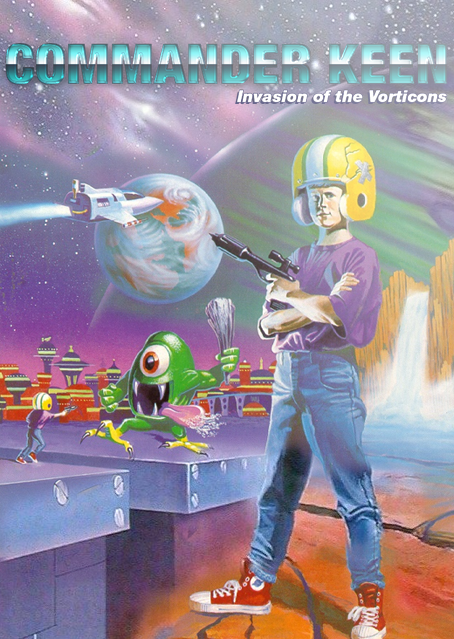
Commander Keen: Invasion of the Vorticons (Game)
Commander Keen: Invasion of the Vorticons is a compilation of the first three Commander Keen episodes.

Hovertank (Game)
A first-person tank-combat game and a precursor to Wolfenstein 3D. Pilot the titular hovertank and rescue refugees while taking on mutants, aliens, and enemy tanks.

Quake III: Team Arena (Game)
Quake III: Team Arena is an expansion pack released for Quake III Arena in December 2000 by id Software. It features new modes focused on teamplay, as well as new weapons, items, player models, and maps.

Commander Keen 5: The Armageddon Machine (Game)
The fifth episode in the Commander Keen serial MS-DOS series of sci-fi platformers. The game follows directly after the events of episode four, with Keen passing through the colossal Shikadi space station The Omegamatic.

Commander Keen 6: Aliens Ate My Babysitter! (Game)
The final episode in the Commander Keen hexalogy, putting the child genius on a quest to rescue his babysitter from the alien Bloogs of Fribbulus Xax.

Wolfenstein RPG (Game)
A first-person RPG set in the Wolfenstein universe. Use touch controls to shoot, punch, kick, and smash toilets on enemies. Find hidden treasures and upgrade your stats through nine levels.
Published Games
View all published games
Quake Mission Pack No 1: Scourge of Armagon (Game)
The only major product released by Hipnotic Interactive before being redubbed Ritual Entertainment, Scourge of Armagon is the first of two expansions packs created for Quake. It portrays events immediately following the climax of the first game.

Hexen: Deathkings of the Dark Citadel (Game)
Deathkings of the Dark Citadel was the first true game expansion that Raven Software ever produced. In addition to providing three new hubs for the original HeXen, the Deathkings expansion was the first multiplayer game that allowed eight players to connect to a LAN simultaneously.