


- Name
- Mac
- Abbreviation
- MAC
- Release Date
- January 1984
- Manufacturer
- Apple Inc. (Company)
- Launch price
- $2,495.99
- Install base
- Online service
- Yes
- Aliases
- Macintosh,OSX,OS X
Mac
The Macintosh (Mac) line of personal computers is designed and developed by Apple, Inc. - formerly Apple Computer, Inc. It runs macOS, a Unix operating system. Its current version, macOS 13.4 "Ventura" was released on May 18, 2023.
Platform Images Related Pages
History
The Macintosh was designed as part of a skunkworks operation originally headed by Jef Raskin. Raskin planned to create an easy to use and affordable appliance computer for use by ordinary people. The project was ongoing at the same time as Apple founder Steve Jobs (Person) was leading development of Lisa, Apple's intended flagship computer. Despite his heavy involvement in the inital stages of the Lisa project, Jobs eventually caught wind of the Macintosh project and gradually turned his full attention to it. In 1981, Raskin departed the team over a dispute with Jobs, making Steve the de facto leader.
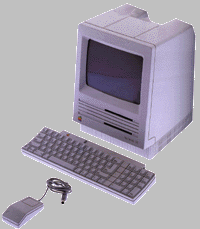 It was under Jobs that the Mac became a GUI-oriented computer, influenced by a tour given to Apple staff of Xerox's Palo Alto Research Center which included looks at PARC's Alto computer and the related Smalltalk software. The computer eventually released in 1984 as a vertically-oriented all-in-one and was gradually revised over the course of the decade. Eventually, Apple began to offer Macs in different formats, ranging from standard desktops to early laptops and other portable designs.
The Mac's popularity was at first fairly high, but after Steve Jobs was stripped of power within Apple (eventually departing to form NeXT), executives who did not fully understand the platform began to devalue it (notably, Apple was criticized in the nineties for offering an absurd amount of Macs which were too similar and had generic names) and the platform struggled. To compound these problems, Apple's Mac System (later Mac OS), the OS powering the Macs, was outdated and needed replacing.
Unfortunately, Apple's internal software R&D had become bloated and ineffectual, stalling development on the next-generation Mac OS codenamed Copland. In 1996, Apple wrote it off as a sinking ship and decided to source the basis for their next-generation operating system from elsewhere. Several options were considered, such as licensing Microsoft's NT architecture and purchasing Be, Inc. for its BeOS. In the end though, it was Apple founder Steve Jobs and his NeXT outfit which Apple decided to buy, allowing them to base what would become OS X (as in the roman numeral for 10) on NeXT's powerful and robust OpenSTEP OS.
This also brought Jobs back into the company. He quickly assumed control and began to turn the Mac platform around. Jobs trimmed the bloat from the product line and steadily began to focus on releasing stylish computers like the iMac and iBook for consumers and powerhouses for the Mac's creative professional base like the PowerBook and PowerMac lines.
It was under Jobs that the Mac became a GUI-oriented computer, influenced by a tour given to Apple staff of Xerox's Palo Alto Research Center which included looks at PARC's Alto computer and the related Smalltalk software. The computer eventually released in 1984 as a vertically-oriented all-in-one and was gradually revised over the course of the decade. Eventually, Apple began to offer Macs in different formats, ranging from standard desktops to early laptops and other portable designs.
The Mac's popularity was at first fairly high, but after Steve Jobs was stripped of power within Apple (eventually departing to form NeXT), executives who did not fully understand the platform began to devalue it (notably, Apple was criticized in the nineties for offering an absurd amount of Macs which were too similar and had generic names) and the platform struggled. To compound these problems, Apple's Mac System (later Mac OS), the OS powering the Macs, was outdated and needed replacing.
Unfortunately, Apple's internal software R&D had become bloated and ineffectual, stalling development on the next-generation Mac OS codenamed Copland. In 1996, Apple wrote it off as a sinking ship and decided to source the basis for their next-generation operating system from elsewhere. Several options were considered, such as licensing Microsoft's NT architecture and purchasing Be, Inc. for its BeOS. In the end though, it was Apple founder Steve Jobs and his NeXT outfit which Apple decided to buy, allowing them to base what would become OS X (as in the roman numeral for 10) on NeXT's powerful and robust OpenSTEP OS.
This also brought Jobs back into the company. He quickly assumed control and began to turn the Mac platform around. Jobs trimmed the bloat from the product line and steadily began to focus on releasing stylish computers like the iMac and iBook for consumers and powerhouses for the Mac's creative professional base like the PowerBook and PowerMac lines.
 Despite the perception of the Mac as a second-rate games platform (by comparison to the dominant Windows PC), it has played host to a number of popular exclusives, most notably much of Bungie's earlier games (before the Microsoft buyout) catalog. In fact, Bungie's Halo, a huge hit for the Xbox, was originally a Mac exclusive, built on OpenGL (Concept). The game later found its way onto Mac as a port of the PC release.
In 2016, Apple changed the name of the operating system on Mac computers to "macOS", which aligns with their other products (iOS, iPadOS, watchOS, tvOS, audioOS).
Despite the perception of the Mac as a second-rate games platform (by comparison to the dominant Windows PC), it has played host to a number of popular exclusives, most notably much of Bungie's earlier games (before the Microsoft buyout) catalog. In fact, Bungie's Halo, a huge hit for the Xbox, was originally a Mac exclusive, built on OpenGL (Concept). The game later found its way onto Mac as a port of the PC release.
In 2016, Apple changed the name of the operating system on Mac computers to "macOS", which aligns with their other products (iOS, iPadOS, watchOS, tvOS, audioOS).
Gaming on the Macintosh
macOS 10.13 "High Sierra" Improvements
With the release of macOS 10.13 "High Sierra" came a number of improvements, through Apples graphical API called "Metal 2" by introducing virtual reality, machine learning and support for external GPU's (eGPU) to improve gaming and media experiences.
Windows Gaming on the Mac
On April 5, 2006 Apple released a beta version of software called Bootcamp. Due to the recent change in architecture - PowerPC to Intel - Mac and Windows computers were now more similar than ever. Bootcamp embraced this by allowing the user to install Windows on a Mac. Windows XP - and later Windows Vista and 7 - now ran natively on Macintosh computers, making gaming on Mac's easier than ever. With the release of macOS 10.5 (Leopard), Bootcamp comes pre-installed on all macOS devices and is thus officially supported by Apple. Although many Mac users are unwilling to install Windows on their computer, Boot Camp still offers Mac users something they've never had before - the ability to run any PC game 100% natively.
Steam for Mac
On March 8th, 2010, Valve announced that it would begin a new Steam (Concept) program for the Mac. Under this new system, Valve games would be able to run natively on the Mac, and 3rd parties would be able to release a Mac version of their game on Steam. Also announced is a program called Steam Play, where players who buy the Mac version of a game will also be able to download the PC version of the same game free of charge. Steam for Mac was released on May 12, 2010. With the release of macOS Catalina (10.15) in 2019, Apple ceased support for 32-bit applications, which impacted compatibility of certain games on Steam. Users can run incompatible games in their library on Windows via Bootcamp on their macOS devices.
Mac App Store
Mimicking their strategy with the iOS platform, Apple has recently added an integrated App Store to macOS. Users can purchase Applications in the same way as on iOS. Apps are then downloaded to a user's system and the App Store App itself keeps track of updates for these Apps. In addition, once an App is purchased, users are free to install it on any other Mac computer by logging into the Mac App Store with the same Apple Account. This service, just like on iOS, extends to games and already a number of Publishers have made classic and more recent titles available for purchase on the Mac App Store. These games range from recent and current hits to old favourites, to popular indie games like the Penny Arcade Adventures episodes and also ports of existing iOS games like Angry Birds (Franchise).
Games view all →]
- !Sqrxz! (Game)
- #AkiRobots (Game)
- #WarGames (Game)
- #hasicontent (Game)
- '90s Super GP (Game)
- 'dillos (Game)
- 'n Verlore Verstand (Game)
- (Don't) Open Your Eyes (Game)
- (I Fell in Love With) The Majesty of Colors Remastered (Game)
- .T.E.S.T: Expected Behaviour — Sci-Fi 3D Puzzle Quest (Game)
- .projekt (Game)
- //Todo: today (Game)
- 0 A.D. (Game)
- 0_abyssalSomewhere (Game)
- 00 mem.: ~Le Chat~ (Game)
- 007: Nightfire (Game)
- 0RBITALIS (Game)
- 0x10c (Game)
- 1,000 Heads Among the Trees (Game)
- 10 Beautiful Postcards (Game)
- 10 Cent Classics: Shady Pack (Game)
- 10 Minute Barbarian (Game)
- 10 Second Ninja (Game)
- 10 in 1 game-a-week bundle! (Game)
- 100 Doors: Escape from School (Game)
- 100% Hidden Objects (Game)
- 1000 Amps (Game)
- 1000 Words (Game)
- 10000000 (Game)
- 1001 Spikes (Game)
- 101 Kitty Pets (Game)
- 101 Penguin Pets (Game)
- 101 Puppy Pets (Game)
- 103 (Game)
- 112 Operator (Game)
- 12 Bananas (Game)
- 12 Is Better Than 6 (Game)
- 12 Labours of Hercules (Game)
- 12 Labours of Hercules II: The Cretan Bull (Game)
- 12 Labours of Hercules III: Girl Power (Game)
- 12 Labours of Hercules IV: Mother Nature (Game)
- 12 Labours of Hercules V: Kids of Hellas (Game)
- 12 Labours of Hercules VI: Race For Olympus (Game)
- 12 Labours of Hercules VII: Fleecing The Fleece (Game)
- 12 Labours of Hercules VIII: How I Met Megara (Game)
- 12 Labours of Hercules X: Greed for Speed (Game)
- 12 Labours of Hercules XI: Painted Adventure (Game)
- 12 Labours of Hercules XII: Timeless Adventure (Game)
- 12 Labours of Hercules XIII: Wonder-ful Builder (Game)
- 12 orbits (Game)
- 121 N (Game)
- 13 Minutes of Light (Game)
- 140 (Game)
- 16-bit Trader (Game)
- 18 Rooms to Home (Game)
- 1849 (Game)
- 1893: A World's Fair Mystery (Game)
- 1916 - Der unbekannte Krieg (Game)
- 1942: The Pacific Air War (Game)
- 1979 Revolution: Black Friday (Game)
- 1BillionHex (Game)
- 2020: My Country (Game)
- 2064: Read Only Memories (Game)
- 2:22 AM (Game)
- 2D Paintball (Game)
- 3 In Three (Game)
- 3-D Ultra Pinball (Game)
- 3-D Ultra Pinball: The Lost Continent (Game)
- 300 Arcade Games (Game)
- 300 Dwarves (Game)
- 3079 (Game)
- 3089 (Game)
- 3571 The Game (Game)
- 39 Days to Mars (Game)
- 3918 (Game)
- 3D Body Adventure (Game)
- 3D Creation Station (Game)
- 3D Paraglider (Game)
- 3D Railroad Master (Game)
- 3SwitcheD (Game)
- 4 Elements II (Game)
- 4*4 Off Road Racer (Game)
- 4089: Ghost Within (Game)
- 4D Golf (Game)
- 4D Sports Boxing (Game)
- 4PM (Game)
- 4x4 Evo 2 (Game)
- 4x4 Evolution (Game)
- 5 Minutes to Burn Something! (Game)
- 5089 (Game)
- 60 Seconds! (Game)
- 6180 the moon (Game)
- 7 Billion Humans (Game)
- 7 Days to Die (Game)
- 7 Grand Steps (Game)
- 7th Chance (Game)
- 8-Bit Adventure Anthology: Volume 1 (Game)
- 8-Bit Commando (Game)
- 80 Days (Game)
- 88 Heroes (Game)