Overview
In most cases, when a game receives a sequel, the sequel exists within the same genre as the previous entry or entries. However, this is not always the case. Sometimes, while the game may be a sequel in terms of plot or by name, its gameplay may have shifted to an entirely different genre.
This concept only applies to direct sequels that are numbered, or carry on the storyline of the previous game. For different genres of games in the same franchise, see the Spin-Off page.
Examples
Warcraft III: Reign of Chaos to World of Warcraft
 RTS to MMO
Even though World of Warcraft is not a direct sequel to Warcraft III: Reign of Chaos, it is in fact a continuation of the storyline and takes place in the same universe. Instead of ordering heroes and units around on a battlefield, players are now able to create their own hero and take on quests to create order in the world of Azeroth. Over the years, several of the game's antagonists have fallen, and with the 2008 expansion pack World of Warcraft: Wrath of the Lich King, the main plot-line of Warcraft III: Reign of Chaos came to an end when players assaulted Northrend in the pursuit of Arthas.
Persona 4 to Persona 4 Arena
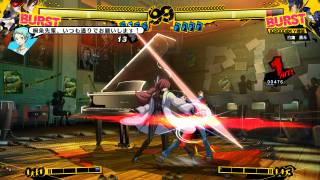 Persona 4 Arena continues the storyline of the previous games.
Like its predecessors, Shin Megami Tensei: Persona 4 is a party-based RPG with turn-based combat. However, the direct sequel to the game, Persona 4 Arena, is a one-on-one fighting game. Though the change in genre is drastic, Arena has close ties to Persona 4, as well as Persona 3, with an intricate storyline that follows the events of both games and leaves plot threads in place that may follow through to Persona 5. Arena also contains numerous stylistic and aesthetic references to the RPGs, with elements such as the characters' Personae, status effects, All-Out Attacks, and so on having been incorporated into the fighting system.
Kid Icarus: Of Myths and Monsters to Kid Icarus: Uprising
 Kid Icarus: Uprising completely reinvents the gameplay of the series.
Nearly twenty years after the release of Kid Icarus: Of Myths and Monsters, a side- and vertical-scrolling platformer much like the original Kid Icarus, Nintendo released Kid Icarus: Uprising. Uprising does away almost entirely with the platforming of its predecessors. The player character Pit cannot jump, save for the use of special floor pads. The game also features on-rails flight sequences in most stages that are reminiscent of such games as Space Harrier or Rez.
Log in to comment