"After more than a decade, portability and a lovely visual makeover are just bonus features for a game that holds up as well as Ocarina of Time."

 The titular character of the Legend of Zelda series, Princess Zelda is a member of Hyrule's royal family. The young princess is the only member of her family that suspects Ganondorf's treachery, fearing that his true interests are to take control of the Triforce (which the Royal Family is sworn to protect).
Link (Character) first meets Princess Zelda at the behest of the Great Deku Tree (Character). His task was to take the Kokiri Emerald to the Princess. After sneaking his way into the castle and avoiding guards in the Castle Royal Gardens, Link finally makes his way into Zelda's room and private garden. At first, Zelda was surprised that the young boy had managed to sneak past the guards, but when she discovers that Link had arrived in the Castle from the forest, and had a fairy companion, Zelda remembered the dream she had of the boy emerging from the forest with a fairy, and was convinced that Link was the one destined to help her keep the Triforce away from Ganondorf. Zelda tells Link of her fears about the dark wizard, and together, the two children hatch a plan to protect the Triforce from Ganondorf's evil.
To open the Door of Time and Access the Sacred Realm (Location), the pair would need to play the Song of Time on Zelda's greatest treasure, the Ocarina of Time, passed down throughout the Royal Family.
However, before Link and Zelda use the Sacred Stones to open the Door of Time, Ganondorf begins his coup in Hyrule Castle (Location) and chases the Princess and her guardian Impa (Character) from the Castle. As they cross the gate to Hyrule Castle Town (Location), Zelda throws the Ocarina of Time into the moat for Link to recover, imbued with a secret message from the princess that teaches Link how to play the Song of Time. The young Princess Zelda won't be seen again until the player has completed the game.
When Link awakens in the Temple of Time seven years in the future, he is greeted by the mysterious Sheik, the last surviving member of the Sheikah, a tribe dedicated to the protection of the royal family. Sheik describes to Link the new world, one controlled and maintained by Ganondorf from the safety of Hyrule Castle. Sheik points Link towards the first Sage, the Sage of the Forest, and gives Link hints about the tools he will need to help save and awaken the various Sages. Sheik will eventually teach Link special "warp" songs that will instantly whisk the Hero of Time to the entrance of the five dungeons, or send him back to the Master Sword (Object)'s pedestal at the Temple of Time, making the navigation of Hyrule much easier.
After Link awakens all six Sages, he returns to meet Sheik at the Temple of Time (Location). Sheik tells Link that, although Ganondorf was the ruler of Hyrule, his victory of the land was not complete. Ganondorf only possessed one piece of the Triforce, the Triforce of Power. Link himself possessed the Triforce of Courage. The Triforce of Wisdom, on the other hand, was bound on the hand of a mysterious "seventh sage", the leader of the other six. To Link's (and the player's) shock, Sheik removes his mask and vestments, and reveals himself to be none other than the Princess Zelda! Her disguise was a ruse to keep the Princess out of Ganondorf's clutches to protect the Triforce of Courage. As the legendary Seventh Sage, Zelda uses her power to grant Link a weapon, the mystical Arrows of Time, that could penetrate any darkness and fill it with light. However, upon revealing her true self, Ganondorf captures the Princess and brings her to Hyrule Castle. Only Link can rescue her from his clutches, so he sets off to Ganon's castle, and ascends to the top and faces the Evil King. Zelda is released upon Link's victory, but the tower starts to collapse, and the two have to escape before they're buried along with it. She helps open the gates that will lead the two to the exit and escape just as the building is destroyed. After a final battle between Link and Ganon, Zelda uses her powers to hold Ganon in place so Link can deliver the final blow to the beast. She then uses her powers in conjunction with the six sages to seal Ganon within the Sacred Realm. With Hyrule saved, Zelda uses the Ocarina of Time to send Link back to his childhood, where he is supposed to be.
 Navi is one of the mysterious fairy's of the Deku Forest. We are introduced to Navi at the very start of the game when she wakes Link from his nightmare, telling Link the Deku Tree has sent her to aid Link on his journey.
Navi is the secondary character that the player controls throughout the game with the new and innovative Z-Targeting mechanic. When the player presses and holds the Z-button, Navi will float over the nearest target in order to keep the players attacks directed to that object or enemy. As well as being a part of a mechanic, Navi is also one of the first characters to have voice acting. She will occasionally yell out "Watch Out" if there is something Link needs to....well, watch out for. She also says "Hey" when she has something important to tell Link, followed by a "Listen" when the player presses the Up C-button. After doing so Navi will give a hint as to what the player should be doing next in terms of the story line, just in case they are lost.
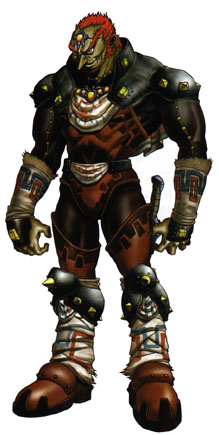 Ganondorf (aka Dark Lord, Great King of Evil, and Man from the West) is the main villain in Ocorina of Time as well as most of the other Zelda games. Ganondorf is from the Gerudo Tribe which is made up primarily of women except for their King and is located in the desert to the west of Hyrule. Ganondorf came to power by simply being the chosen male child to be born every hundred years. He then uses his status as King of the Gerudo to make peace with the King of Hyrule and become an adviser to the king. As a young child Princess Zelda senses something dishonest and evil about Ganondorf as he is making a truce with her father. It is through this suspicion that Princess Zelda recruits Link to help her keep Ganondorf from achieving his goal, whatever it may be. Little do they know that Ganondorf will actually use Link as a pawn to get to the Triforce.
The Legend of Zelda: Ocarina of Time 3D is a remake of the N64 classic for the Nintendo 3DS. The game was first displayed in a tech demo format at E3 2010. It was released on June 19, 2011 in North America.
 Previewed behind closed doors at Nintendo's E3 developer roundtable, Shigeru Miyamoto claimed that one of the reasons Nintendo made the 3DS was so that players could get the "Hyrule Feel". He wanted players to experience what it would feel like to actually be running around in Hyrule.
Eiji Aonuma said that portions of the game (such as theWater Temple) would be easier because of the ability to quickly change equipment with the touchscreen. A new addition to Ocarina of Time 3D is that the Water Temple features fluorescent patterns on the walls which enable the player to find the switches to alter the water levels more easily.
In addition to the enhanced version of the original game, Ocarina of Time 3D also includes some extra content:
The Water Temple adds multiple colored lines which extend the length of the entire dungeon per floor. Each line can be found in every room in the temple. These lines each lead to one of the three doors which lead to the three points where you change the water levels. This greatly decreases the pure frustration of fans of the original release by making the temple much less maze like.
After completing the original version of Ocarina of Time 3D players will unlock Master Quest, which is a remixed version of the game originally released on the Nintendo GameCube. Though it is the same game at its core, the Master Quest version of Ocarina of Time 3D is fully mirrored and consist of rearranged dungeons and enemies that do twice the damage in order to be more challenging.
An all-new side mode which is accessible by talking to Link's bed in Kokiri Forest. Boss Challenge is simply a mode that lets the players fight the game's bosses in one-off battles or as a Boss Rush.
Ocarina of Time 3D includes videos that players can consult if they get stuck. These videos are called visions and can be found through Sheikah Stones, which look like bigger versions of the Gossip Stones. These videos give the player hints on how to beat certain puzzles. Visions are not accessible in the Master Quest playthrough of the game.
Block Size: 4,096 blocks (512 MB)
As of September 30 2016, Ocarina of Time 3D has sold 4.52 million copies worldwide.
| 1. | "Title Theme" | 1:20 |
| 2. | "Enter Ganondorf" | 0:13 |
| 3. | "Deku Tree" | 0:36 |
| 4. | "Fairy Flying" | 0:23 |
| 5. | "House" | 0:36 |
| 6. | "Kokiri Forest" | 1:01 |
| 7. | "Open Treasure Box" | 0:10 |
| 8. | "Item Catch" | 0:04 |
| 9. | "Small Item Catch" | 0:05 |
| 10. | "Shop" | 1:08 |
| 11. | "Battle" | 1:07 |
| 12. | "Inside the Deku Tree" | 1:27 |
| 13. | "Boss Battle" | 1:19 |
| 14. | "Boss Clear" | 0:13 |
| 15. | "Heart Container Get" | 0:05 |
| 16. | "Legend of Hyrule" | 1:58 |
| 17. | "Spiritual Stone Get" | 0:16 |
| 18. | "Fairy Ocarina Get" | 0:11 |
| 19. | "Hyrule Field Main Theme" | 4:43 |
| 20. | "Kepora Gebora's Theme" | 1:00 |
| 21. | "Market" | 0:59 |
| 22. | "Shooting Gallery" | 0:39 |
| 23. | "Hyrule Castle Courtyard" | 0:53 |
| 24. | "Enter Zelda" | 0:06 |
| 25. | "Ocarina "Zelda's Lullaby"" | 0:12 |
| 26. | "Zelda's Theme" | 0:49 |
| 27. | "Ocarina "Epona's Song"" | 0:09 |
| 28. | "LonLon Ranch" | 2:08 |
| 29. | "Mini Game" | 0:32 |
| 30. | "Kakariko Village" | 1:44 |
| 31. | "Ocarina "Sun's Song"" | 0:07 |
| 32. | "Hyrule Field Morning Theme" | 0:37 |
| 33. | "Goron City" | 1:38 |
| 34. | "Ocarina "Saria's Song"" | 0:09 |
| 35. | "Lost Woods" | 0:39 |
| 36. | "Dodongo's Cavern" | 0:46 |
| 37. | "Middle Boss Battle" | 1:07 |
| 38. | "Dinosaur Boss Battle" | 1:08 |
| 39. | "Zora's Domain" | 1:30 |
| 40. | "Great Fairy's Fountain" | 0:35 |
| 41. | "Potion Shop" | 0:52 |
| 42. | "Inside Jabu-Jabu's Belly" | 0:34 |
| 43. | "Ocarina "Song of Time"" | 0:12 |
| 44. | "Temple of Time" | 1:19 |
| 45. | "Open Door of Temple of Time" | 0:15 |
| 46. | "Master Sword" | 0:13 |
| 47. | "Ganondorf's Theme" | 0:41 |
| 48. | "Chamber of the Sages" | 1:43 |
| 49. | "Medal Get Fanfare" | 0:14 |
| 50. | "Sheik's Theme" | 0:30 |
| 51. | "Horse Race" | 0:46 |
| 52. | "Horse Race Goal" | 0:05 |
| 53. | "Ingo's Theme" | 0:39 |
| 54. | "Escape from LonLon Ranch" | 0:09 |
| 55. | "Kakariko Village Orchestra Ver." | 1:44 |
| 56. | "Ocarina "Song of Storms"" | 0:07 |
| 57. | "Windmill Hut" | 0:52 |
| 58. | "Minuet of Woods" | 0:17 |
| 59. | "Forest Temple" | 1:52 |
| 60. | "Bolero of Fire" | 0:20 |
| 61. | "Fire Temple" | 0:42 |
| 62. | "Ice Cavern" | 0:45 |
| 63. | "Serenade of Water" | 0:19 |
| 64. | "Water Temple" | 1:44 |
| 65. | "Nocturne of Shadow" | 0:23 |
| 66. | "Prelude of Light" | 0:18 |
| 67. | "Shadow Temple" | 1:45 |
| 68. | "Gerudo Valley" | 1:34 |
| 69. | "Spirit Temple" | 2:57 |
| 70. | "Requiem of Spirit" | 0:24 |
| 71. | "Kotake & Koume's Theme" | 0:52 |
| 72. | "Meet Again Zelda" | 0:51 |
| 73. | "Game Over" | 0:09 |
| 74. | "Ganon's Castle Bridge" | 0:22 |
| 75. | "Ganon's Castle Under Ground" | 0:53 |
| 76. | "Inside Ganon's Castle" | 3:26 |
| 77. | "Ganondorf's Battle" | 1:12 |
| 78. | "Escape from Ganon's Castle" | 0:33 |
| 79. | "Last Battle" | 2:10 |
| 80. | "Seal of Six Sages" | 0:29 |
| 81. | "Ocarina of Time" | 0:32 |
| 82. | "End Credits" | 7:10 |