


- Name
- Tim Schafer
- Gender
- Male
- Born
- 26 July 1967
- Died
- Hometown
- Sonoma, California
- Country
- Website
- http://www.DoubleFine.com
- @TimOfLegend
- Aliases
Tim Schafer
Tim Schafer is a game designer best known for his contributions to the adventure genre. His work often features a unique sense of offbeat humor. Schafer served in creative roles on numerous LucasArts games in the 1990s before departing to form Double Fine Productions.
Career
Growing up in Sonoma, California, Timothy Schafer was introduced to video games at an early age when his father brought home the Magnavox Odyssey -- the very first home video game console. After becoming fascinated by the concept of video games, Schafer eventually moved on to Atari, where playing soon turned into programming, with the 6502 assembly language of the Atari 800 being his main focus.
This programming experience led Schafer to choose computer science as his major at UC Berkeley (although his English classes, writing classes and anthropology course ended up being the subjects he enjoyed most). While still studying computer science, Schafer discovered a unique job opportunity when searching the job listings at Berkeley college career centre.
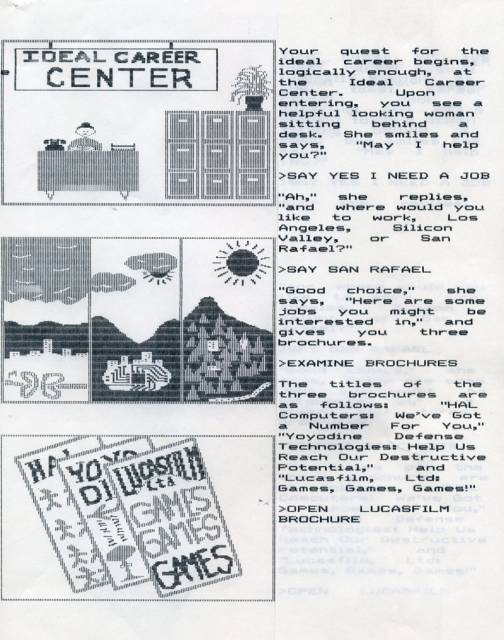
Your quest for the ideal career begins...
The job posting was with LucasArts (LucasFilm Games at the time) for a play testing position. During his interview with David Fox, a founding member of LucasFilm Games, Schafer mentioned how much he enjoyed one of their games: "Ballblaster." Ballblaster, unfortunately, was the name used in the pirated version of Ballblazer (Game), a LucasArts game which had yet to be released. To make matters worse, Schafer also admitted that he had never played Zak McKracken, a popular LucasFilm Games release, created by David Fox himself. This admission to piracy, lack of preparation, and awkwardness with his interviewer led Schafer to believe he had lost the job. So, instead of sending a CV, he sent LucasArts a cartoon strip about him landing the job, in the style of a graphic adventure game. The comic won him the job.
After briefly beta-testing Indiana Jones andamp;amp;amp; The Last Crusade: The Action Game, Schafer was taken under the wing of designer Ron Gilbert (Person) and taught the art of SCUMM (Script Creation Utility for Maniac Mansion), the engine that would power all of LucasArts' adventure titles up until Grim Fandango (Game). Schafer first showed off his programming skills by assisting with the NES port of Maniac Mansion (Game).
At that time, Ron Gilbert was starting work on The Secret of Monkey Island (Game), and the team at LucasArts' were keeping their eyes on Schafer and Dave Grossman (Person), the two quickly rising stars of the games division. Eventually they were both picked to work on Monkey Island, with Schafer given the role of Programmer and Writer as the game began to take shape.
In the early stages of development, game creator Gilbert had envisioned Monkey Island as a serious pirate-themed adventure game. Schafer and Grossman, however, had filled most of the game with humorous and often absurd placeholder dialogue. They assumed their dialogue would later be removed by Gilbert, but instead he was so impressed that the game design was changed to work with their sense of humor. Schafer's contributions to Monkey Island earned him a significant boost of prominence in the industry, later returning to work on its sequel, LeChuck's Revenge.
He soon moved on to his first project lead position, shared with Grossman, for the sequel to Maniac Mansion, Day of the Tentacle. After the success of Day of the Tentacle, Schafer worked largely solo as lead designer on Full Throttle, and eventually Grim Fandango (Game). After the critically-acclaimed Grim Fandango, Schafer began work on an unannounced PlayStation 2 action-adventure title for LucasArts that never made it out of early development.

The Double Fine Productions logo
He left LucasArts soon after the project was canceled in 2000 to found his own production company, Double Fine Productions, where he took a different direction from his previous adventure games and developed Psychonauts (Game), a 3D platformer for the Xbox and PlayStation 2. Schafer followed the critical success of Psychonauts with the open-world action-adventure game Brütal Legend (Game) for Xbox 360 and PS3.
During his keynote speech at the 2010 Develop Conference, Schafer announced that his studio, Double Fine Productions, is busy working on 4 separate projects with 4 separate leads, and none of them is being lead by Schafer. He also noted that as the president and CEO of Double Fine, he spent more time involved with lawsuits than designing the actual game.
He celebrated 20 years in the video games industry on September 27, 2009
Awards
Tim Schafer has won several awards during his career:
- At the 2006 Developers Choice Awards he won the award for best writing for Psychonauts along with co-writer Erik Wolpaw (Person)
- In 2006 he won a BAFTA game award for best screenplay, again for Psychonauts.
Trivia
- Schafer always has a Rubik's Cube on his desk. He can solve it in under 5 minutes.
- Ozzy Osbourne's Diary of a Madman was the first vinyl record Schafer ever owned, and was one of many Metal albums that inspired Brutal Legend, which Ozzy voice acted for.
- Believes Jeff Gerstmann (Person) was fired from GameSpot for being "honest."
- The first funniest game Tim Schafer had ever played was Hitchhiker's Guide to The Galaxy followed by Leisure Suit Larry.
- Tim can play Zelda's lullaby on ukulele.
Games view all →]
- No games found