Overview
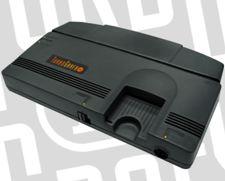 NEC's TurboGrafx-16 console
The TurboGrafx-16 is a fourth generation, 8/16-bit video game console manufactured by Nippon Electric Company (NEC), with the assistance of Hudson. It is known in Japan as the PC Engine and was released in Japan on October 30, 1987. It was released in North America on August 29, 1989, and was released in a very limited manner in Europe in 1990. The console is known as the PC Engine Plus in the UK (where many gamers preferred importing the Japanese PC Engine instead) and as simply the TurboGrafx elsewhere in Europe.
Games were distributed on HuCards, which are roughly the size of a credit card and about twice as thick; similar to the Sega Card used by the Master System. The original TurboGrafx-16 console included one TurboPad controller, and the pack-in title: Keith Courage in Alpha Zones. The TurboGrafx-16 was the first (and only) major console release by any company to include a multifire (turbo)-capable controller. The TurboStick, an arcade-style controller; and the TurboTap, a 5-player multitap, were also offered.
A large expansion port at the rear of the console is hidden under a removable plastic cover. The optional TurboBooster accessory attaches to the expansion port, and boosts the system's video RAM, while provisioning the system for composite video output, and stereo sound. This was a fairly novel feature at release.
16-bit marketing
The TurboGrafx-16 was the first console to be marketed as a 16-bit console, though it is debatable whether it qualifies as a 16-bit console. While the central CPU of the TG-16 is 8-bit, the dual GPU processor setup and graphics card is 16-bit, and can display 482 colors at once out of a 512 color palette. It was the first console that came reasonably close to arcade-quality graphics, approaching that of a mid-range arcade machine at the time. Its 8-bit CPU was also faster than the 16-bit CPU of the SNES, though not the Mega Drive.
While often not considered a "true" 16-bit console due to its use of an 8-bit CPU, the PC Engine technically surpassed both of its true 16-bit rivals, the Mega Drive (released 1988) and SNES (released 1990), by the end of the 16-bit era, due to expansions such as the Super CD-ROM and Arcade Card in Japan providing greater storage capacity and RAM memory.
Popularity in Japan
The PC Engine was very popular in Japan, where NEC had already been dominating the personal computer market with the PC-88 and PC-98 platforms. By 1988, it had outsold Nintendo's Famicom, becoming Japan's console leader until the Super Famicom's release in 1990. Meanwhile, the PC Engine continued to outsell the Sega Mega Drive in Japan throughout the 16-bit era.
The console's success in Japan was partly due to NEC's strong presence in the personal computer market, with the PC-88 and PC-98 systems dominating the country's computer market for nearly two decades.
The PC Engine was also smaller than its later TurboGrafx counterpart released in North America. The PC Engine was about the same size of a packet of crisps, making it the smallest console ever released up until then.
PC Engine CD-ROM
The console's success was mainly due to the PC Engine CD-ROM peripheral, which allowed greater storage space, more RAM, and higher audio quality, than rival consoles. It had a very large library of CD-ROM games released exclusively in Japan.
Introduction in North America
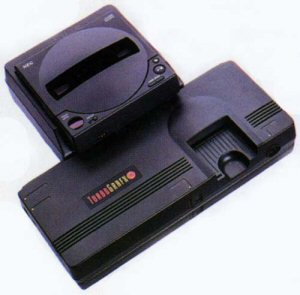 TurboGrafx CD
The TG-16 was released in North America with a CD-ROM peripheral that cost about $400 USD. It was called the TurboGrafx-CD. This was the first home gaming peripheral in the US to use CD's. The debut titles of the TG-CD were popular, but the TG-CD library grew slowly compared to the TG-16 HuCards.
Despite slow CD growth, the PC Engine CD-ROM peripheral had a very large library of CD-ROM games that were released almost exclusively in Japan, including gems such as Dracula X: Rondo of Blood. However, because most of these titles were never localized for the US, the US library size for the TG-CD was eclipsed by the later released Sega CD, despite the Sega CD's library being significantly smaller than the PC Engine CD-ROM's library in Japan.
In Europe
After the US release of the TurboGrafx-16, NEC got cold feet upon seeing the sales numbers and decided to cancel their planned European releases. All of the stock planned for release in Europe - US systems poorly modified to run on PAL televisions - was instead sold to various distributors to handle themselves.
The United Kingdom
The UK's allotment of consoles was bought up and handled by Telegames, who elected to sell the console via mail-order as the Turbografx. Telegames reportedly found supporting the system difficult, as PAL consoles would no longer be manufactured, resulting in limited supplies.
In France
In France, the system was imported and sold without license by Sodipeng (Société de Distribution de la PC Engine), a subsidiary of Guillemot International, a hardware distribution firm founded by the same people as Ubisoft.
Other expansions
Most early games relied on the console's 2 KB internal memory to save data; this was the first time game saves could be stored internally within a console. The TurboDuo later increased the internal memory for save data to 192 KB. An additional device to store save data was also released, the Memory Base 128. This was the first device to allow game saves to be stored externally from the console or games themselves.
A modem expansion was also intended for the Japanese market, to compete with the online services of the Famicom and Mega Drive (and later the Super Famicom). The project was eventually cancelled, however.
PC Engine Multitap / TurboTap
The TurboGrafx-16 was also the first console to feature a multitap adaptor, which allowed up to five players to play at the same time, in titles such as the 5-player co-op action RPG tile Dungeon Explorer. The PC Engine Multitap, released in 1987, was the first multitap peripheral for a console, setting a template for later multitap peripherals such as the Super Multitap and PlayStation Multitap.
PC Engine GT / TurboExpress / PC Engine LT
The TurboExpress / PC Engine GT handheld system was released in 1990 for $249.99. It plays all HuCards on a backlit color LCD screen, with a typical 3-hour battery life on a set of 6 AA batteries. The size of the screen was an issue on text-heavy games, as games were designed to have legible text on larger TV sets. The $249-$299 retail price proved to be too high for all except the most well-heeled gamers, and accessories like the TurboVision (a TV tuner) weren't enough to help the TurboExpress ever gain wide acceptance. Though unpopular, TurboExpress was ahead of its time for a handheld, as the most powerful console of its era, playing the same games as the full console. The Sega Nomad accomplished a similar goal (playing Mega Drive / Genesis carts on a portable) five years later.
In 1991, the PC Engine LT was released in Japan, with a new case design that resembles the later Game Boy Advance SP and Nintendo DS.
Arcade Card / Arcade CD-ROM
NEC released the Arcade Card expansion in 1994. It greatly increased the system's RAM, giving it up to 2304 KB of memory. The Arcade Card expansion, however, was never released in the U.S.
Despite having an 8-bit CPU, the Arcade Card's increased memory allows its graphical quality to greatly exceed its 16-bit rivals, the Super Famicom and Sega Mega Drive, though not quite as advanced as the more expensive Neo Geo. The increased memory also allows full-motion video at a much higher quality than the Sega CD.
Console's downfall in North America
The TG-16 was marketed as a 16-bit console, but struggled against its competition since it was an 8-bit/16-bit hybrid. It also struggled in North America because many big developers supported the PC Engine, but also made games primarily for Nintendo. Nintendo's licensing policies of the day made developers sign exclusivity agreements with them to ensure games on the NES would not be ported to other consoles. Nintendo said at the time this was to ensure there would not be another crash of the video game market like 1984. This made it all but impossible for the TG-16 to import well-known franchises for its limited American audience.
In October of 1992, NEC partnered with Hudson Soft to release the TurboDuo. Essentially, a TG-16 combined with the Turbo CD system. It also had system BIOS upgrades and an additional 192k of RAM built in. It was initially sold for $299. At the same time a Super System card was released for $60. It contained the new BIOS and additional RAM for owners of the original TG-16 and CD-ROM to play the updated games. The Duo (as it was shortened to) and the Super System Card also failed to gain much ground and was another disappointment in the US market. According to Gamepro.com, the TurboGrafx-16 is the #9 worst-selling game console of all time, at least in North America.
Hardware Specifications
CPU (Central Processing Unit)
- CPU processor: 8-bit Hudson HuC6280A (based on MOS 6502) at 7.6 MHz
- Performance: 3.3 MIPS (Million Instructions Per Second)
Graphics
- GPU (Graphics Processing Unit) processors: Dual 16-bit Hudson GPU setup
- Video Display Controller (VDC) chip: HuC6270A (2x with SuperGrafx)
- Video Color Encoder (VCE) chip: HuC6260
- Color palette: 9-bit (512 colors)
- Maximum colors on screen: 482
- Maximum sprites on screen: 64 (128 with SuperGrafx)
- Screen resolution: 256x224 - 512x242 (most commonly 256x239)
- Possible AV outputs: RF, Composite
Sound
- Sound CPU: HuC6280A also used to program/control sound
- 6 channel wavetable at 3.58 MHz, PSG (programmable sound generator)
- 5-10 bit stereo PCM
- LFO (low frequency oscillation), noise generation, DAC (digital-analog converter)
- TurboGrafx-CD expansion
- Sound chip: Oki MSM5205 ADPCM chip
- Sound DRAM memory: 128 KB (64 KB for samples, 64 KB for code and data)
- Audio formats: ADPCM, CD-DA, Red Book
Memory
- RAM memory
- Main RAM memory: 8 KB
- Video RAM (VRAM) memory: 64 KB (128 KB with SuperGrafx)
- Additional RAM expansions: 64 KB (TurboGrafx-CD), 256 KB (TurboDuo), 2304 KB (Arcade Card)
- Game storage:
- HuCard: Up to 2.5 MB
- CD-ROM: 540 MB (requires TurboGrafx-CD)
- Save data:
- Internal memory: 2 KB (base), 192 KB (TurboDuo)
- Additional memory: Memory Base 128 device
External links
Log in to comment