Overview
Whether they originate from post-nuclear fallout, an experiment gone wrong, an evil pharmaceutical company, aliens, or simply Hell running out of room, the walking dead are always a threat. Although the term "zombie" properly refers to a corpse that has been brought back to life through magical means such as voodoo, various films and literature have popularized "zombie" as a generic term for all manner of reanimated corpses.
Zombies crave one thing and one thing only: to sink their rotting teeth and claws into the succulent flesh of the living, preferably delicious brains. The classic image of a zombie is that of a slow, shambling corpse lurching tirelessly forward; however, zombies have been imagined in many different forms, including the nimble killing machines of 28 Days Later, the dead bodies inhabited by intelligent, otherworldly beings from Brian Keene's novels, and animals of various forms like the zombie dogs in Resident Evil.
The Early Years
 Zombie Nation
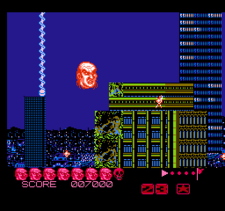
Some of the earliest games to include are Wolfenstein 3D, DOOM, Castlevania, Ghosts and Goblins, and Zombie Nation. Wolfenstein 3D's second episode, Operation Eiesenfaust, introduces mutant zombie enemies created by Dr. Schabbs. DOOM also featured zombies, brought to life by the powers of Hell. Side-scrollers Castlevania and Ghosts and Goblins had plenty of zombies to whip or throw daggers at. Zombie Nation, perhaps the strangest zombie game ever made, gives players control of a floating zombie head that uses vomit and eyeballs as projectiles to fight legions of other zombies. The SNES saw zombie success with Zombies Ate My Neighbors. Sega produced what was perhaps the first zombie game to use full-motion video, the light gun shooter Corpse Killer. Corpse Killer was one of the games shown to Congress, along with Mortal Kombat, in the push to create a ratings system for games.
House Of The Dead / Typing Of The Dead / Touch The Dead
Sega took the idea of Corpse Killer and developed further into the form of the House Of The Dead series. House of The Dead is an arcade on-rails light-gun shooter which had you shooting your way though haunted houses, killing zombies of all shapes and sizes, including zombie frogs. The Typing Of The Dead, a spinoff of the House Of The Dead series, instead instead required the player to type words and phrases to kill the zombies. The more conservative Touch The Dead replaced the light gun with the DS stylus, requiring the player to tap zombies to dispatch them.
Resident Evil
 And so it Begins...
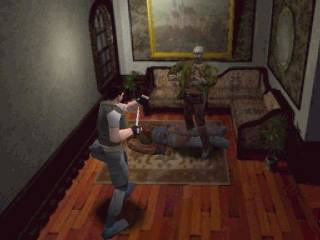
Perhaps the most iconic zombie game franchise is Resident Evil. In Resident Evils 0, 1, 2, 3, and Code Veronica, members of the S.T.A.R.S. team encounter a wide variety of hostile undead created by the Umbrella Corporation, a nefarious and secretive pharmaceutical company. Resident Evil 4 was the first game in the series without zombies, instead introducing los Ganados ('the herd' or 'the cattle' in Spanish). While they behave much like normal zombies, los Ganados are actually living people infected with a parasite known as las Plagas, rendering them zombie-like without being technically dead. They also tend to sprout large insectoid appendages from their heads when shot. The las Plagas-infected humans return in Resident Evil 5, under the name Majini.
Dead Rising
In 2006, Capcom's new zombie franchise, Dead Rising, was released. The setting is very similar to the George A. Romero movie Dawn Of The Dead, featuring zombies in a shopping mall. In Dead Rising, you play as photographer Frank West who is investigating the town of Willamette where nearly all of the inhabitants have been turned into zombies. Dead Rising has the largest amount of zombies on screen of any zombie game in the genre to date. The difference between Dead Rising, and most other zombie games though, is that Dead Rising zombies were never designed to be scary, more a toy to play with, much like Zombies Ate My Neighbors, long before. This gives Dead Rising's zombies a different feel to most others, never quite being an actual threat, that being more left to the psychopaths that share the shopping mall's space.
Dead Rising 2
 More Zombies!
 Dead Rising 2 like in Dead Rising, has a lot of zombies. It keeps the same idea from the first Dead Rising and increases the number of zombies. These zombies are your standard, slow, dumb zombies. They sometimes try to lunge at the character and eat him. What makes these zombies different from the ones in the first game is when they mutate. They become faster, more powerful and gang up on you a lot more. They also deal out a lot more damage.
Left 4 Dead
Fighting the good fight in the original Left 4 DeadSome of the more popular zombie-related games in recent years are Valve's Left 4 Dead and its sequel, Left 4 Dead 2. The games are played from the first-person perspective and make the player choose one of four "survivors" to play as (The survivors are Bill, Zoey, Francis, and Louis in the first Left 4 Dead, and in Left 4 Dead 2 they are Coach, Rochelle, Nick, and Ellis). The objective is then to make it to the safe-house on the other side of the level, blasting the horde aside with a variety of firearms and explosives. The second game also introduced melee weapons such as a baseball bat and the slightly less obvious guitar. While playing alone is an option, the games have always encouraged trying to get four people together and playing cooperatively. This not only made the game more fun, but also more manageable, as the horde is made up of various, imaginative types of zombies. While the AI does a fine job providing aid most of the time, human partners are more reliable, and there's something about the Left 4 Dead franchise that makes fighting for survival that much more lively when you're doing it alongside friends. Another Valve series, Half Life, has headcrabs, which latch onto a victim's head and "zombify" them, mutating their bodies and are unable to revert back to normal despite the host being alive and undergoing unimaginable pain. Headcrab zombies make up a considerable number of the enemies in the series.
Halo
OH MAN. ZAMBEES. Halo also takes the zombie idea but put a spin on it in the form of The Flood. The Flood attacks with small creatures and it infects anything it comes in contact with, by burrowing into the host's spinal cord. It does not differentiate between a Human Marine or a Covenant Elite. Zombies also slowly shambled their way into Halo multiplayer. Zombies first appeared in Halo 2 as an honor rules game-type where players spawn with shotguns and energy swords. The humans could only use shotguns, and the zombies could only use swords, but whenever a zombie killed a human, they had to switch to the zombie team. Zombies proved popular enough in Halo 2 custom games that Bungie built the game-type into Halo 3, calling it "Infection".
the Undead Nightmare add-on content for Xbox 360 and PS3 systems, players (once again) become John Marston and attack the undead. John fights crawlers, fast, and average Zombies in this six hours of intense story line. While this is only the tip of the iceberg, John Marston also has to deal with animals going on the side of the undead! Grizzly Bears and occasionally John's trusty steed, will be bitten and turned into a zombie animal. While John's horse still is capable of being ridden, it will eventually turn and crave blood and flesh! Taking care of the horse during these dark times is key in surviving the onslaught!
Nazi zombies are exponentially worse than regular ones, I've been told.This popular game has a side game known as Nazi Zombies, players fight wave after wave of undead German soldiers. Four maps known as Nacht Der Untoten, Verruckt, Shi No Numa, and Der Riese all deal with these horrific undead. The story behind these particular zombies lies in the hands of one Doctor Edward Richtofen, a playable character in Nazi Zombies, who was the assistant to the Illuminati Doctor that created these Zombies.
Mortal Kombat
Something's different about Liu Kang...The Mortal Kombat series even took one of its most beloved characters Liu Kang and said "Let's kill him off and turn him into a zombie." So they did. In the 2011 reboot Mortal Kombat, there are several challenges in the tower that see you fighting off zombies that approach you with projectiles until you have taken down the required amount.
Pop-Cultural Influences
While most tend to recognize the zombie as a horror or disaster movie staple creature, few seem to agree on the particulars. Zombies have a rather deep and varied history in popular culture, beyond the Caribbean and African folklore that may have given rise to the myth of the zombie-like undead in the first place.
Zombies now seem to have migrated quite far from their roots, although in general culture you can still see zombie referred to more as an alternate driving force in living people, rather than something that animates the dead. The Serpent and the Rainbow is a good example of a film which sticks closer to the old tales (which often suggest that it is a living person put under a spell or controlled in some way that leads to their becoming a zombie).
In some traditions, even passing out is considered to be the loss of your soul, and that when you awake you are some other thing, inhabited by an evil spirit. It's not that the body is dead, it's that the mind is dead. Actually, the Rage Zombie movement of recent decades actually pays more of a homage to this origin than the preceding films, the latter of which pay more attention to the fact that these zombies are undead. Even Romero's satirical elements of consumer culture in Dawn of the Dead could be said to be more about the real world's mindless zombie-ism rather than the folkloric rising of the dead. In a sense, the terms undead and zombie can, in some interpretations, be mutually exclusive terms!
Since this isn't meant to be an exhaustive article, it may be best to narrow down the discussion to a few of the touchstones that people keep coming back to when defining what zombies are. "Undeath" will, for the purpose of general context, be closely linked to zombies, despite the aforementioned potential divergences.
The Film that Raised a Thousand Corpses
While there were films that predated it, George Romero's Night of the Living Dead is often cited as the most influential zombie horror film. The zombie it established has since been modified or outright rewritten, but there are many that cling to Romero's version of the undead as the truest. For the purposes of this discussion we'll use Romero's seminal film as the basis for the definition of a zombie; yet even Romero stalwarts sometimes mistake Romero's zombies for others' creations. Below is a list of traits that are usually used to define a zombie, along with their possible pop-cultural influences.
Speed
In zombie debates one of the first aspects that comes up is a zombie's speed. As with all mythological creatures, the zombie has its strengths and weaknesses, and speed is often considered one of its biggest weaknesses. Usually the traditional zombie is ascribed to be slow and stumbling, barely able to move its stiff limbs as it ambles about. What's surprising is the variance with which even the supposedly traditional zombie movies.
For instance, in the original Night of the Living Dead, the very first zombie shown actually breaks into a run, albeit awkward and staggering, toward its prey. The woman it is pursuing is only barely escape, suggesting that despite her relative speed the zombie was not much slower than she was. Most of Romero's zombies, when presented with potential food, tend to break into a sad little canter, though they are usually still easily outrun.
Dispensing with such assumptions, the remake of Dawn of the Dead, as well as entries in the newer Rage Zombie phenomenon featured in such films as 28 Days Later, have zombies running toward their prey, though some would argue that many of these examples begin to fall outside of what is considered traditional, especially the Rage Zombie.
Intelligence
The traditional zombie tends considered to be almost animal-like in intelligence, driven only by hunger or the desire to kill. Zombie intelligence, though, actually tends to vary quite a bit. You could come up with in-universe explanations for this, but it seems that a given zombie's intelligence seems to grow to fit the requirements of the story, and this includes many of George Romero's films.
In Romero's original Dawn of the Dead, many of the zombies have an instinctual connection with the recognizably human, if mindless, pastime of shopping. In Day of the Dead, a zombie is trained through negative reinforcement to use weaponry in an attempt to use it against its fellow zombies. In Land of the Dead, zombies begin to develop pack-like mentality, with alpha zombies exhibiting the ability to adapt to situations, albeit much slower and less complete than most intelligent humans could do.
The Rage Zombie movement often includes zombies that are a lot more willful and deliberate. It seems that only their overwhelming rage prevents them from more adaptive behavior.
The Cause of "Undeath"
Are the spirits of the deceased animating these corpses? Is there some biological process we don't understand animating them? Is there no way of figuring it out? Is this some twisted interpretation of the biblical rise of the dead that no one foresaw?
Often the question is never properly answered, and many storytellers would argue that it shouldn't be, as the mystery helps drive viewers further into the story.
The Spread of "Undeath"
One break in the skin during a zombie attack is all it takes in Romero's universe, as well as being dead in the first place. In others its long-term exposure to the contaminant, along with a susceptibility to its effects, like you see in Night of the Comet. For others it's listening to a signal.
If you have a wound you will be the vector for "undeath", you will seriously drop the survival rate of your universe, so depending upon the requirements of the story, this one-wound-one-zombie rule is sometimes ignored for the sake of the protagonists.
The Nature of "Undeath"
Does the body slowly rot, or is it preserved through the same process that animates it? How can muscles move if they no longer get oxygen pumped by the heart?
Often the nature of "undeath", as the cause, is never fully explained. Again, this drives the story forward, but unlike origins, it is often a lingering question in the reader or watcher's mind. What level of decay would there need to be for the zombie to cease functioning? You could consider a hail of bullets a form of decay, really, so why does that work when natural processes don't?
Often biological causes are cited as the reason cellular decay doesn't stop them; the zombies are somehow reanimated through augmentation. Supernatural forces work too, although this explanation doesn't seem as satisfactory to audiences as it once was.
The Hunger
Zombies eating brains was actually a more recent development. Romero's zombies just wanted any old living human's meat. Return of the Living Dead is what started the specific brain fetish among zombies, and the idea that they could lay into your most important nervous bundle struck a chord with people so that even Romero's walking corpses are often attributed the "brains" mantra, even though they never uttered it.
Depending on the film, Rage Zombies are often suggested to be there to simply murder others. While some eat flesh, others are just there for the killing, making them especially fearful predators who don't really bother to stop for a snack.
Disposal
Romero's zombies followed the song "Shoot them in the brains, if you want to live." Return of the Living Dead had zombies be a lot more invincible than Romero's. They seemed more able to move about despite lacking the muscles to do so should they be fragmented into little bits or severely decayed to the point that they were just tendons, skin, and bones.
Usually no matter what, some severe incapacitation is needed, often meeting or exceeding what one would need to do to take down a living human being.
When in doubt, remember that zombies hate fire and being shot in the head. Especially in tandem.
Animal Zombies
Throughout many recent games, zombies have plagued areas with populated civilians. Though Zombies mostly munch on humans; there have been numerous times that Zombies bite into animals! The concept of "Zombie Animals" had started in the 1988 game Splatterhouse. The first animal to turn into a zombie was a dog - thus the age of animal zombies! From there on, appearances of Zombie cats, horses and bears have appeared in gaming.
Log in to comment