
The Gift that keeps on giving
by infantpipoc
On the Stars My Destinations by Alfred Bester The cover of the Star My Destinations, published under the SF Masterworks umbrella in UK with afterword by Neil Gaiman. This cover featuring protagonist Gully Foyle is almost inseparable from the book in my mind. The first time yours truly read this novel in Chinese, it was on 2003’s first issue of Science Fiction World All Translation Bi-monthly. O...
On the Stars My Destinations by Alfred Bester
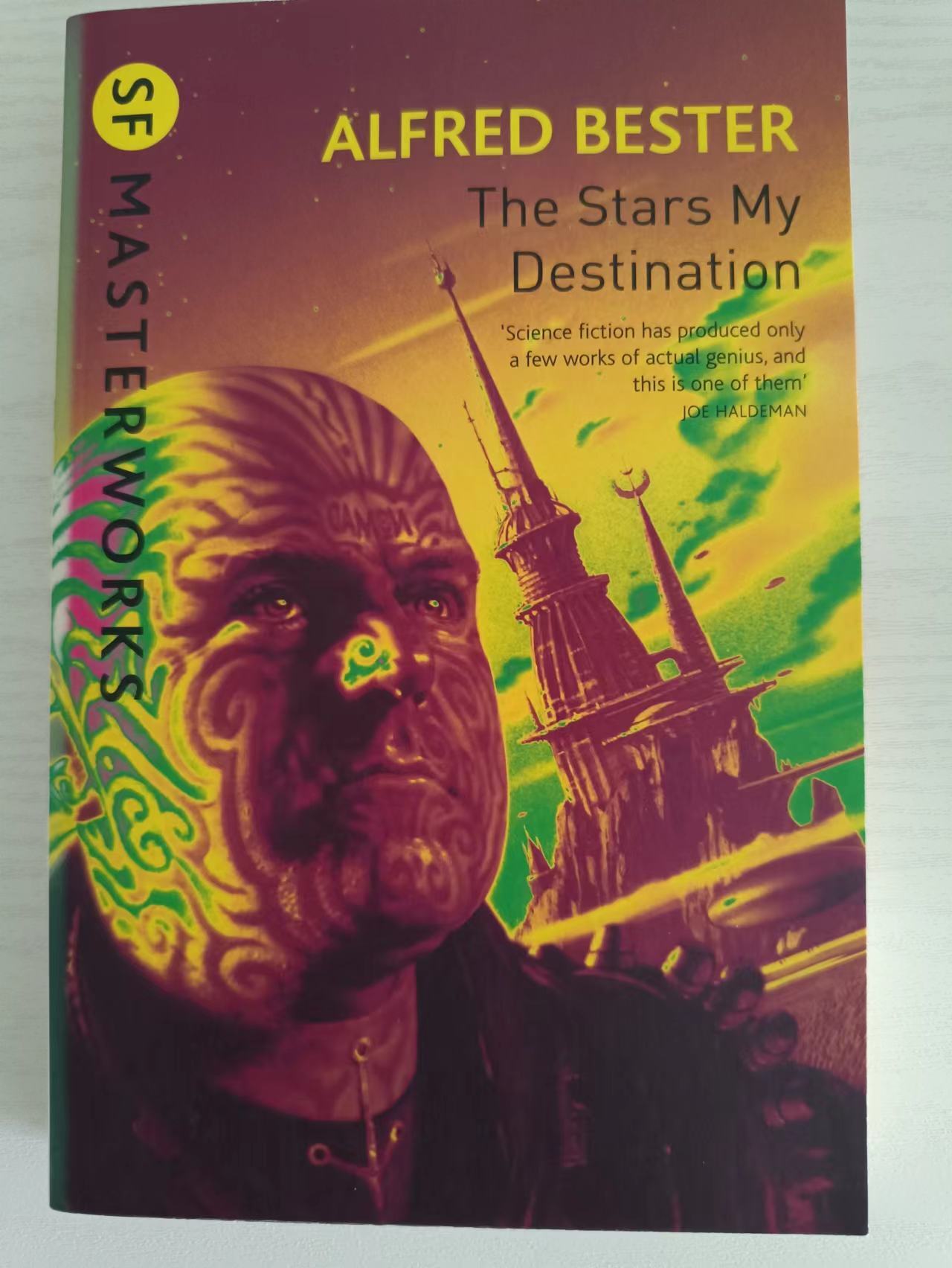 The cover of the Star My Destinations, published under the SF Masterworks umbrella in UK with afterword by Neil Gaiman. This cover featuring protagonist Gully Foyle is almost inseparable from the book in my mind. The first time yours truly read this novel in Chinese, it was on 2003’s first issue of Science Fiction World All Translation Bi-monthly. On the first page past the contents of that magazine, there was a monochrome recreation of this cover. Someone took great care to redraw this tattooed face with ink and changed the background to something more spacey.
“In fact, before Blade Runner, I’d only read two novels in the entire field of science fiction.” One of these books was Alfred Bester’s The Stars My Destinations…The other was Do Android Dream of Electric Sheep?
---Hampton Fancher, co-screenwriter and executive producer of Blade Runner.
Interviewed for Future Noir, with the book’s author Paul M. Sammon clarifying which “two novels”.
To Bester and Clarke, who got us here.
---James S. A. Corey, dedication page of Caliban’s War, the Expanse book 2 of 9
(It’s funny to hear that not only does an amateur like yours truly feel more inclined to cover books while referencing video game these days, professionals do as well.)
I first saw Blade Runner in 2004, three years before the Final Cut came out. It was the Director’s Cut included in a collector’s edition of 1997’s Westwood adventure game with the same title. Dubbed in Mandarin, Deckard’s voice-over narration did not sound as bad as Ford phoning it in.
There was a sense of déjà vu, as I felt like I’ve read something where the future was this fascinatingly fouled up. Yet I could not name it. What I could be sure of was that it’s not from Do Android Dream of Electric Sheep, the Philip K Dick novel that movie was based on. I read it in 2004 as well, and Blade Runner’s fascinatingly fouled up future is nowhere to be found in that book.
Fast forward 15 years, I got to the part where Future Noir: The Making of Blade Runner covering the movie’s script, read the passage I quoted up there and it all made sense. When Ridley Scott encouraged Fancher to think about the world outside those windows, the latter was clearly lifting things left and right from the only other science fiction novel he had read by then.
But the decidedly not science fiction aficionado behind the bafflingly beloved sci-fi film noir was not the only professional loving this book. Out of all the SF Masterworks on my shelf, the on-cover praises for only this one all came from sci-fi novelists: Robert Sliverberg, a successor to John W. Campbell; William Gibson, who needs no farther introduction among this crowd I believe; Samuel R. Delany, whose work video game critic Cameron Kunzelman would pick over Assassin Creed lure any day of the week; and Joe Haldeman, whose Forever War will be mentioned somewhere down the road. And nods towards this book can be found in and around video games.
Standing on the shoulder of a giant while having Supergiant stand on its
“A fifties SF classic which reworked and reset Alexander Dumas’ Count of Monte Cristo in the far future” was how Paul M. Sammon summed up the Stars My Destinations (referred to as “Stars” later) in Future Noir. Though my experience with the ninetieth century French revenge swashbuckler was only through that 2002 Hollywood movie, the plot about a man thrown into jail, escaped, got filthy rich by chance and then revenge is unmistakable. “Far future” is not something I would agree, since the book take place in a speculated twenty-fifth century, as far as so-called “near future” can go.
But revenge tale was not how I first knew about this book. On an early 2003 issue of Science World’s regular semi-monthly, there was an article about teleportation and the Bester novel was mentioned in it. Jaunt is how teleportation is called and is not due to technological advancement but rather human evolution. One Mr. Jaunte first teleported would be how it all began by the end of twenty-fourth century and when this story picked up in the mid twenty-fifth century Jaunting had a decades long history of regulation and rebellion against that regulation.
Among many proper nouns in Stars, PyrE, capital P and capital E, is another one stands out. In many thrillers like this, people from opposing factions are always after one single McGuffin. PyrE, as a new type of super weapon, is that McGuffin here. And if my fellow Supergiant Games appreciators think they have heard those 2 before, here is my guesses.
The dash move in 2014’s Transistor is called Jaunt, and much like the first case of teleportation in this book, it’s merely going from one end of a relatively large room to another in an instant. Then the stylized title for 2017’s Pyre only has its y in lower case. It’s hard to imagine the well-read lot at Supergiant Games have not read, enjoyed and taken things from this book.
Of course, a couple of proper nouns are not the only thing one can draw parallel between Supergiant and Bester. Both obsesses with world building yet never let that tricky aspect getting in the way of action. The volume of Stars I read is “only” 240 pages long, a pamphlet compared to many phone book size epics, yet it describes the stages, actor and then they went nuts without feeling rushed.
Universe composed of planets instead of stars
Stars takes place in a twenty-fifth century when human has spread across the solar system. A sometimes cold and sometimes hot long war is fought between 2 major factions, Inner Planet and Outer Satellites. The former refers to Venus, Terra and Mars while the latter includes seven moons of planets Jupiter, Saturn and Neptune.
Yes, my fellow Expanse readers, I heard you loud and clear. The writer duo known James S.A. Corey did admit that the United Nations of Earth and Lunar, the Congressional Republic of Mars and the Outer Planets Alliance in their books are modeled after things in the Bester masterpiece. Though it’s about it since the newer books take a quite different approach than the older one.
Let’s get what the older one did better out of the way first: its McGuffin has nothing to do with the Ancient Alien trope that plagues games and high fantasy. The Expanse was once visioned as MMO and then table top role playing or even a fantasy novel if the duo took some ill advise from relatives, includes Ancient Alien relic is almost evadible. But then Expanse series would more often than not takes some borrowed concept and turns things on its head. The solar system wide war story is one of those.
In Stars, residents of Outer Satellites might as well be unknowable space aliens. Not one of them is seen in person in that book. Protagonist Gully Foyle, as much as he hates the Inner Planet rich people who wronged him, still consider Outer Satellites people his sworn enemies. Once he learns that he was made bait by those enemies, and the Terran vessel Vorga was in the right when it ignored him, he gave up on vengeance and the rest of the book is more about this new-found sense of enlightenment of his. It’s almost as if the men wrote under the pen name James S.A. Corey read this and thought “Our stuff would not fly today if it goes like this.”
In Leviathan Wakes, the opening volume of Expanse, there are only 2 point-of-view characters and both are hellbent to give readers a more sympathetic look at the life in deeper space. There is of course the Paladin we all love to hate James Fucking Holden who born into a rich family on Earth but prefers to live among those less privileged born and raised in deep space. Then there is the cynic born in that deep space Joe Miller, who would give readers a “first-hand” account about psyche forged by that harsh life.
I’m not judging one against another here, you all should read and compare on your own.
Homefront in the future
Stars is considered as a precursor to the whole Cyberpunk subgenre. Mr. Gaiman’s piece included in more than one edition of this book has dedicated one whole paragraph to the similarities between the 1956 novel and its successors in the 1980s. For my money though, it might have a bigger impact on military science fiction. Joe Haldeman, author of the Forever War, had obviously taken cues from this book for his first Hugo and Nebula winner. Though it might be more of a rediscovery than invention.
The Forever War is a book so influential that people might use its title without reading it. American military posting overall the globe is referred to as a Forever War after all. However, the book’s forever warriors are not always on the battle front. After all it is one visit to the so-called home front that makes them prefers to remain on the battle front of a forever war. They just choose the devil they know over the one they don’t. It’s not something new, since this early Academy Award winner and the book it was based on tackled the same issue.
The Forever War’s home front is of course a fascinatingly fouled up near future that is not unlike ones seen in Stars and Cyberpunk stories. The Forever War was published in late 1970s, those started to write in the 1980s were obviously influenced by it. Though I do wonder. Haldeman could have sticked to the future military formula of Heinlein’s Starship Troopers and just added sorrowful reflection since the forever warriors do mourn those killed in training exercise, the book might still be considered the next step in military sci-fi, with mentality changed from the triumph of World War Two to the guilt of the Vietnam War. But war efforts had better not be viewed in a vacuum.
Stars did not shame away from the fact that everything will be conscripted into a war effort and how an already fouled up society would end up worse for it. Bester dedicated most of the whole volume of Stars as a window into a dystopia created by a long war. Haldeman, who fought as a combat engineer in the Vietnam War, just flipped the script a little bit, dedicated one single chapter as glimpse into a dark future ushered in by the forever war and latter science fiction might be very different without him doing do.
Stars was among the first science fiction novels I’ve read. The 13-year-old who first read it had since grown into someone older and not necessarily wiser. The book can still give that person some joy despite some issues, like how violent and horny the book’s leading man can be at times, the book did try to mediate that by making him saying some enlightened bullshit by the end. The 1950s, heh? Still, if the modern phone book size standard of genre novel is too much for you, this little pamphlet just might be what the doctor ordered. It certain offered yours truly more than all five volumes of A Song of Ice and Fire combined ever had.