
Indie Game of the Week 386: Ghost 1.0
by mento
September heralds the arrival of a new autumnal season and with it some welcome changes (cooler temperatures, longer nights) as the year lurches towards its conclusion, so to me it's always a benevolent turning point in the year that provides ample opportunity to switch things up and try a whole new approach to life. So it is with no small amount of excitement that I'm announcing that Indie Gam...
September heralds the arrival of a new autumnal season and with it some welcome changes (cooler temperatures, longer nights) as the year lurches towards its conclusion, so to me it's always a benevolent turning point in the year that provides ample opportunity to switch things up and try a whole new approach to life. So it is with no small amount of excitement that I'm announcing that Indie Game of the Week will start covering exploration platformers, or "explormers" for short, in greater frequency. This oft-underestimated platformer subgenre doesn't really get the love (nor an almost worrying amount of oversaturation) it deserves from either the Indie developer scene or from reviewers like me, so it seemed high time to turn that public image around and give it the sort of boost you could normally only enjoy from a well-placed double-jump upgrade. (The other thing about it getting colder and darker is that it's a good time to start lighting things with gas, as it were.)
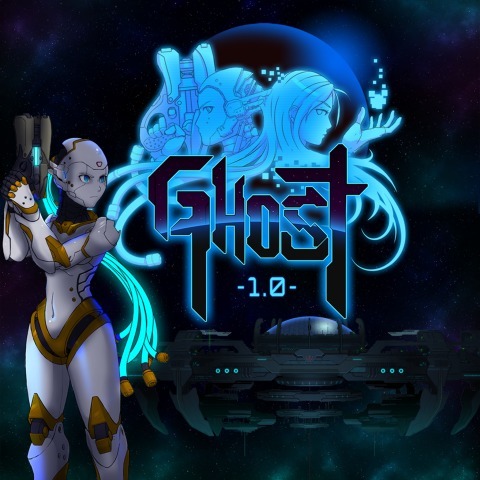
OK, so I'm playing Ghost 1.0 this time. It's another explormer. Natch. It's also our third IGotW game from Spanish solo developer Franfistro (a.k.a. @unepic_fran) after the fantasy-themed UnEpic and this game's prequel "demake" Mini Ghost. Ghost 1.0 is set in the near-future and follows the titular agent-for-hire as she infiltrates an orbital space station (that classic setting) of Nakamura Corp, a major robotics company that's raking it in due to their unerringly human-like servile androids. Her clients are a dirtbag hacker called Jacker (the masturbation jokes still carrying over from UnEpic) and his equally nerdy engineer pal Boogan, the two working together for either common altruistic purpose or money (or both), and both frequently piping in over the comms to give Ghost directions or assist in her mission. Ghost herself is so-named for her uncanny ability to disassociate from her custom-made robot chassis and go wandering around as a disembodied spirit, Geist-style, that can inhabit other robots to take advantage of their abilities, whether they're combat-oriented and can be used as disposable meatshields (or, well, metalshields) or they have security privileges her infiltration unit naturally lacks. Ghost's journey takes her all across the Nakamura station from one themed area to the next, the enemies and challenges different in each, as she assembles the pass keys needed to reach the more sensitive areas and uncover the corporation's shady secrets.
 A typically chaotic alarm sequence. It's less about killing everything, more about staying alive for a duration.
Ghost 1.0 is legit pretty cool from a guy who is all about games with an abundance of features and ideas. All your guns run on cooldowns so there's no ammo to worry about, the fast travel system is incorporated into the save point system to cut down on unnecessary rooms with various unlockable shortcuts too, the map conveniently displays shops including their as-yet-unbought inventories, death removes your currency but as it's not tied into your level up system (that runs on skill points found incrementally while following the main progression) it's no huge loss and you can even buy upgrades to recover some of it after a successful corpse run, there's a whole bunch of minor and major passive upgrades to either buy or find while travelling but nothing that's instrumental to progress that might waylay you for a while, and the disembodied ghost mode lets you explore the current screen and take in all the traps and enemies without worrying about damage though you do tend to leave your "shell" vulnerable in the process. That's just a smattering of the QoL features I've bumped into so far, on top of the already solid combat system that takes a leaf from Metroid (as most games in this genre do) with its running-and-gunning format that offers multiple main weapons and secondary weapons to tactically choose between.
However, it's in the bigger features where the game really stands out among its peers. The first is the always perilous alarm-tripping mechanic that summons no end of aggravation. Rooms have these sensor traps set up, some are unavoidable and others easily so, and tripping one causes a multi-wave combat arena to initiate while also trapping you in that enclosed area. You can get a bunch of upgrades that specifically make these sequences easier to handle, replacing enemy spawns with malfunctioning bots or free healing, and the alarm level (and thus the peril) goes up as you progress through the game or trip multiple alarms in quick succession. The reason you'd want to do the latter is that there are big rewards for every successfully survived alarm sequence and these also increase depending on the current alarm level: if you're looking to buy some expensive new upgrade or a secondary gun, it's the most effective means of farming the cash in a hurry (if you can walk away in one piece, of course).
The other major mechanic takes after a game I don't think I've ever seen homaged in an explormer before: The Tower of Druaga, the hopelessly obtuse 1984 arcade top-down dungeon-crawler from Namco. Like in that four-decade-old dinosaur, almost every room in Ghost 1.0 has a secret objective, in this game's case producing a mysterious substance called "souls": nanomachine-looking twinklies that will only appear if you complete some arcane mission in the immediate vicinity and then need to be swept up to make the reward appear. Some of these objectives are more obvious than others, like touching a remote part of the room or destroying all the enemies or activating a shortcut or locked door, but others descend beyond "puzzling" right into "how the hell was I meant to figure this out?" territory that must be greatly amusing to anyone who had the patience to figure them out. The more inscrutable mini-quests might involve crouching for several seconds, walking into the room as a robot borrowed from an adjoining area, accessing the main menu (that is, not the map/inventory screens, but the menu with the save/load/quit commands), unequipping one of your passive power-ups, or burning one of your precious finite items. If a solution isn't immediately obvious after a few sweeps of the room, you might find yourselves going through every system and menu you have just to see if that triggers it. The reason you'd want to put yourself through all this trouble is that you can get an awful lot of resources and passive stat boosts by completing them: I've almost doubled my initial health amount and maximum weapon charges since I began chasing these blind little scavenger hunts so I'm still compelled to figure them out regardless. It hasn't been since Chantelise from over a decade ago that I've been forced(?) to jump through so many invisible hoops like this.
 Real handy of the map to remember things like this. Never know when you might need to pay a guy for some back shots.
Any explormer that has me gushing about its novel features, with everything else being either perfectly perfunctory (like the graphics) or better (even the humor's improved since UnEpic), is a winner in my book and I'm kind of surprised that this game had so many interesting ideas given that Mini Ghost, while entirely acceptable, didn't really explore any of them. I suppose that game was meant to be a less feature-rich 8-bit throwback, but still. It'd be like if the original Zelda just didn't have items or hidden rooms in dungeons: without curious angles like those it wouldn't come anywhere close to the 16-bit games and beyond. That Ghost 1.0 is a substantial 15+ hour game on top of everything else, with both a "Classic" pre-determined game map and progression and a much more roguelite-fashioned procgen "Survival" mode with its random levels and upgrade placements, definitely makes it one of the more impressive Indie explormer playthroughs I've experienced even in a year that's seen, to put it eloquently, a buttload of them. I may have had (and continue to have; a tower defense sequence for a final boss?!) some doubts about UnEpic but this developer is definitely one I ought to be following closely from here on out.
Rating: 4 out of 5.
Post-Playthrough Edit: Despite some familiar irritations towards the end (a very long stealth-based sequence that robs you of your powers, plus a final boss fight that mostly involved surviving tons of enemies) Ghost 1.0 remained a pretty engaging explormer throughout. I like that it gave you the usual explormer accoutrements (a double jump, an air dash, a glide) yet they weren't all that necessary in this context beyond making the platforming a bit more fluid and interesting, which is why they were all optional skill upgrades instead. Dumb geek humor, unappealing side characters, and some bizarre challenge hikes (there's certain turrets that can just murder you in a split second) aren't quite enough to tarnish the strengths of this inventive and versatile game.
| < Back to 385: Zeno Clash II | 001-100 | 101-200 | 201-300 | > Forward to 387: The Darkside Detective |