
Might and Mento: The March-Date of Heaven: Part One
by mento
Because I don't really value my free time as much as I should, and I've reinforced the frame that's just about holding my backlog at bay, I've decided to spend a chunk of March filling a classic CRPG blindspot of mine: the sixth in New World Computing 's venerable Might and Magic series, Might and Magic VI: The Mandate of Heaven . Released in 1998, and fitting between what was the "expert" camp...
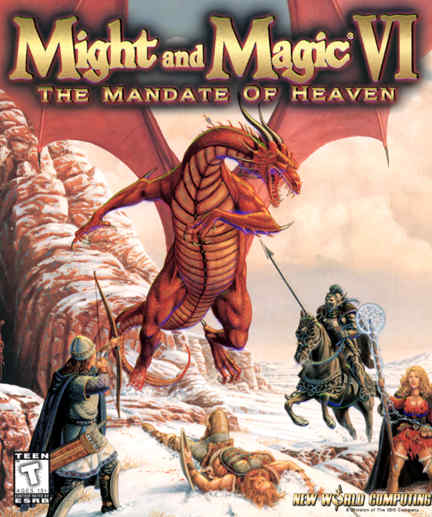
Because I don't really value my free time as much as I should, and I've reinforced the frame that's just about holding my backlog at bay, I've decided to spend a chunk of March filling a classic CRPG blindspot of mine: the sixth in New World Computing's venerable Might and Magic series, Might and Magic VI: The Mandate of Heaven. Released in 1998, and fitting between what was the "expert" campaign of Might and Magic V: Darkside of Xeen and what is popularly considered the franchise's second peak with Might and Magic VII: For Blood and Honor, the sixth game is notable for introducing the new panoramic movement engine that its two sequels would build on (and the ninth, albeit in true 3D rather than 2D sprites in a 3D environment) and otherwise modernizing the franchise by introducing many quality-of-life improvements. It's also one of the largest games in the series and, quite possibly, one of the ugliest: these two factors were what put me off the game for a long while but now that I've finished 4, 7, 8, 9, and X (and played quite a bit of 5) its absence on my list of completed CRPGs has been made all the more conspicuous.
I've done a bit of research into the game's foibles, without necessarily poking my head into spoiler territory, so I'm hoping to muster up plenty of misadventures as I once again get to grips with how this particular franchise and its rules work and start moving through its overworlds and dungeons in as meticulous and cautious a way as is required, given there's always dozens of wandering monsters over every hill and behind every door: one of the odd quirks about this game and (to a lesser extent) the two that followed is that, instead of being told there are 100 goblins right in front of you in the abstract "goblins = 100" numeral way the older games did, you can actually scan the horizon and count that many out yourself as they all stand menacingly clumped together with their little identical canned animations. As well as more terrifying, it makes the fights that much more contingent on crowd control tactics and kiting away smaller groups, somewhat similar to a partially-turn-based fantasy RPG Doom (that isn't Heretic). It's going to take some real powerhouses to save the nation of Enroth from its extraterrestrial demon problem on top of all the other evils crawling out of the woodwork.
As for the party I'm dragging through this mess, well...
Teen Magical Girl Squad
 With apologies to the Brothers Chaps
Working off of what I know about this game's treatment of magic classes versus fighter classes (the former greatly outpace the latter around the mid-game and after) and residual memories of the structurally similar 7th and 8th games, I put together this party with an eye for magical dominance and a versatility in the various "schools": those of the four Elemental skills of Fire, Earth, Air, and Water; the three Self disciplines of Body, Mind, and Spirit; and the late-game morality-contingent schools of Light and Dark. Unlike MM7, which had your entire party join either the Light faction or the Dark faction and be fixed to one or the other, I believe you can mix and match here. Possibly. Light tends to be mostly buffs while Dark, expectedly, is focused on destruction so I'm hoping for some sort of broken combination once I have access to those spells.

Cheerhealer is a Druid, which is a composite arcane/divine spellcaster (far as I know this game doesn't let you transform into animals), and I've made her the party leader (if not necessarily the vanguard) due to her combination of talents. Since she'll be spreading points across multiple magical disciplines I'm going to give the rogue/utility skills to someone else.

So-and-Sorceress is a pure Sorcerer class and the one I'm also assigning as the party thief. I'll give her most of the utility magics (like those in Water and Air) and have her checking for traps and unlocking chests whenever she's not nuking fools. With this, I hope to mold her into the "Overachieving Bandit" of her namesake.

What's Her Faith is our tank and main healer, stuck at the front of the pack to absorb as much melee aggro as possible while the rest hang back and pepper the field with offense spells and/or arrows (getting everyone the Bow skill is an immediate requisite, if past and future games are any indication). She'll be the one focusing on restoration spells and buffs for the most part.

The Egregious One is another pure-damage Sorcerer and the one I hope to transform into a groovy skeletal lich if circumstances allow. I'm pouring all her building points into anything that can turn our enemies into clouds of red mist; hopefully I can keep her spell points up, which is where the Meditation skill will come in clutch. (I might have to assign her Alchemy so she can craft her own mana potions too; or at least that was the plan before I realized that MM6 doesn't have that skill and just lets anyone mix potions. Now that's something I'll have to take advantage of later.)
Might, Magic, and the Rest

The general flow of a M&M game is to break through that tough combat outer candy shell and start appreciating the chocolate-y and peanut-y goodness that is its character development systems, specifically its skill system. When you level up—and it doesn't happen automatically, you have to go to a training facility and pay money and spend several in-game days there before you reap the benefits—you're given a smattering of skill points to invest in the skills you've acquired from guilds (or during the character creation process). To level up a skill once, you have to invest as many points into it as it needs to go up a number: so to go from 3 to 4 would take 4 of your precious points. Once a skill hits 4 you can then go out into the world and find a special vendor who can turn it into an "expert" skill and, subsequently, a "master" skill at 7. These ranks enhance the utility of the skill, or the individual spells in the case of magic skills, in many cases finally making it useful enough to be worth the point/time/money investment in it thus far.
This, rather than simply coasting on whatever stat boosts come from levels and equipment, is the key to transforming an easily wiped party of wieners into one that can actually deal with dangers bigger than a cartoon rat or some dork who got stuck on the geometry and can safely be killed from a distance. This is naturally even more the case for mages, since the spells you acquire later on not only turn you into veritable nukes but also open up very useful utilities like instantaneous fast-travel, floating over the map to access areas otherwise out of reach (as well as avoid non-ranged enemies you don't want to deal with), and a dozen different buffs that will make life so much easier. I would call it a classic example of a "slow-burn" RPG: one where at the start you're celebrating every tiny victory as your pack of underdogs barely survive another dungeon to that power creep endgame where you're dropping the elemental equivalent of hydrogen bombs on entire fleets of dragons.
Early on, though, we're going to have to rely on simple quests without too much combat if we want to survive...
Episode 1: Baa, Ram, Shoot (The Beginning)
 What the game (and my party) actually looks like. It's... of a time, let's say. New Sorpigal's a quiet town but for the many NPCs milling around doing nothing in particular. Unlike in VII, they won't get attacked by the wandering monsters just outside of town.
The land has been torn asunder by a costly war of succession by the honorable Roland Ironfist and his nefarious brother Archibold Ironfist: a conflict that was introduced as the main campaigns (good and evil) in Heroes of Might and Magic II and would persist into the seventh game as well. Several years later, due to Roland's crusade against the invading Kreegans (the aforementioned devil aliens), his Queen Catherine off attending her father's funeral, Archibald cursed to be an insensate statue following his loss of the war, and the young prince Nicolai and his regent uncle Wilbur Humphrey being left to run things at Castle Ironfist, the nation's many shadowy enemies have seen an opportunity to cause mayhem or else wrest control of the continent themselves.
Your party lands in New Sorpigal, a coastal village at the southeast of the continent of Enroth close to Castle Ironfist and debatably the safest place to be right now, though whatever peace is here won't last. New Sorpigal is naturally a beginner-friendly zone with most of its overworld enemies being simple goblins, apprentice mages with HP in the single digits, and geriatric "Followers of Baa": fanatics supporting a growing cult seeking to undermine the kingdom. It has a town with a great number of Expert skill trainers, a few shops with low-level goods, and the usual facilities like an inn, a temple, a transport company, and magic and combat guilds for learning the skills necessary for survival this early on. It also has two local dungeons close by: the fort of Goblinwatch (now ironically taken over by goblins) and the abandoned former Temple of Baa, now overrun by subterranean wildlife crawling up from the caves beneath.
 I love the whole 'digitized actors in bad cosplay' aesthetic of RPGs made in this era. Betrayal at Krondor's another good one. Just look at how uncomfortable this guy is, and how he was probably pulled out of the NWC programming division to stand around wearing Ren Faire rejects.
While there are quests relating to the dungeons the smart choice is to simply head to Castle Ironfist, the sole adjoining travel location to the west, where you can pick up the first of the game's big quests—you have to complete tasks for all six of Enroth's ruling lords as well as the regent and prince before you can take the fight to the devils that destroyed your hometown of Sweet Water—as well as have access to many more trainers and vendors. Notably, Castle Ironfist is the earliest you can acquire the Bow skill: the most useful skill in the game, at least universally speaking, given how important it is to defeat enemies at range.

I might've elected instead to stay in New Sorpigal. In fairness, I had no idea Ironfist had so many conveniences waiting for me: I was loath to depart this starting location until I'd exhausted those early dungeons and earned the XP from their related quests and monsters to bump my numbers up a bit. Once I'd visited Ironfist and used the money earned from the first quest—delivering a letter to Regent Humphrey, which doesn't require fighting a thing—to learn archery from trainers and buy fancy longbows for everyone, I came back to have a much easier time clearing the abandoned ruins of its many, many spiders, rats, bats, and cobras. Goblinwatch was still a bit tough given there's little maneuvering for distance in a manmade internal location full of twisting corridors and tiny rooms but there's a spell in the Air school called Sparks that is very effective in enclosed areas due to how often its lightning projectiles bounce off the walls. Goblinwatch also had a fun little puzzle concerning an alphabetical safe combination that required spelling "GOBLIN" backwards to activate: one of the letters teleported you deep underground instead, where you'd be surrounded by goblins on all sides, as a trap to keep out thieves that was actually a lot more effective than the creators had perhaps intended.
 This guy was disappointingly fragile. Of course, the enemies in the M&M series are big believers in the 'safety in numbers' adage. One I hope to tragically/hilariously turn on its head once I get some nice, big, splashy AoE spells.
Castle Ironfist, given it's a bit more central on the map, had a greater disparity of dungeon difficulty. Its overworld enemies were still weaklings at least, so I'd managed to cover the whole map and jotted down places I'd have to check out later once I was a higher level and/or someone had told me to go there (since why do anything unless I'm going to be rewarded for it?). Those dungeons include: the new Temple of Baa, which is where I encountered my first undead enemies (surprisingly easy; even the ominously tall and red "skeleton lords"); the Dragoons' Caverns, a cave network filled with tough bandits that I was sent into in order to find some accountant's harp (sure); the Shadow Guild Hideout, a small structure full of switches to reveal more corridors, mostly occupied by dangerous rogue enemies, in which I was to rescue a citizen of New Sorpigal; and to the west there's a mine called Snergle's Caverns and a haunted estate owned by a former ally of Archibald, both of which had enemies (dwarves and ghosts, respectively) that were a little beyond my group. Like many traditional open-world RPGs that aren't The Elder Scrolls, most of these locations had a specific level range in mind when they were made and would likely stay out of my reach for the time being. A less celebrated aspect of this model of game is that the non-linearity was largely illusory: by locating the breadcrumb trail to the quests and dungeons you could actually handle, you'd find yourself crossing and re-crossing the world several times to hit these places in their semi-intended order once you were ready for them, though perhaps with some premature rewards for the truly daring.
 The full map, with this entry's related territory encircled. This is after like 6-8 hours. I'm going to be here for a while.
With that, we've explored two regions with some spots earmarked for much later, with a party level somewhere in the early teens and a smattering of expert (but no master) skills and some cheap but functional equipment. Our bows naturally got the most attention, since that skill will be integral for combat until our magic levels are pumped higher and I get access to better spellcraft, and though the entire party (bar the cleric) is limited to leather there's plenty of miscellaneous armor items—gauntlets, belts, boots, cloaks, helmets—that should provide enough protection, though finding enough of each for all four members might prove a challenge. Our next destination is Bootleg Bay to the north—as a mostly coastal region, there'll be places like in New Sorpigal I simply won't be able to access until I can either fly or water-walk—as the west leads to a place called the Mire of the Damned, and I'll be similarly damned if I'm going to a place called that while scrub-tier enemies are still giving me problems. A conundrum for another entry to sort out, though, as we conclude our travails today and I figure out how to condense all the questing to follow for subsequent entries while perhaps still leaving enough room to jab about the mechanics some more. Or I could just keep on being my charmingly garrulous self, who knows.
With that, I leave you with one last heinous revelation into our enemies and their motivations:

(It'd probably help understanding some of this blog if you knew about this.)