
Ridge Ranker: #3
[This is the eighth entry in a countdown of the best Ridge Racer games. I recommend you read the introduction before reading this; it includes a brief history of the series and links for each entry.] R4: Ridge Racer Type 4 - Sony PlayStation, 1998 RIDGE RACER TYPE 4, creating a nu wave in the racing scene. Powering beyond RIDGE and RAGE RACER, high-speed control and advanced dynamics accelerate...
[This is the eighth entry in a countdown of the best Ridge Racer games. I recommend you read the introduction before reading this; it includes a brief history of the series and links for each entry.]
R4: Ridge Racer Type 4 - Sony PlayStation, 1998

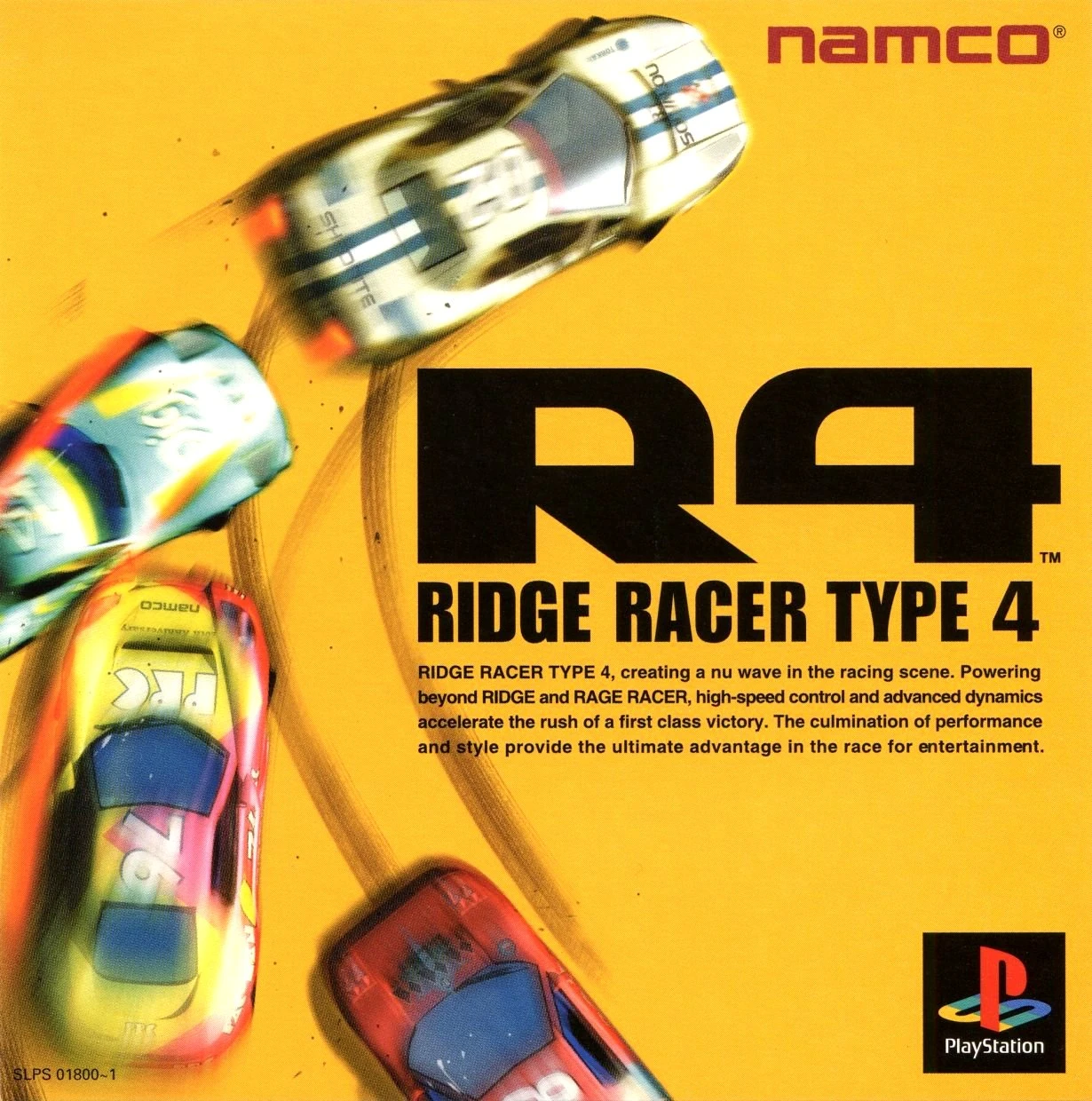
RIDGE RACER TYPE 4, creating a nu wave in the racing scene. Powering beyond RIDGE and RAGE RACER, high-speed control and advanced dynamics accelerate the rush of a first class victory. The culmination of performance and style provide the ultimate advantage in the race for entertainment.
These words accompany the Japanese box art for R4, and despite reminding one of the ostentatious intro text from the previous game, it's a perfect mission statement: R4 is one of the most beloved games in the series because of the very focus on performance and style they mention. Breaking free from the sea of prior entries that used existing content to excess, R4 is in fact a nu wave, feeling fresh in every sense of the word. It kicks all of the old Ridge Racer content to the curb and replaces it with eight original racetracks (double the amount of any prior games), hundreds of cars to drive, and a slick new aesthetic whose charm is irresistible. Even if the actual racing often resembles so many other games in the franchise, it's undeniable that R4 stands above the rest as one of the most charismatic games of its time.
Style
R4 feels different from the instant you start it up: as the decidedly-cinematic FMV intro begins with Reiko Nagase hanging out in her bedroom, you're treated to a kitschy dance tune with vocals that wouldn't feel out of place in Sonic R and character names ("There's characters?") flash on-screen like they're actors at the start of a movie. Like Rage Racer, the game takes itself extremely seriously, but R4 takes on a completely different complexion thanks to a shift from the lame "we're Rage Racers and just the scent of an exhaust pipe is enough to get us hard, motherfucker" aesthetic to a sleeker, jazzy style. Everything, whether it's the cutscenes, the menus, or even the cars themselves, is just dripping with a kind of swagger that almost feels like a precursor to some of what you see in games like Persona 4. The PlayStation's dithering, twitchy textures, and 240p resolution certainly shows its age these days, but try as it might, that can't quite kill R4's vibe: a brand of cool that feels as effortlessly-accomplished as the series' drifting.
 A lot of replay value comes from unlocking the wide variety of cars, which range from impractical to futuristic.
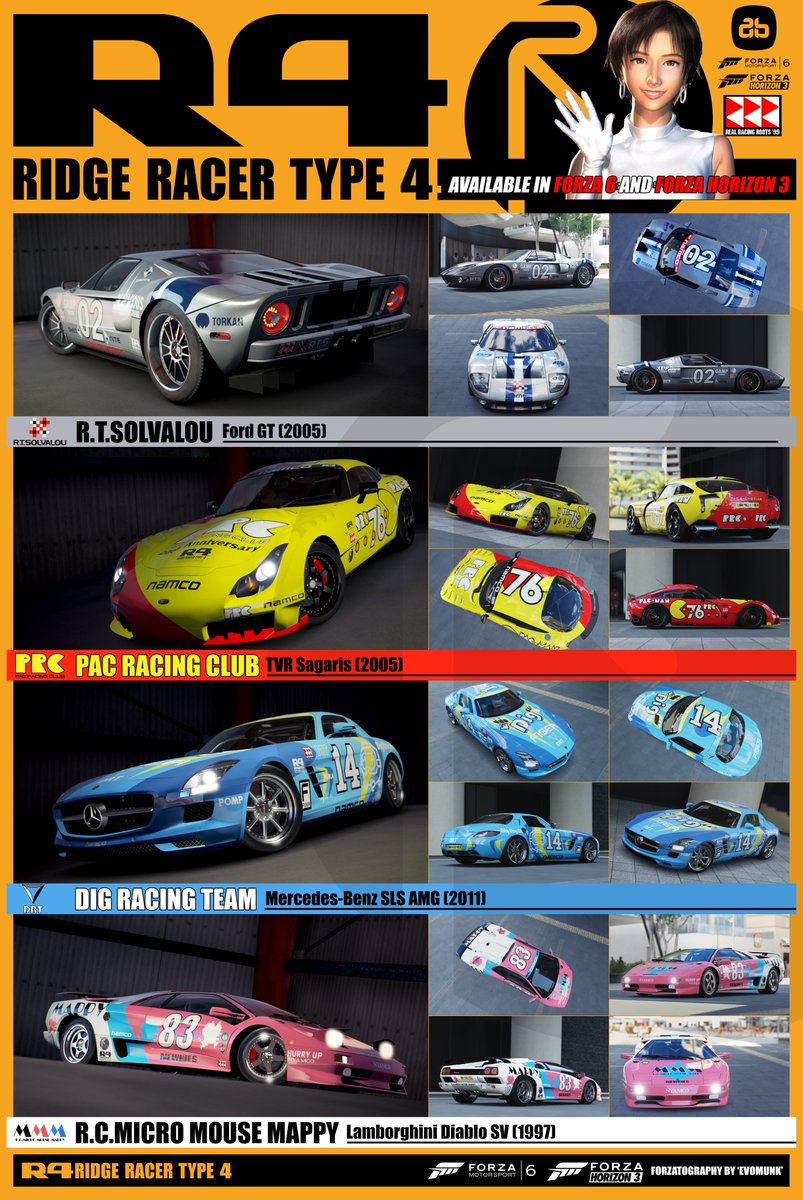
Arriving relatively late in the PlayStation's life, R4 was a visual showpiece at the time, standing alongside the realism-driven Gran Turismo as one of the nicest looking racing games you could find outside of an arcade or PC. It continues Rage Racer's quest for realism, but doesn't feel quite as drab as that game did, injecting the more realistic look with a much-welcome dose of color. It isn't much to look at from a fidelity standpoint now that we have games like Forza Horizon 4 hopping over the uncanny valley, but the art direction shines through regardless. The car models in particular are excellent: in addition to being gouraud-shaded for the first time, they also have some of the most ambitious designs in the series, whether it's in the paint or the actual machines themselves. As you play through the game, you unlock some really crazy vehicles, ranging from three-wheelers and F1 cars to hovercrafts and rocket cars. They're divvied up not only by manufacturer (The Japan-based Terrazi Corporation's designs are among some of the more outlandish, while the Italian Assoluto is clearly inspired by Ferrari and Lamborghini...), but also by a racing team of the player's choice, each of which supplies their cars with distinct and colorful livery paintjobs. The Pac Racing Club color scheme of red and yellow is my favorite, but each of the game's four teams give their cars memorable designs (and they translate to more photorealistic games damn well, too). Later games would look and run better on a technical level, but R4 finds a happy medium of classic arcade vibrancy and hardware-pushing realism that still stands out today. It cleaning up well in an emulator helps out too, of course.

Bringing this newfound focus on style together is the soundtrack, which may be the best in the series. The duo of Hiroshi Okubo and Tetsukazu Nakanishi (Namco composers who picked up the pieces after SamplingMasters left Namco during the development of Rage Racer) are joined by three more composers: Kōta Takahashi, Asuka Sakai (who would go on to be known for her work on the Katamari series), and Koji Nakagawa. Instead of trying to emulate the sound of the older games, these five find their footing in a post-SamplingMasters world and create one of the smoothest soundscapes to ever grace a video game. Influenced by neo soul, acid jazz, UK garage, and countless other genres, the sounds here are almost too suave to be suitable for racing, but through one way or another, the instrumentation keeps things moving. Rage Racer's ripping guitars show up here for a few tracks, but even then the soundtrack manages to flow like silk, with songs like Revlimit Funk and The Ride being accompanied by graceful synths and piano keys. The best track in the game (and perhaps the series as a whole), Takahashi's Move Me, is the perfect union of these contrasts: equal parts intense and serene, it basks in synth glory all while a hectic drum 'n' bass sample and infectious guitar riffs go to town. It's some of the best racing music I've ever heard.
The soundtrack is astounding, but its implementation goes the extra mile and makes it even more memorable. You can still pick your song before each race, but every course also has a default track associated with it, enhancing the vibe of both the music and the racing itself. The one that sticks with me most is the pairing of Lucid Rhythms and the seaport roadways of the Out of Blue racetrack. It reinforces the early morning coastal atmosphere of the race while making Lucid Rhythms come across as the god damn best water level music ever. Of course, there's also the grand finale in Shooting Hoops, where a climactic reprisal of the game's main theme plays while you finish out the Grand Prix just as the year crosses over to the new millennium, but other people have covered that better than I could. All of the music is great stuff in a vacuum, but as a part of R4, it's really something special.
Performance
This would all be for naught if the game still played like Rage Racer, but thankfully, the driving is far less demanding in R4. Drifts don't impact your speed nearly as much, and you're even given a choice to bypass drifting altogether. Two separate driving configurations replace the tire customization system seen in Rage Racer, giving two distinct playstyles to choose from. The Drift style seen in Assoluto and Lizard vehicles feels like classic arcade Ridge Racer (although closer to the skidding of Rave Racer than the "gliding" of the original arcade release), while the Grip style of Terrazi and Âge cars changes things up a bit. Instead of drifting, you gain the ability to take sharp corners as you let off the gas, something seen in the arcade spin-off Pocket Racer. It's easier in execution than drifting, but it isn't necessarily an easy mode. In addition to shifting the focus from executing drifts to hitting the apex of each corner, Grip cars typically don't turn as well outside of drifts as most Drift cars do, cutting down on the room for error a little bit. You're inevitably going to prefer one to the other, but the Drift/Grip split gives some fresh life to the gameplay.
 R4's story-driven Grand Prix mode is one of the most iconic things in the series.
The Grand Prix from Rage Racer returns here, but any similarities start and end at the name of the mode. No longer are you repeatedly racing on the same four tracks to earn money to buy new cars or upgrade old ones. Instead, you pick a racing team and a car manufacturer and compete in Real Racing Roots '99: a three-round tournament spanning eight all-new races taking place in Yokohama, Fukuoka, New York City, and Los Angeles. The track design in R4 is among some of the best in the series, with diverse courses that vary in difficulty and atmosphere, even when they're are variants of one another. The class of vehicle driven still improves after each round (and again for the final race), but this time, your performance determines your reward, with better rankings leading to better cars. After each round, a new car is provided by your racing team, and with four classes, four manufacturers, and four racing teams, this leads to a hell of a lot of cars to unlock. The game boasts a daunting 321 automobiles, but this is a bit of a misnomer. In reality, there are 40 unique Grand Prix cars, 4 boss cars earned through a 1-on-1 Extra Trial, and a Pac-Man car that unlocks as a reward for 100% completion. The remaining 276 cars are all variants determined by class and/or racing team, but a roster of 45 is still the largest in the series, and unlocking them keeps you around for quite some time.
The initial racing team decision chiefly serves as a kind of difficulty select (one team may not be as willing to reward a first-place finish as another, and some teams spec their cars with speed in mind over handling), but the real draw to them is in the stories that play out around them as you progress. Each racing team has a story arc that follows their respective managers as they work out various conflicts: Racing Team Solvalou's perfectionist owner Enki Gilbert is haunted by a fatal accident that happened decades ago, Sophie Chevalier is looking to prove she can run Racing Club Micro Mouse Mappy after the previous owner (her grandfather) becomes ill, Dig Racing Team's Robert Chrisman is frustrated by the organization's aloof upper management, and Shinji Yakazi of the debuting Pac Racing Club tries to keep a low profile because of his troubling past. A story is the last thing I would've expected to want from Ridge Racer, but watching the characters deal with their struggles by finding inspiration in your driving is surprisingly endearing, and there's just enough narrative here to intrigue without getting in the way of the actual racing.
I don't have the numbers on me, but from what I've seen, R4 is the fan favorite by far (well, I kind of have numbers), and it's pretty easy to see why. Ridge Racer Type 4 is one of the most cohesive experiences in the series, with a fusion of style and substance that's unforgettable. It's not without its issues (the game can't escape the series-long battle with repetition, even if the stories and unlocks do a good job of keeping it at bay for a while), and I think later games introduce some vital mechanics, but R4 nails everything it sets out to do, and you really can't argue with that.
[Key Tracks: Move Me, Motor Species, Lucid Rhythms]