5 ★ (0)
4 ★ (0)
3 ★ (0)
2 ★ (1)
1 ★ (0)
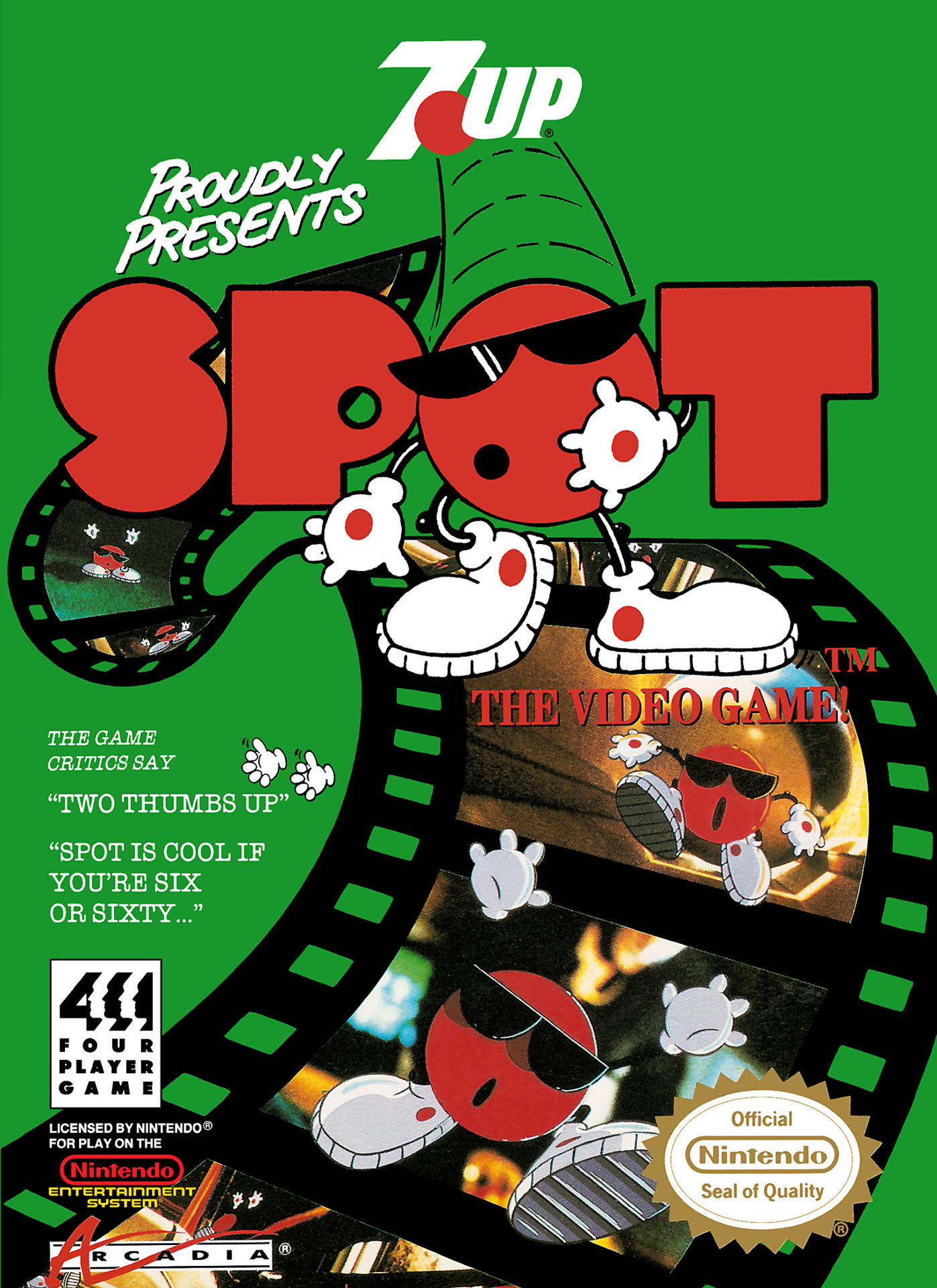

Spot: The Video Game, known in the Japanese version simply as Spot, and in the computer-based versions as Spot: The Computer Game, is a virtual board game and advergame developed by Virgin Games and released in 1990 for the Nintendo Entertainment System (Platform), Game Boy (Platform), DOS PCs, Amiga (Platform), and Atari ST (Platform). The PC, Amiga, and Atari ST versions were published in Europe by Virgin Mastertronic, the NES version was published in North America by Arcadia, the GB version was published in North America by Virgin Games, and both NES and GB versions were published in Japan by Bullet-Proof Software.
The first game to star the character Spot (Character), then the North American mascot for the soft drink 7 Up, Spot is an abstract strategy game similar in concept to Reversi and Go, with up to four players (two in the GB version) fighting for supremacy of a 7×7 gridded board by spreading their pieces throughout the board and "capturing" their opponents' pieces by moving adjacent to them. It is known for its animations, with the character Spot having one of several elaborate animations based on the movement being made.
The game is based on an earlier unreleased prototype for a computer game called Infection, which was also spun off into the 1990 arcade game Ataxx (Game). One of the designers for the Spot game, Graeme Devine (Person), later made his own version as mini-games for both The 7th Guest (Game) and The 11th Hour (Game) (the latter of which uses hexagonal boards).
Spot is played on a 7×7 gridded board, and the game starts with each corner of the board occupied by a player piece. In two-player games, both players start with one piece in each side of the board. All players take turns making valid moves using their pieces until either the board is completely full (in which the player with the most pieces on the board wins) or only one player still has pieces on the board.
For each turn, the player must either:
When a player occupies a new space, all opposing pieces adjacent to that space are "captured" and converted into their own pieces.
There are multiple board layouts to choose from, each of them having a different assortment of blocks that already occupy spaces (and cannot be converted).