5 ★ (139)
4 ★ (26)
3 ★ (5)
2 ★ (1)
1 ★ (0)

Super Mario 64 was a launch for the Nintendo 64 (Platform). Developed by Shigeru Miyamoto's team at Nintendo EAD (Company), it was released alongside the console on September 29th, 1996 in North America. The game pioneered many elements of the 3D subgenre of platformer. The game sold over 11.8 million copies worldwide and was also one of the first N64 games available for the Wii's Virtual Console (Concept) collection of retro releases.
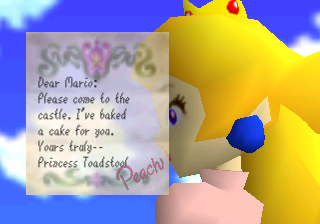 The plot of Super Mario 64 starts off with Mario (Character) arriving at Princess Peach's castle at her invitation and promise of cake. However, upon arriving, he finds the castle nearly deserted and learns that the evil Bowser (Character) has once again abducted her. In order to stop Bowser and rescue the princess, Mario must explore the worlds within a series of paintings hanging in various rooms throughout the castle and collect the power stars hidden in each. Only once he has the necessary stars will he be able to face off against Bowser and save Peach.
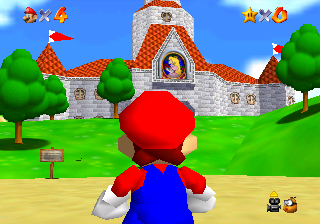 Super Mario 64 takes the core concepts of the 2D Super Mario titles and applies them to a 3D space. The player takes control of Mario and runs, jumps, swims, and flies through the games various stages in order to complete challenges and collect power stars. The game uses Peach's castle as a hub world; within the castle, there are paintings that transport Mario to various worlds that contain power stars. As the player collects more power stars, more regions of the castle become available with new paintings to explore. By ultimately collecting enough stars, the player is able to access the final level in which Bowser resides for the final showdown.
Mario's movements are controlled using the controller's analog stick. Gentle tilts of the stick cause Mario to move at a walking pace, while tilting further causes him to break into a run. Pressing the A Button allows Mario to jump, and for the first time in the Super Mario series, he can perform actions such as a wall jump, a jumping backflip, and a running triple jump.
 * Walking - Press the analog stick gently in the desired direction.
 Super Mario 64 was an early example of a game that offered the player manual control over the camera. The C Buttons on the N64 controller could nudge the camera to provide a better view of the action, while the C Up button zoomed the camera in to view the world from Mario's eyes.
Lakitu, a character commonly seen in the Super Mario series as one of Mario's enemies, has a new role in Super Mario 64 as the game's cameraman. At times when the player is viewing Mario's reflection in a mirrored surface, Lakitu can also be seen behind him, holding the camera if the viewing angle is right. This is justified in game with Lakitu being a reporter for a popular news station who's covering the Princess's kidnapping. A similar scenario would be presented years later in Mario Kart 8with various Toadstools covering the race events for a similar organization.
Super Mario 64 was an early example of a game that offered the player manual control over the camera. The C Buttons on the N64 controller could nudge the camera to provide a better view of the action, while the C Up button zoomed the camera in to view the world from Mario's eyes.
Lakitu, a character commonly seen in the Super Mario series as one of Mario's enemies, has a new role in Super Mario 64 as the game's cameraman. At times when the player is viewing Mario's reflection in a mirrored surface, Lakitu can also be seen behind him, holding the camera if the viewing angle is right. This is justified in game with Lakitu being a reporter for a popular news station who's covering the Princess's kidnapping. A similar scenario would be presented years later in Mario Kart 8with various Toadstools covering the race events for a similar organization.
As the first polygonal Super Mario title, Super Mario 64's graphics were a significant change from the sprite art of Super Mario World (Game). Super Mario 64 is also the first Mario title to feature voice acting. Mario's voice in the game is provided by Charles Martinet (Person), who to date has provided the character's voice in every Mario title with vocals.
| Level | Description |
|---|---|
 |
Bob-omb's Battlefield is comprised of green grassy fields, deep ravines, a high spiraling mountain plateau, and a floating island in the sky. It is ruled by the , found atop the mountain, and his army of . Five cannons littered across the level make for easy traveling, but beware Wan Wan, a giant Chain-Chomp chained to a pole in the center. |
 |
Whomp's Fortress is a huge floating island with a tower in the center and many smaller floating islands all around. This level is easy to fall from, and can be difficult to navigate for beginners. A tower appears after Mario defeats the evil Button King, a giant wall that tries to crush its opponents. Some enemies to watch out for are the sleeping and mini button minions. There is also a friendly that will take Mario for a ride if found. This level was remade and appears again in as part of the . |
 |
Jolly Roger Bay is an aquatic level with a deep cave hiding buried treasure, sunken ships, and giant electric eels. Clams hide coins which help replenish Mario's health and prevent him from drowning. Use the metal cap to walk along the bottom of the ocean and find the turtle shell to rocket through the water. |
 |
Cool, Cool Mountain is a giant spiraling ice mountain. Mario can slide down the mountain side or go in the ski lodge chimney and race a giant penguin. Watch out for the baby penguin. Mario will want to help it back to its mother andwhile he's at it find the snowman head a new body. |
 |
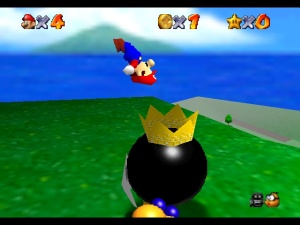
Bowser In The Dark World is the first of three Bowser levels. This level is linear and has only one path to Bowser's lair. Only one star is obtainable in this level: a reward for collecting 8 red coins. At the top, the player must enter the green pipe and fight Bowser for the Key to the Basement. To defeat Bowser, the player must grab him by the tail and throw him into one of the bombs surrounding the arena. |
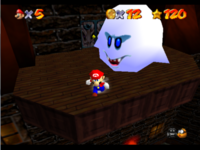 |
Big Boo's Haunt is a level hidden inside a boo in the castle courtyard. It is a giant haunted house with many ghosts and secret rooms. Mario will have to fight for their stars throughout the mansion, such as on a giant merry go round in the basement. Go around the back of the mansion for a secret door. Large eyeball enemies that appear in this world can be defeated if if Mario run circles around them to make them dizzy. |
 |
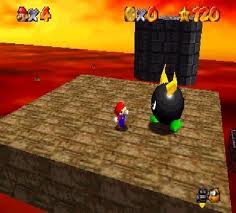
Hazy Maze Cave is a set of underground caverns. There are rolling boulders to dodge, fiery pits to jump, and tunnels filled with . Deep within this complex is a tranquil lake with a friendly dinosaur creature called Nessie who will help Mario navigate to a star, as well as the secret green P switch that unlocks green boxes. After obtaining it Mario will be able to use the metal cap to turn into . |
 |
Lethal Lava Land is an ocean of lava with platforms and set pieces jutting up out of it. Mario must leap from platform to platform and avoid falling in the . This can be difficult, as many of the enemies try to bump Mario off, and some of the platforms move. In the center is a that conceals a giant inner chamber. |
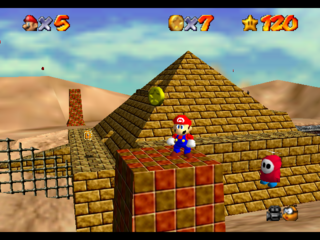 |
Shifting Sand Land is a giant desert with a huge in the center. It has many deadly sand traps and powerful sand whirlwinds which will throw Mario through the air. The pyramid is filled with obstacles, and two giant stone hands with eyes wait in the dark to crush Mario. There is also a giant flying through the sky who is holding onto a star and can steal Mario's hat. When hatless, Mario's defense is reduced and he takes more damage. |
 |
Dire Dire Docks is a water level with a huge whirlpool and a docked . There is also a giant that Mario should avoid. Once the second Bowser stage has been completed, the submarine will mysteriously disappear. |
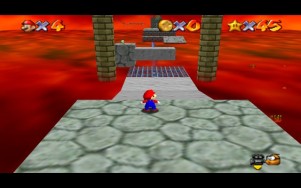 |
Bowser In The Fire Sea is much like Lethal Lava Lands in that it is a giant lava ocean. The level extends vertically up out of the lava so that a misstep will send Mario falling into a fiery pit. Like the first Bowser level, Bowser In The Fire Sea is linear and it too has a red coins star. At the top is spirally portal that will lead to Mario's second encounter with Bowser, who holds the key for the upstairs. This battle sees Bowser with a few new tricks, but he can be defeated once again by throwing him into the bombs lining the battlefield. |
 |
Snowman's Land is a snow level with a huge in the center. Mario can scale the snowman but should watch that he isn't blown off by the snowman's powerful breath. Mario will lose his hat if he is. The lake is frigid and will slowly damage Mario, but a skilled player can jump on the flower hatted snowmen to fly over it. |
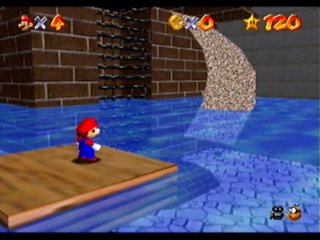 |
Wet-Dry world is a very vertical level. Mario can scale the cliffs and floating platforms to adjust the water level using switches. The water level present at the stage's start is dependent on whether Mario makes a high or low jump through the painting to enter the stage. There is a hidden town with a though an underwater tunnel. |
 |
Tall, Tall Mountain is all about scaling a large mountain surrounded by an abyss. There are many places where if Mario falls he will be taken back to the bottom or lose a life. There is a mischievous monkey that can steal Mario's hat and a sliding challenge much like the earlier snow lodge sledding course. Some of the most difficult tasks have Mario jumping across huge toadstools growing from the abyss around the mountain. |
 |
This appropriately named level has features that allow Mario to transition between tiny and huge sizes. Depending on Mario's size, the player can affect the environment in different ways. The level has a grassy mountain in the center which can be difficult to scale. The wind is dangerous in this level and can cause Mario to fall to his doom. A giant , an easy-to-anger -like creature with boots, lives at the top of the mountain. |
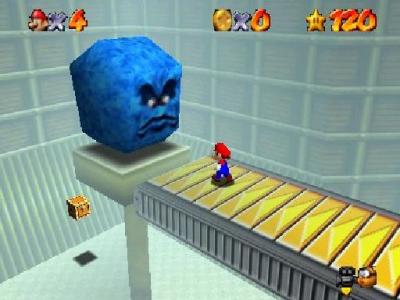 |
Tick Tock Clock (Location) is a level consisting of the inside of a . The level requires Mario to ascend a hexagonal structure dodging swinging pendulums and riding conveyor belts and clock hands. Depending on what time it is on the clock when Mario enters the level, the level's obstacles change speed. Certain speeds will make certain stars easier to obtain. |
 |
Rainbow Ride takes place high up in the sky and has Mario flying on and swaying air ships. There is a giant in the sky complete with a fire place and table. This course is very difficult as a single misstep will send Mario to his death. |
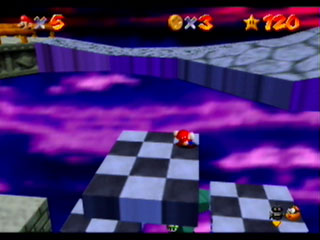 |
Bowser In The Sky is linear like its predecessors and also has a red coins star. It is the longest and arguably hardest of the Bowser levels and at the top is a pipe that leads Mario to his final confrontation with the Koopa King. To defeat Bowser this time Mario must launch him into three bombs instead of just one. After Bowser is hit two times the land next to the bombs falls away leaving the arena in the shape of a star. This makes the last throw to kill Bowser more difficult as it must be done from farther away. When Bowser is destroyed, Mario is awarded with a giant star and Princess Peach is rescued. |
Super Mario 64 excludes many of the franchise's classic items, such as the super mushroom and fire flower, in favor of special hats that give Mario unique abilities for a limited time. These caps include the metal cap that make him invulnerable and able to walk on the ocean floor, the vanish cap that allows him to pass through certain barriers, and the wing cap that lets him fly. However, some classic Mario items do make a return. These include the 1-up mushroom, Koopa shell, and collectible coins, though the functions of coins and shells are different compared to previous Super Mario games. In Super Mario 64, Koopa shells are rare and can be used to surf across the ground and destroy enemies, while collecting coins can restore Mario's health gauge. There are also three types of coins, yellow, blue, and red, worth one, two, and five health points respectively. Additionally, each world contains eight red coins, and collecting all eight during one visit earns Mario a power star. A unique attribute of the 1up Mushroom is that it will always follow and fly to the player after they trigger it. This would spawn a minor youtube sensation years later where players would trigger a 1up Mushroom and then attempt to complete a challenge without being hit by it.
 Shigeru Miyamoto (Person) began work on a 3D iteration of the Mario franchise after working on Star Fox (Game) for the Super Nintendo Entertainment System (Platform). For a time he considered developing it for the Super Nintendo, but later decided to develop it for the Nintendo 64 (Platform) due to the limitations of the SNES's hardware. The team spent many of the first months developing the camera and how the gameplay would work.
Originally the game levels were to be linear, but it was later decided that they should be open, free-roaming environments. However, the concept of linear levels can still be seen in final game in the Bowser (Character) levels, which require Mario to traverse a set path of obstacles to reach Bowser's lair. The development team prioritized making Mario's movements feel fluid and natural.
Before any levels were created, they tested his movements in a simple grid level which featured a golden bunny named "MIPS". This character later made an appearance in the final game. When the levels were finally designed, they incorporated more puzzles than was typically associated with Mario games. This is probably because The Legend of Zelda: Ocarina of Time was in development at the same time but was not released until years later. Some of its puzzle ideas were likely incorporated into Mario 64.
Shigeru Miyamoto (Person) began work on a 3D iteration of the Mario franchise after working on Star Fox (Game) for the Super Nintendo Entertainment System (Platform). For a time he considered developing it for the Super Nintendo, but later decided to develop it for the Nintendo 64 (Platform) due to the limitations of the SNES's hardware. The team spent many of the first months developing the camera and how the gameplay would work.
Originally the game levels were to be linear, but it was later decided that they should be open, free-roaming environments. However, the concept of linear levels can still be seen in final game in the Bowser (Character) levels, which require Mario to traverse a set path of obstacles to reach Bowser's lair. The development team prioritized making Mario's movements feel fluid and natural.
Before any levels were created, they tested his movements in a simple grid level which featured a golden bunny named "MIPS". This character later made an appearance in the final game. When the levels were finally designed, they incorporated more puzzles than was typically associated with Mario games. This is probably because The Legend of Zelda: Ocarina of Time was in development at the same time but was not released until years later. Some of its puzzle ideas were likely incorporated into Mario 64.
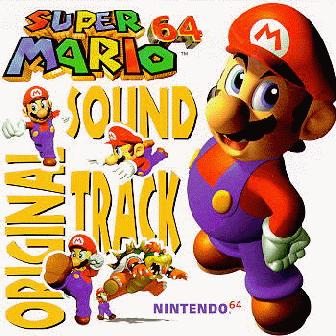
The soundtrack to Super Mario 64 was composed by renowned Nintendo composer Koji Kondo (Person). It was first published by Pony Canyon in Japan on July 19, 1996. It was later published in North America by Nintendo on November 1st, 1996.
 # It's a me, Mario!
Super Mario 64 is one of the most critically acclaimed and commercially successful video games of all time. It was the top selling Nintendo 64 (Platform) game and is the second highest selling Wii (Platform) Virtual Console (Concept) game. As of the end of 2007, it has sold 11.8 million copies world wide. The game is often praised as having revolutionized the 3D platformer and for pioneering many of the key gameplay concepts used in modern platforming games.
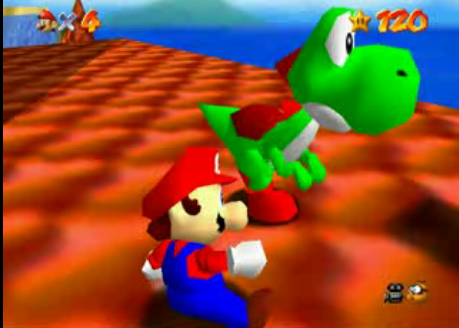
A remake of Super Mario 64 entitled Super Mario 64 DS (Game) was released for the original DS handheld on November 20, 2004. The game is faithful to the original version and contains all of the original levels. Additions made to the game include a variety of new minigames, as well as the ability to play the game as Luigi (Character), Yoshi (Character), or Wario (Character).
 * The fastest recorded completion time for Super Mario 64 is 6 minutes and 41 seconds. This run makes use of various glitches in the game that make the game beatable with zero stars.