5 ★ (0)
4 ★ (0)
3 ★ (0)
2 ★ (0)
1 ★ (0)

From the back of the box:
The designers of the Bard's Tale series, Wasteland, and Battle Chess pooled their talents to create the ultimate role-playing fantasy. They knew it had to be a first-rate story with sophisticated graphics. The result was Dragon Wars.
Sailing across uncharted seas, you and your party are in search of a legendary paradise called Dilmun - a place where the streets are paved with gold and no one wants for anything.
However, King Drake of Phoebus has declared all magic illegal - magickers have been slain or fled into exile. In retaliation, enemy islands have threatened to unleash their guardian dragons, the most destructive force in the world. While docked at a harbor in Dilmun, you are arrested on suspicion of spellcasting.
Imprisoned and stripped of everything but your wits, you are sentenced to a life in a cesspool called Purgatory. Magic is your only salvation - a worldly possesion in a world possessed.
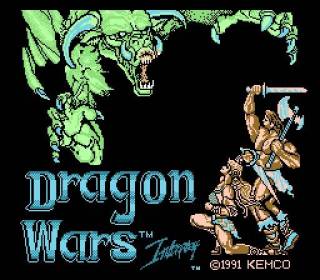
Dragon Wars was the third game released under Interplay Productions' own label outside of EA. It was developed by many of the same people involved with the Bard's Tale and Wastelandand as a result, shares many concepts and ideas from those titles within its design. It is also considered the spiritual successor to the Bard's Tale series, even so far as being referred to by some accounts as Bard's Tale IV, but because EA owned the rights to the name, Interplay had to create a new world from scratch. The box also featured art from artist Boris Vallejo with a poster copy inside and there were many references to Sumerian mythology within the game.
The game casts the player along with their party as prisoner exiles amidst the slums of the city of Purgatory. Originally on a pilgrimage to the land of Dilmun, the ship they were traveling on was immediately placed under arrest by the city when it came into port. The player and their party are among the lucky few not to be consigned as sacrifices to the dragons, but they are stripped of everything other than the rags on their backs and dumped into Purgatory's streets to survive on their own wits. It is up to the player to somehow find a way to survive and escape Purgatory and eventually seek revenge against Namtar, the Beast From The Pit, who seeks to dominate the world of Oceana.
In the world of Dragon Wars, dragons are considered as a form of nuclear deterrence albeit with a fantasy flavor. City-states scattered across the island nations of Oceana each have a dragon within their walls, kept under lock and key and fed well to protect their city from all rivals. A sort of "Cold War" exists where the dragons are held back and to be used only as the final option in war. Part of the mystery is why the city-states haven't yet used their dragons to strike back at Namtar's aggression as a united front.
Many of the gameplay systems are a hybrid of ideas from both Wasteland and the Bard's Tale. For example, while the game uses the ranged attack system present in both titles, it does not use classes and instead relies on the skill system first used by Interplay in Wasteland. The automapping feature used in titles such as Bard's Tale III was also included.
The game also uses the grid-based, 3D system wherein the world is viewed from a first-person perspective with 90° turns and movement spaces similar to the Bard's Tale series with a few cosmetic differences. Within the ever-present interface, on the upper left quadrant of the screen displayed the world with the party listed to the right along with any encounter messages and options. A text box on the bottom quadrant of the screen would display messages such as combat results. Random enemy encounters would provide combat opportunities within the game against mixed groups of foes. Hit and spell points are represented by bars instead of numbers.
Copy protection took the form of a series of paragraphs that served as descriptors for various areas within the game proper. When prompted, the player was asked to read the appropriate paragraph for the required information. This method had also been used in Wasteland.

The game challenged players immediately from the start. After character creation was completed and a party assembled, the player was tested to find a way to survive as they would start the game with nothing in their inventory.
As with most RPGs of this type, party setup and character selection were left entirely up to the player. If the player so chose to create a party of warriors, they could expect extreme difficulty ahead without a mage to help teleport them back home, out of a dungeon, or heal them adequately in combat. A party is limited to seven characters, although the manual suggests leaving one slot open for summoned monsters or special encounters that may join the party.
Characters could be imported from any of the three games in the Bard's Tale series which would give them an advantage in statistics early on.
As noted earlier, it is suggested that players do so in order to survive the initial encounters, or grind the first dungeon until they are able to hold their own in combat. It will only get worse from there. However, there are a variety of exploits that can dramatically level parties up with experience early on in the game.
Dragon Wars did not feature any races within the game to choose from for character creation. Everyone on Oceana was human.
Death was also somewhat permanent and there were no listed spells within the manual that could perform resurrection.

Parties consist of seven characters. Players can only create four characters of their own and the last three slots are reserved for NPCs that can be hired into the group as they are encountered in the adventure. Unlike the Bard's Tale or Wasteland, however, there is no Adventurer's Guild or HQ for players to swap out characters or create new ones on the fly. Once a party was created, the only way to create a new character would be to start the game over.
During character creation, the player can determine their name, sex, and then distribute fifty character points to improve their statistics and purchase skills. Statistics in Dragon Wars are not rolled during creation. Every character starts out with a ten in every attribute and further changes are made using the points that they are given.
During creation, the player is given the chance to adjust the starting statistics for their character. While playing the game, a character's profile could be viewed by simply hitting an appropriate number key to show a character's abbreviated statistics along with various other pieces of information. The abbreviated value for how these attributes appear onscreen are listed in parenthesis.
These determine how well your characters will survive the game with a variety of fields that can help them. Because of the slow rate of character development and the low number of skill points given to each character when they level, character specialists are increasingly important to consider when building your party. Although Wasteland uses a skill system, the one in Dragon Wars is not dependent on the intelligence level of any particular character. Having the right number of character points is all that is needed.
The skills available to characters are:
As in Wasteland, characters can use any of their skills in order to solve puzzles or on certain NPCs.

With the restrictions on magic in the world of Dragon Wars, being a magic user comes at a high price. Namtar, the main antagonist of the story, has become the most powerful sorceror of Dilmun by manipulating King Drake to declare his ban on magic. With no other opposition, Namtar is free to monopolize his power and has already acted. The other city-states took to warfare to defy King Drake's decree, losing their spellcasters in the opening stages of the war. Namtar's Stosstrupen, a sort of magical secret police, had also worked to assassinate Dilmun's top sorcerors before they could organize an effective resistance. It is the player's task to recover this magical knowledge and use it against Namtar before he can move ahead with his plans to conquer what is left.
Learning a spell in Dragon Wars requires finding a scroll with the appropriate knowledge and then using it, causing it to vanish forever. Because most of those that even knew of how to teach magic are dead, in hiding, or worse, discovering any piece of magic is one of the challenges.
Low Magic is initially available as a skill purchase to new characters, but the disciplines of High, Sun, and Druid magic must be learned from their respective masters.
There are four major spell classes:

When the party encounters a random enemy, a descriptive list is given at the start. Any group of monsters within 10' (feet) of your party are within melee range. Some monsters, however, will also use ranged attacks. Combat is divided into a series of rounds and it is up to the player to decide what they should do next.
The player's options during such an encounter are are:
If the Fight option is chosen, melee character will have the option of striking a normal blow (as in Quick Fight), a mighty blow (reduced hitting chance but greater damage), or a disarm which will deal some damage but attempt to knock an enemy's weapon away. Players will also be able to rearrange their party. They will also be able to block when this option is used.
Under both types of fighting options, players will always be able to use an item, run like a coward, dodge an attack, or cast a spell. If players run from combat, the computer will randomly run the party across the map. This can sometimes place them in a far more dangerous area than the one they had just left.