
Indie Game of the Week 433: Deliver Us the Moon
by mento
When you're the greatest courier in the world it's easy to get complacent, but when mafiosos abduct your estranged wife—the love of your life that you neglected so you could get really, really good at taking a thing from one place to another place—and demand nothing short but the shipment of a rock that weighs 70,000,000,000,000,000,000,000 tons and is floating around 240,000 miles away, well,...
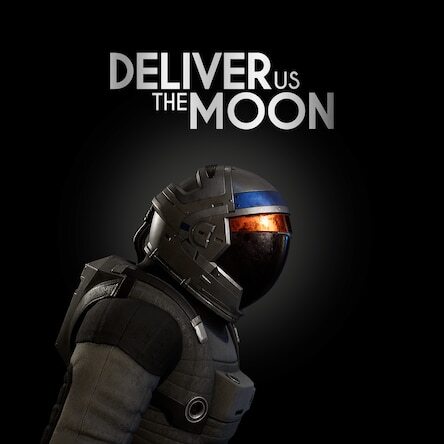
When you're the greatest courier in the world it's easy to get complacent, but when mafiosos abduct your estranged wife—the love of your life that you neglected so you could get really, really good at taking a thing from one place to another place—and demand nothing short but the shipment of a rock that weighs 70,000,000,000,000,000,000,000 tons and is floating around 240,000 miles away, well, the usual U-Hauls ain't gonna cut it. Deliver Us the Moon has nothing to do with any of that and is instead yet another one of these atmospheric (even when there's no atmosphere) sci-fi roaming around adventure games in which your task is to figure out why a Helium-3 power plant on the moon ceased sending energy back to a dying Earth that desperately needs it. Finding the entire moon base completely deserted, you do the usual thing of piecing together what happened through audiologs, scanned items (gotta love any Metroid Prime touches), and something akin to the hologram video recordings that Tacoma featured prominently. It also has a few awkward timed action sequences that I'll get into later to add a bit of peril, but is otherwise combat-free and a largely sedate "aftermath purveyor" (the term I used for the thematically similar The Station, which I reviewed a little while ago).
Deliver Us the Moon is certainly a narratively ambitious game, balancing the slow-pace of an investigative graphic adventure with a few environmental puzzles—often about escorting batteries around to power up areas of the moonbase—and the aforementioned timed sequences, many of which relate to having a limited supply of oxygen as you run and float around on the moon's surface or in outer space. It's a largely linear affair too, escorting you from one area to the next with discrete chapters that helpfully track how many collectibles you've found in each in case you feel the need to bounce back for anything you missed. Information is typically given to you through the holograms and audiologs, neither are hard to miss (in fact, the audiologs can't be avoided as far as I can tell, though I suppose you can always refuse to listen to them), while incidental details often relate and fill out the backgrounds of unseen characters like Sarah Baker, a software technician left behind when the moonbase was mysteriously evacuated, or Claire Johanson, the daughter of a now-missing Lunar colony bigwig who acts as your Earthbound radio liaison whom occasionally pipes in to deliver new mission objectives.
 Oh, so I wasn't supposed to push that button? Who knew an abandoned lunar base could be so precarious?
Visually the game has a pretty decent lock on that realistic space exploration aesthetic though there's a few elements that feel a bit amateurish in comparison, like the font choice that has odd vertical kerning that doesn't quite look like it belongs on the various screens and interfaces you examine while exploring. It frequently looks like someone just imposed text over a model like you might in a Photoshop or MS Paint doodle. The voice acting is fine but clearly ESL in many cases, with slightly off inflections and deliveries: the studio is from the Netherlands where (as I understand it) English fluency is high enough that they probably didn't feel the need to import too many foreign actors. Nothing wrong with the script, on that note, and I think I only saw a single notable typo the entire time which is impressive enough for any adventure game as text-heavy as this.
If I had any misgivings about this game besides a really rough QTE sequence where directions to change the trajectory of a moon monorail (or moonorail) flashed on screen for half a second before the deadline passed, it's in technical plot details that the game either neglected to properly explain or just exist as giant holes. Now, I'm hardly the "CinemaSins" type of pedant that focuses on every undercooked story detail—I think it was Grubb who said something recently along the lines of being an adult that still has command of their imagination means being able to fill those holes yourself with a little bit of conceptualizing—but details in the plot made almost no sense to me and I was waiting to find some log or journal that would help explain the discrepancies, yet never found them. The first concerns the way Claire's little sister was forcibly taken to her father, the aforementioned moonbase science team leader, through a custody battle that left both Claire and her father estranged until his disappearance. How does one win custody of a child when escorting her to her new home would involve an extremely costly and dangerous journey from Earth? Even if we're in the near-future it's not like they establish that going from the Moon to Earth and back is like a basic ferry service—in fact, the importance of this in-game mission hinges on the fact that it's now next to impossible for a Lunar trip to happen due to the amount of power reserves required, which Earth no longer has. You also acquire a robot companion named the ASE, which formerly belonged to another lunar administrator. It managed to record a lot of revealing conversations (the ones depicted as holograms), which meant it had to be destroyed by the villain of the piece to ensure its silence: a player task involves repairing it so you can take advantage of its confidential logs as well as its distinct utility as a drone that can reach places you cannot. Yet you can also use it to listen in on conversations it very definitely wasn't around for, including those that occurred after it had already been destroyed and disconnected from the network these ASE units belong to and that no longer functions by the time you make it to the moonbase yourself, so... yeah, no idea what's up there.
The last nitpick involves big narrative spoiler, so I've blocked it here:
As you explore the Pearson Station, the first area of the Moon you come to, you find living quarters for two individuals: the technician Sarah, who you follow for most of the game, and the engineer Rolf, who was forced to leave Sarah behind and evacuate with everyone else on the Moon for the "Outward" project: a series of arks built secretly on the Moon that would leave the dying Earth behind for a "Hail Mary" shot to colonize deep space. This all happens just before and after "the blackout", an event engineered by the game's antagonist to force the Moon colonists to agree to his ark plan as the Moon's reactor at the Tombaugh Facility could no longer function in its role to deliver energy to Earth. Yet although no Moon personnel made it back to Earth to explain what had happened up there—figuring out that mystery is partly why you've been sent up, along with reactivating the energy exchange—it's later revealed that the protagonist, the one that started the game on Earth and took on the mission to visit the Moon, is none other than Rolf. So how'd he get back home? And why didn't he tell anyone about what he discovered up there during his investigation just after the blackout? I'm sure I missed an important detail but when the protag reveal occurred long after the arc on Pearson I had absolutely no idea how I could be a former Moon colonist given everything I knew about what happened up there and how "no-one who was there is around to explain what happened" is central to the game's mystery plot. That Rolf had to leave Sarah behind because of his supervisor constantly reminding them of an imminent evacuation, which I could only assume was the same evacuation that happened just hours after the blackout that involved the entire moonbase crew boarding the arks, is a case where the language and timeframe left things extremely ambiguous as to what happened to poor ol' Rolf. Anyway. Just some real weird storytelling; it almost felt like a last minute change to the script to make the player care a little more about Sarah's recorded survival journey given the unspoken history between those two characters, and no-one thought to double-check the continuity.
 Can't make a moon game without a moon rover driving sequence. Just gotta not wander too close to any thresher maws.
I wanted to like Deliver Us the Moon because after Mouthwashing and The Station—or J.U.L.I.A., Morningstar, Tacoma, and Adr1ft going further back—I've become attached to this sort of "figure out how everything broke bad" sci-fi mystery thriller format. Yet for all its delicious enigmata to unwrap, the game and its frequent overtures towards building dramatic tension through action sequences meant it was plagued with minor gameplay issues that undermined the playthrough at every turn. I wouldn't say it was a bad game by any stretch or that it failed to accomplish its goal of creating a mission that felt every bit as perilous as it should for someone stranded on an inhospitable rock surrounded by high-tech machinery that had been left to rot (well, not that there's bacteria on the moon) for years after this mass exodus and was quickly approaching a fatal fail state. Yet besides some real basic environmental puzzle stuff little of the non-adventure game action business really did much for me, and as I intimated above even the narrative core felt compromised by some bizarre gaps I was unable to explain away. I'll give it props for the presentation, the lived-in feeling that many of these immersive first-person adventure games tend to prioritize, and an ambition to be something a little more than a "walking sim" but I had hoped for so much more. Maybe its sequel, Deliver Us Mars, fulfills that potential (though going by Steam reviews it looks like it might have its own share of problems).
Rating: 3 out of 5.
| < Back to 432: Grapple Dog | 001-100 | 101-200 | 201-300 | 301-400 | > Forward to 434: Shadows of Adam |