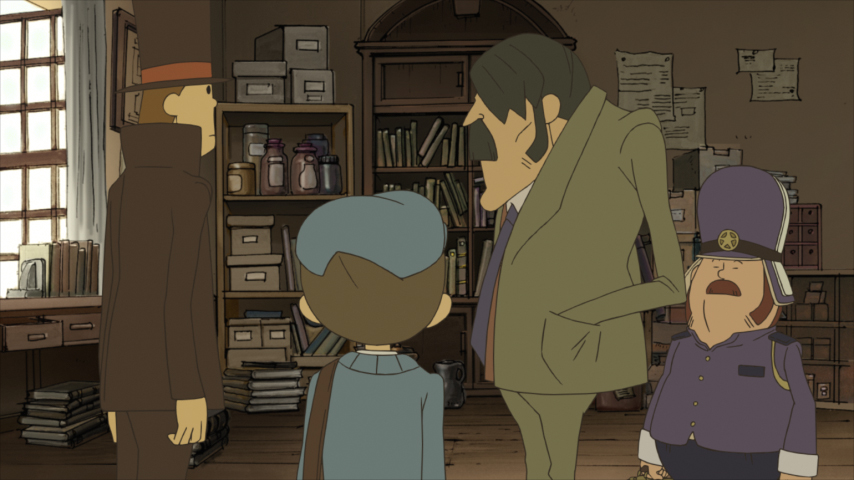
The new game finds Layton and Luke on the trail of the Elysian Box, the antique referenced in the title that's said to instantly kill anyone who opens it. After the professor's old mentor falls victim to the box--or some other kind of foul play--the pair sets off on a luxury train line called the Molentary Express on a cross-country pursuit of both the item and some real answers. By contrast, the Curious Village was set entirely in the odd, eponymous hamlet of St. Mystere, and you as the player spent so much time confined there, covering the same ground and plumbing the town's mysteries that I felt like the Curious Village itself almost became a character or active participant in the story. Consequently, the story in this sequel initially felt a little disjointed to me, since you spend a comparatively short time in each location as you ride the train and explore the places where it stops.
But the Molentary Express is just the beginning here, and it's not long before the story takes a turn for the surreal (and slightly macabre) and begins to take on an identity of its own, especially as the train deposits you in eerie, unexplained areas. Numerous references to the first game and some neat reappearances by its characters help ground this game's storyline in the familiar, too. And though I wasn't counting minutes or lines, I'd swear The Diabolical Box has a little more spoken dialogue and animated video sequences to flesh out its story than The Curious Village did.
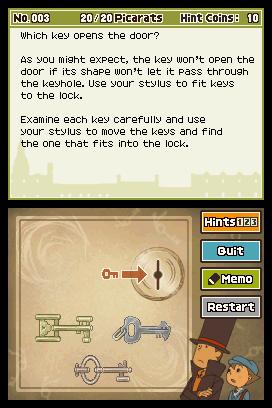
It's also worth noting that Diabolical Box attempts to tie more if its puzzles' subject matter directly into the storyline. So when the train gets stuck on the tracks, you get... a puzzle about rearranging train cars. Or when the identity of a missing child comes into question, you'll solve a sliding tile puzzle that reveals his true nature. It's a neat way to bridge the puzzle-solving gameplay with what's currently happening around you, so all the puzzles don't feel like total non sequiturs. On the other hand, while the game mostly does a good job of keeping the puzzles feeling fresh for veterans of the original game, you will notice a few puzzle styles returning on occasion, and a couple of puzzles were similar enough to ones I remember from the first time around that I felt like I knew how to solve them almost as soon as I saw them. For the most part, though, doing the puzzles here is just as satisfying as it was before.
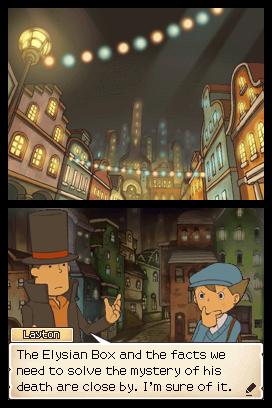
The real success of the Professor Layton series is the way its puzzle-solving and crime-solving aspects support and blend with one another. Alone, the two halves would respectively make for a decent minigame collection and dialogue-driven adventure game. But together they create a wonderful mixture of narrative intrigue and head-scratching puzzle gameplay that propels itself forward straight through to the end of the story. Every time you hit a slow period in your investigation, you'll be excited to have some new puzzles to solve--and every time you're feeling the mental fatigue of puzzling your way through them, you'll be glad to reveal another piece of the mystery. That mix is in full effect in DIabolical Box, and while the charm and satisfaction of playing Layton may be a little less of a surprise the second time around, it's still plenty worth coming back for.