
RARE REPLAY RELAY, PART 6: The Pinata Game
by jeremyf
[Editor’s note: Please forgive the lack of “ñ” in this post. I didn’t feel like using it.] Wait, this game had a PC release? I wish I could have played that! By this point in the challenge, I had conquered all sorts of heinous tasks. I battled disgusting design, crappy controls, and egregious grinding. Despite my victories, I was still trepidatious when it was time for Viva Pinata . This kind o...
[Editor’s note: Please forgive the lack of “ñ” in this post. I didn’t feel like using it.]
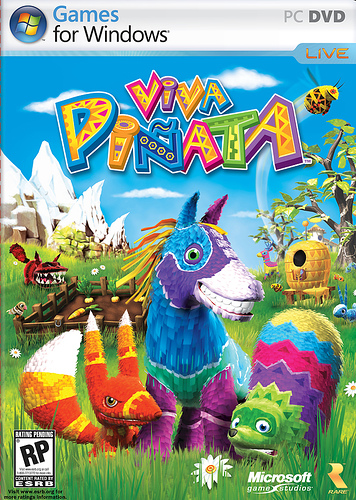 Wait, this game had a PC release? I wish I could have played that!
By this point in the challenge, I had conquered all sorts of heinous tasks. I battled disgusting design, crappy controls, and egregious grinding. Despite my victories, I was still trepidatious when it was time for Viva Pinata. This kind of simulation game would be nothing like what I had done so far. Ordinarily, I actually love sim games. But I never play them because I know they would destroy my free time. There are two Viva Pinata games included in Rare Replay, and I had a feeling they wouldn’t be a good match for this challenge. To rush through a management game and try to minmax achievements is already counter to the point of the genre. Doing so for two similar titles could only exacerbate that.
After a string of difficulties under team Xbox, Rare is seemingly back to its old self with Viva Pinata. Any sense of self-seriousness from the 360 launch is shed in favor of what the studio does best: cheekiness. This gaggle of paper animals is packed with personality as well as candy. I was most impressed by the animation work. Each pinata identifiably moves like the creature it’s based on. At the same time, they are all super goofy, and it’s fun to just watch one do its thing. The attention to detail is best seen in the romance dance cutscenes. Each pinata species has its own little routine with a different type of music, and it’s a delightfully silly way to represent reproduction with an E rating. Multiply that care and attention by the seemingly limitless number of species in the game, and you’re always on a treadmill waiting for the next new thing. Every humanoid NPC’s look and writing also comes from the Rare catalogue: irreverent and occasionally unsettling. It’s funny to compare the actual game’s tone with its intro scene, which comes from the tie-in cartoon. That is all about animals screaming and/or partying, which was kinda the baseline for any cartoon made in the 2000s. The contrast between that and Rare’s quieter British humor shows a remaining divide between creators and owners, even for characters this marketable.
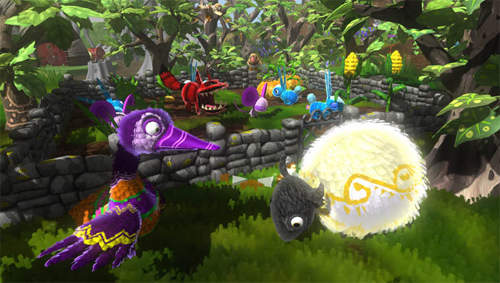 I promise, my gardens looked nowhere near this attractive.
In this first Viva Pinata, if you play it, achievements will come. There’s not anything extraordinary that requires hard work beyond the game’s normal progression. That progression is open-ended. It’s up to you to grow plants, decorate, and fill your garden with pinatas to level up. Then, you unlock more things and continue on. The achievements are nice mile markers along that path. I was not prepared for how much of the process would resemble Harvest Moon, though. Experience is awarded for each variety of plant you can successfully keep alive. Even more is available for feeding it the right fertilizer three times. I had to invest in a green space because accruing a menagerie of paper animals is actually very challenging. The other way experience comes down is, of course, for every new species of pinata, then for making them get busy a bunch of times.
But the requirements for new visitors are increasingly arcane. You may need particular objects, plants, or even other pinatas before a new species even deigns to visit. When they finally show up, you hover over them like an over-eager party host, asking if the furniture is to their liking. While your owned pinatas can be directed towards places (when that decides to work), these noncommittal pinatas have their own priorities. I would repeatedly drop their favorite food in front of their faces, only to be ignored time and again. Play this way long enough, and any semblance of an attractive garden is destroyed. My plots were filled with rotting fruit, half-grown dried-out vegetation, and a dysfunctional mess of food-themed animals. Much respect goes to sim players who use the tools to create gorgeous art pieces, but that has never been my strength.
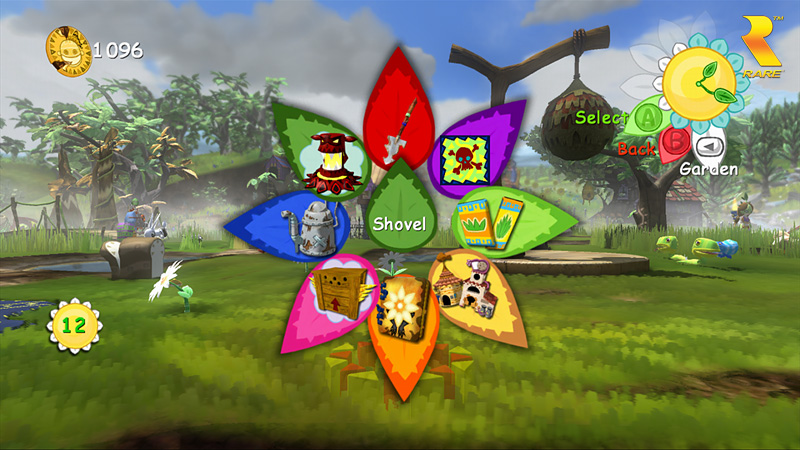 I spent way too much time navigating this multilayered menu.
Playing so manically also meant I was navigating menus constantly, most often for Costalot’s general store. I grew the muscle memory to instinctively input the sequence to get there, but on a good day it still takes five to seven seconds. Picking out what you need from the many subcategories takes even longer, plus Lottie’s multiple dialogue boxes of quips to skip through. Having to deal with this so often, I did not appreciate that the most important NPC in the game is explicitly ripping you off. And it’s her favorite thing to talk about. To finance this operation, I had to maintain a separate plot of land as a designated farm for lucrative chili plants. After some number of hours, I was sitting on a disastrously ugly garden that nonetheless contained high value pinatas and items. The penultimate achievement I needed was for a garden worth 100 thousand coins. The last was to have those coins on hand. You can see the economic path here. The only logical thing to do was scorch earth and sell every last thing I could. I was now the owner of a barren wasteland, but I had what I needed. I didn’t get into the pinata game for the love of it. I did it for the Gamerscore.
I knew that immediately moving on to the sequel would be a bad idea, so I took a little break at this point. In retrospect, it probably should have been a big break, because Trouble in Paradise burnt me out hard. Internally, Rare had debated making this content as an expansion or a full sequel. I would agree that there’s (barely) enough new stuff to justify the latter, especially since there’s a new Madden every year. If I could change anything about Trouble in Paradise, I would have it recognize my save from the last game and unlock all the stuff I had. I know they could do it, most of the code has got to be exactly the same. Instead, you must unlock everything you worked so hard for once again – but this time, the game is not impressed anymore, so no achievements for you. All the achievements center around the added content, which is kind of sprinkled around the edges of what was already there. I was scared because my magic margin for the Rare Replay stamps was razor-thin this time. A healthy portion of Gamerscore is tied up in online modes and a defunct card-reading accessory for the Xbox 360. Developers know that these choices will destroy achievement freaks years after release, and they think the pain is funny.
The most prominent additions to Trouble in Paradise are the new desert and arctic areas. These spaces are empty squares traveled through by thematically appropriate wild pinatas. You can buy and bait traps to hopefully poach these pinatas for your own garden. To make them stay, though, you’ll need to replicate their preferred environment. That’s one of the big reasons I was juggling five to six gardens at once while trying to muscle through the game. There are also a pair of new minigames, a race and a pageant. I felt that the best way to engage with these was to hope for the best. Imaginary Player 2 was a huge help once again, letting me tilt the randomness ever so slightly more in my favor. They also satisfied some achievements just for sticking around for a few hours. What a great pal – I’m sorry to see them go.
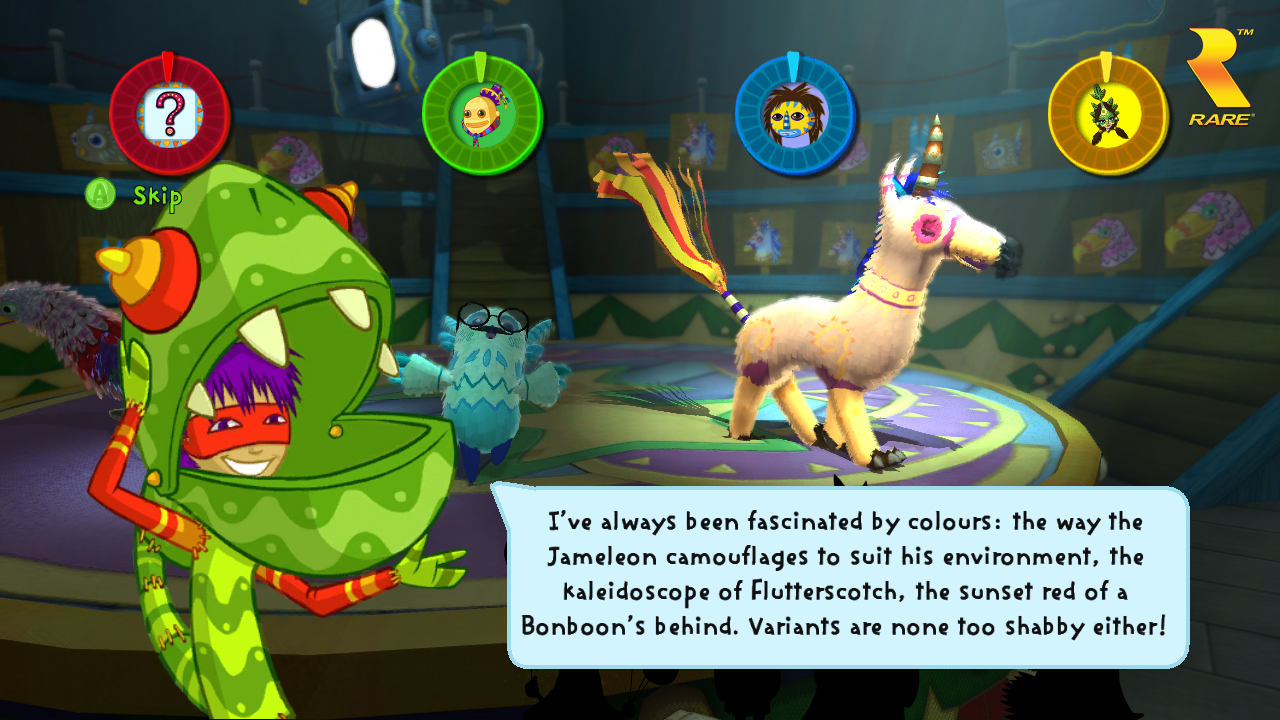 Not only are the contests unintuitive, I don't even know who this guy is.
While everything from the first game is still present, Trouble in Paradise does contain a more structured progression, albeit one that can be taken at any pace. There will always be representatives of three countries asking for a specific pinata at their party. When you possess a matching creature, you feed them candy and send them off temporarily to entertain the children of the world. Each country has around half a dozen of these requests, and there are quite a lot to contend with in total. Achievements are doled out for satisfying the challenges on each continent. However, nothing can be so simple. The requests start innocuously enough, but before long, things get very particular. What color does the pinata need to be? What tricks must it know? What accessories must it wear? The calculus becomes a mess because the path to unlocking all this junk is not clear in game. I was constantly crosschecking multiple guides and wikis, and I felt dizzy. Pinata A needs three of fruit B before it will come to the garden. I can’t unlock fruit B until I reach level X and have 7 of pinata C to clear the path, then I need Y amount of sand in my garden to attract pinata D to scare away creature Z…
I could not wrap my mind around this, and to be fully honest, I was more stressed at this point than at almost any other part of the challenge. Each of my gardens was its own microclimate that had even more of a disastrous layout than before. Even with the last true cheat code in the challenge that effectively gave infinite money, I was anxious managing the hundreds of other variables. In retrospect, the presence of three challenges at once pulled my brain in multiple directions simultaneously, keeping me from focusing on any one of them for long. I would try to put the game down for the day, then I would come back minutes later because maybe the thing I needed would show up soon. Playing in the game’s order was driving me up the wall, so I resorted to a “catch ‘em all” approach where I compiled every pinata on a list and crossed them off when they finally appeared. As I madly typed their ridiculous names, it brought to mind an insane horror villain scrawling “Galagoogoo” and the like on a wall.
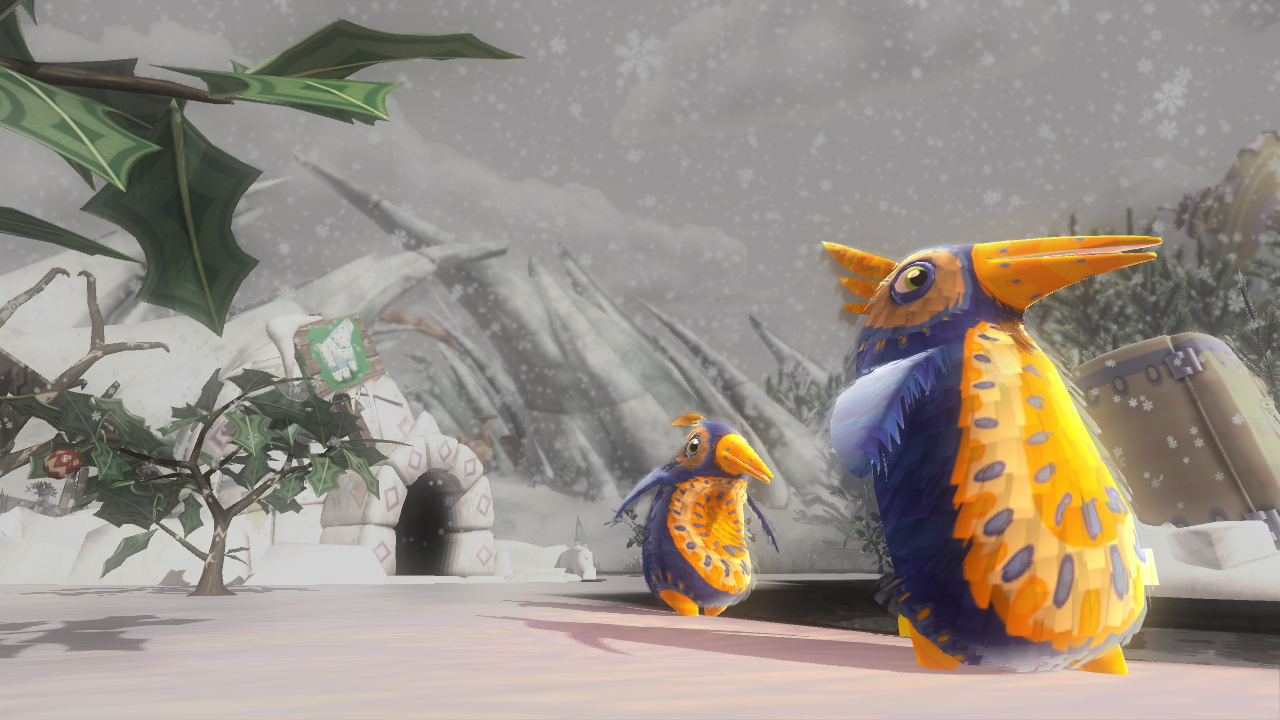 Pengums!! Cute!!!
All the while, opponents were interloping. I haven’t talked about the enemies of these games yet because I felt their presence much more intensely in the sequel. Sour pinatas show up at level gates to poison your creatures, ruin your plants, and otherwise just be a thorn in your side. You can and should turn them good like any other pinata, but they always appeared far before I had the means to do so. The humanoid enemies have even more ways to ruin your day, and they’re more persistent. You can hire security guards who don’t feel like doing their job half the time, and you’re pretty helpless otherwise. If you’re not on top of the antics these cronies get up to, it can become an expensive headache. Their boss, Professor Pester, is the worst of the lot. He targets high value pinatas and blows them up while you try in vain to stop him. Now, there is a surefire way to keep Pester out, and that’s to simply build a fence in front of his house. For all his presenting intellect, he can’t figure that one out. This is pretty clearly an unintended solution, but I couldn’t find another way of dealing with him. Was the design really to have him constantly ruin everything you’re working so hard on? Since I was bouncing between gardens so often, I forgot to build the barrier each time. On the very last pinata I needed, moments before becoming free, I watched the scene play out in slow motion, helpless. My polar bear went kaput. Perfect freakin’ ending.
Trouble in Paradise, though a more feature-rich entry, is decidedly less friendly with its achievements. The more relaxed vibes of the first game were much preferred. But blame can only go so far when you play a genre in the objective wrong way. I liked playing around with the pinatas and finding some of their hidden talents for miscellaneous achievements, and the steady flow of unlocks was nice when I could get it. It was only when I tried to take control of the game’s pace that the rough edges became utterly abrasive. Next, we’re bringing it all home with the final game of these chosen 30 – and it’s the one I was most excited to try.