Split/Second's high-gloss mayhem is best-in-class, though it peaks early, and the chaos can overwhelm the actual racing.
Welcome to Split/Second. Now blow everything up! That Split/Second is a racing game is almost beside the point. Black Rock Studio--which previously developed the gorgeous ATV racer Pure, as well as games in the MotoGP and ATV Offroad Fury franchises when it was still part of the Climax Group--understands the visceral satisfaction of a good racing game, and that understanding is apparent in Split/Second's constantly careening handling. But, like the Bruckheimer films it mines much of its stylistic inspiration from, it's clear from the word go that Split/Second is more about derailing the race with obsessively orchestrated explosions while looking absolutely fantastic than it is about the actual racing. Don't take this as a negative; it's simply true, and it makes for an almost euphoric experience, at least for the first few hours. Like any good sugar rush, Split/Second peaks early, and it peaks fantastically, but there are (much to my personal surprise) diminishing returns on the explosions, and the increasingly flagrant computer competitors can curdle the chaos that started off oh-so-sweet.
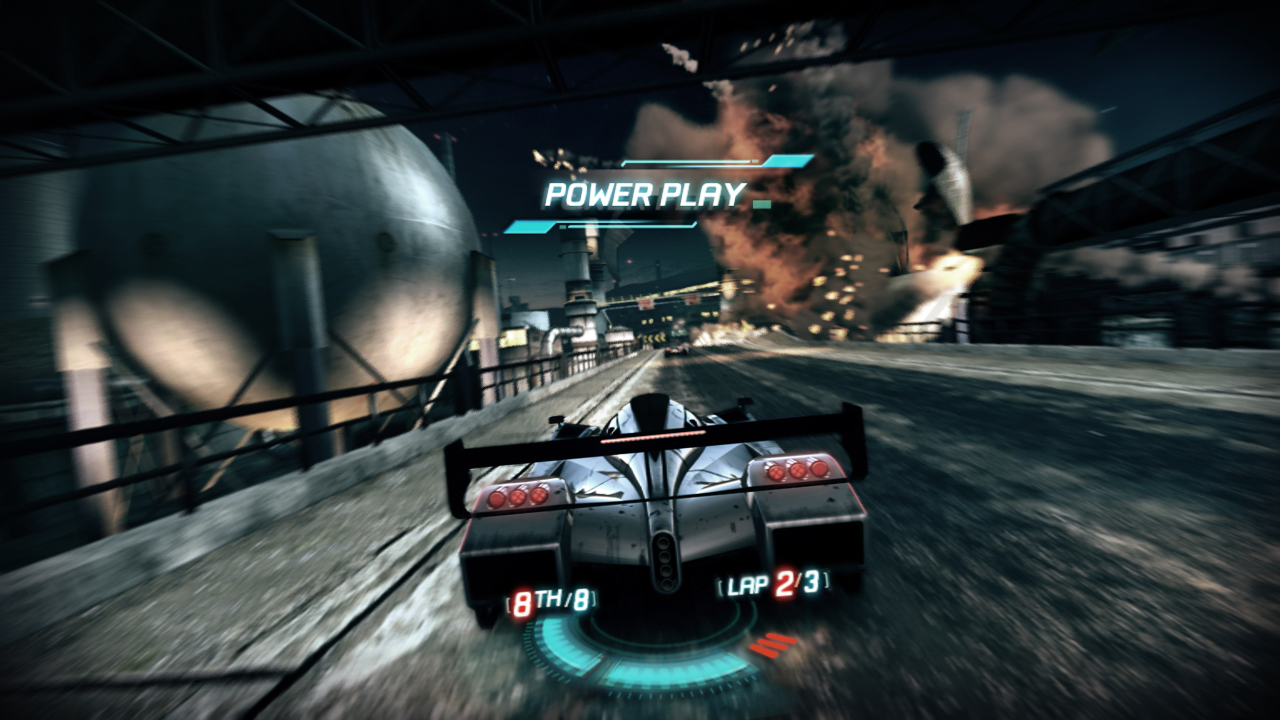
But I'm getting ahead of myself here, as there's nothing terribly self-explanatory about the incredible contrivances that make Split/Second unique, and occasionally great. Speaking broadly, I've taken to describing it as Burnout in reverse--rather than throwing cars at the environments to see what happens, you get your warm-and-fuzzies in Split/Second by throwing the environment at the cars. This Burnout comparison holds up, I think, beyond the concept stage, as Split/Second has a similar zest for destruction, and it too rewards the player for drifting, drafting, and jumping. What you get in Split/Second for your driving derring-do, though, is energy towards a three-part power-play meter. Power plays, in the simplest terms, are explosive environmental triggers you can use to derail, or simply destroy, competing racers--and if you're not careful, yourself--and they are the absolute crux of Split/Second.
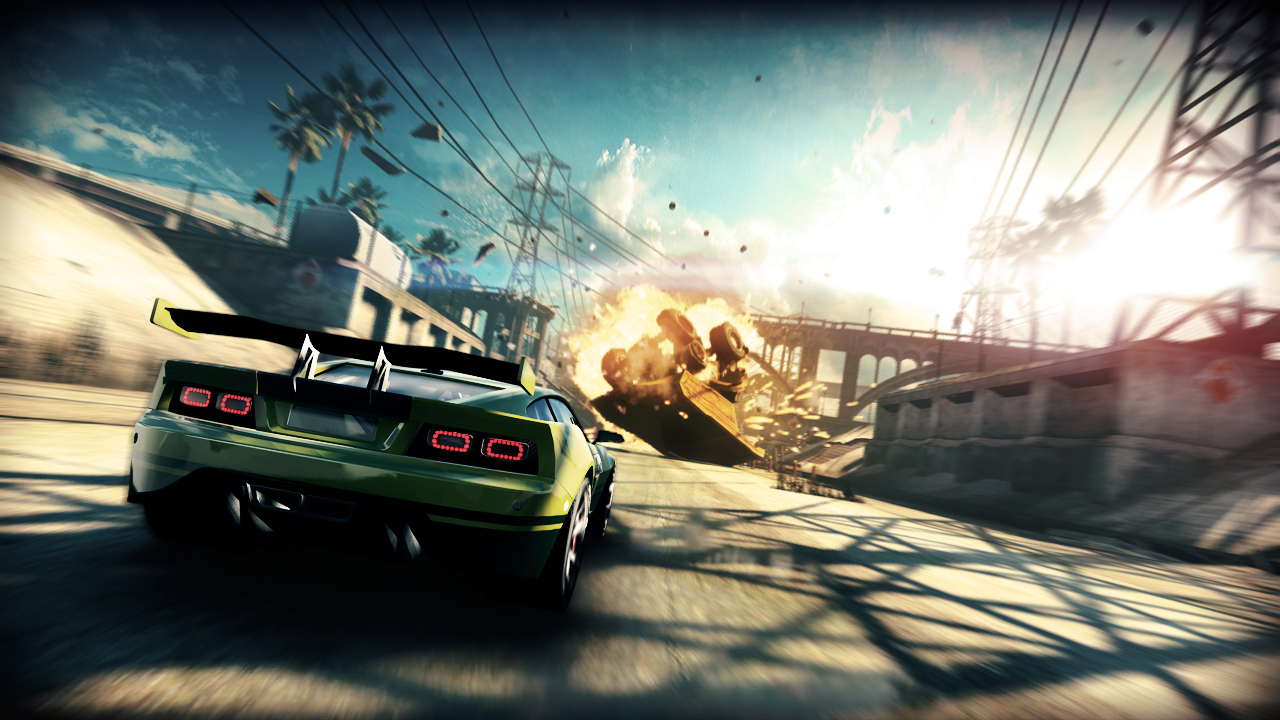
"Power play" is just another word for "fun button." If you've got enough juice in the power-play meter, and the timing is right, you'll see a little icon pop up above the vehicle of an opponent that's in front of you, and with the press of a button, something awful will happen. Each track is littered with power play opportunities both big and small. Some of them you'll see repeated throughout the game, such as buses, semi trucks, and clusters of taxi cabs that will explode out into the middle of the track, or hovering helicopters that will drop explosive barrels on command. The best power plays, though, are unique to the location, and often involve some large structure falling violently onto the track.
You can also tap into your power-play meter to open up shortcuts. Bigger power plays will drain all three sections of your meter, as will the dramatic mid-race course changes, which are really Split/Second's pièce de résistance. Skyscrapers will tip, cruise ships will run aground, and massive dams will crumble with a profound immediacy as you hurtle down the course doing a simulated buck-twenty. Couching these incredible disasters in a racing game is the purest genius of Split/Second, because there's ultimately no avoiding the chaos that's unfurling in front of you--the best you can hope is to dodge the worst parts of it. There's actually a replay option that will occasionally pop up after you've done something truly atrocious, but watching these disasters from a static perspective is comparatively kind of boring.
Split/Second brokers heavily in lookalike landmarks for its mocked-up city, and it seems pretty deliberate that you might be reminded of the Brooklyn Bridge, the Space Needle, or the Hoover Dam while playing the game. There's certainly an extra charge to be had from seeing recognizable structures come tumbling down, but the game is also clear about making the whole thing "safe," at least from a weird, twice-removed psychological standpoint. You see, this isn't a real city. I mean, yeah, it's a video game, so you already inherently know it's not a "real" city. But even within the reality of the game, it's actually just a giant, elaborate soundstage built specifically for an impossibly big-budget reality TV competition called Split/Second, which is kicking off its next season.
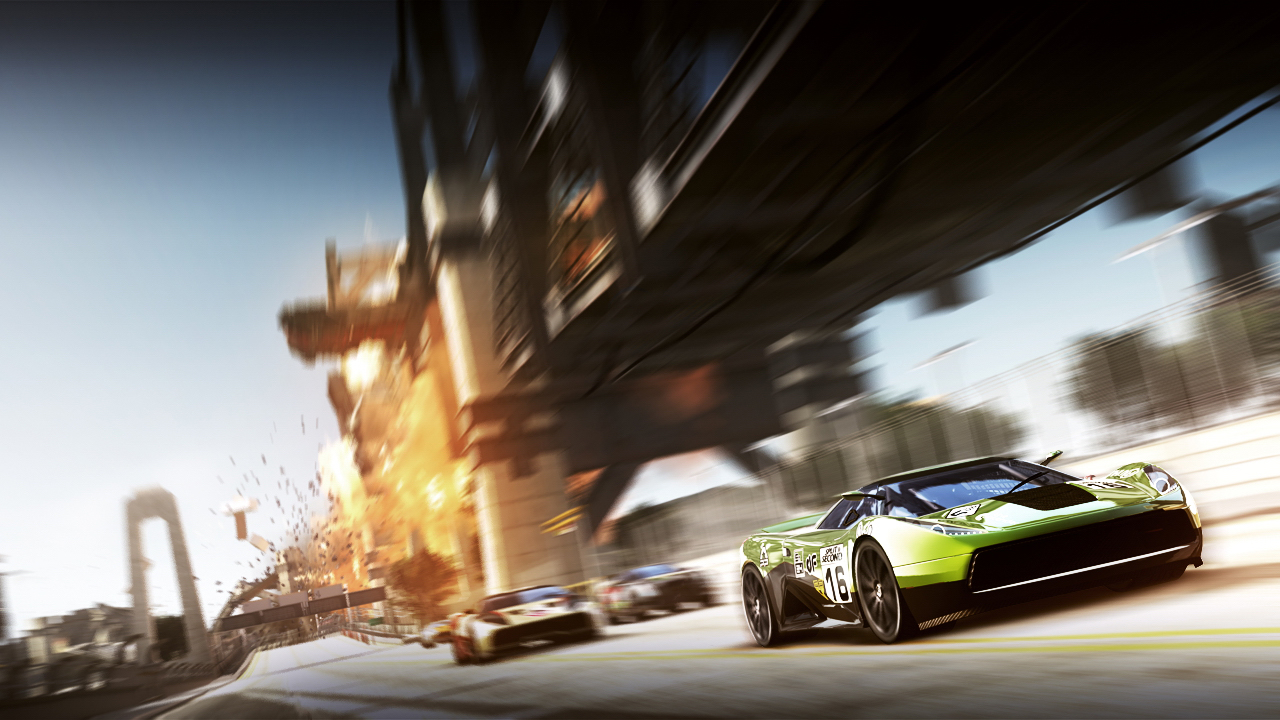
It looks even better in motion. No, really. While the temptation to go all Running Man with the reality competition concept would seem overwhelming--with the evil network execs and the wrongfully imprisoned contestant and the hypocritical hand-wringing about entertainment gone too far--the game uses a surprisingly light touch. The reality show idea mostly serves to justify the power plays, and to provide some structure for the single-player experience, which splits the game up into twelve episodes, each consisting of five races. That's not to say it doesn't commit to the idea, with really keen touches like teaser promos for the next episode that run while the credits for the episode you just finished roll at the bottom of the screen. The quality of the packaging in Split/Second isn't limited to the bumpers, though, as this is from top to bottom a really amazing-looking racing game. The sensation of speed is bracing, all of the explosive environmental effects look top-notch, and the whole game is swathed in verité touches like motion blur, camera shake, light bleed, and some heavy vignetting around the edges of the screen that really amp up the sense of reality. Even if it's not supposed to be a real place within the context of the game, it's so dense with gritty, vulcanized detail that it's convincing enough.
This only reaffirms my hatred of helicopters. There's a lot of straight racing in the single-player season--at least what passes for "straight" in Split/Second--though there are elimination events as well, where the last player in the pack is eliminated at regular intervals, until just one racer remains. There are survival races where rolling semi trucks throw explosive barrels out the back, and you're scored on how many of these trucks you can pass without getting blowed up. The weirdest, and least successful of the single-player events involves you dodging incoming missile attacks from a marauding helicopter. Million-dollar-super-car-versus-military-attack-helicopter is an idea tailor-made for Split/Second, and even on paper it sounds like 27 kinds of awesome, but the scoring is complicated and seems arbitrary, and it goes against the staunchly pro-speed, pro-destruction campaign that the rest of the game rides on.
So some of the events are duds, but the two things that really temper my appreciation for Split/Second are repetition, cheatin'-ass AI opponents, and repetition. Repetition is kind of an inherent issue for racing games in general, since your performance often hinges on knowing, or at least being able to anticipate, what's coming next. But Split/Second is all about the shock of first impressions, and repetition is death for surprises. The first time you see a big location-specific power play go off, you're too gobsmacked by what you're seeing to really react. The second time, you have some idea of what's coming and can prepare yourself accordingly. By the third time you're not even looking at what's blowing up, since, if you're doing the same race three times in a row, you're probably preoccupied with struggling against the aforementioned cheatin'-ass AI opponents.
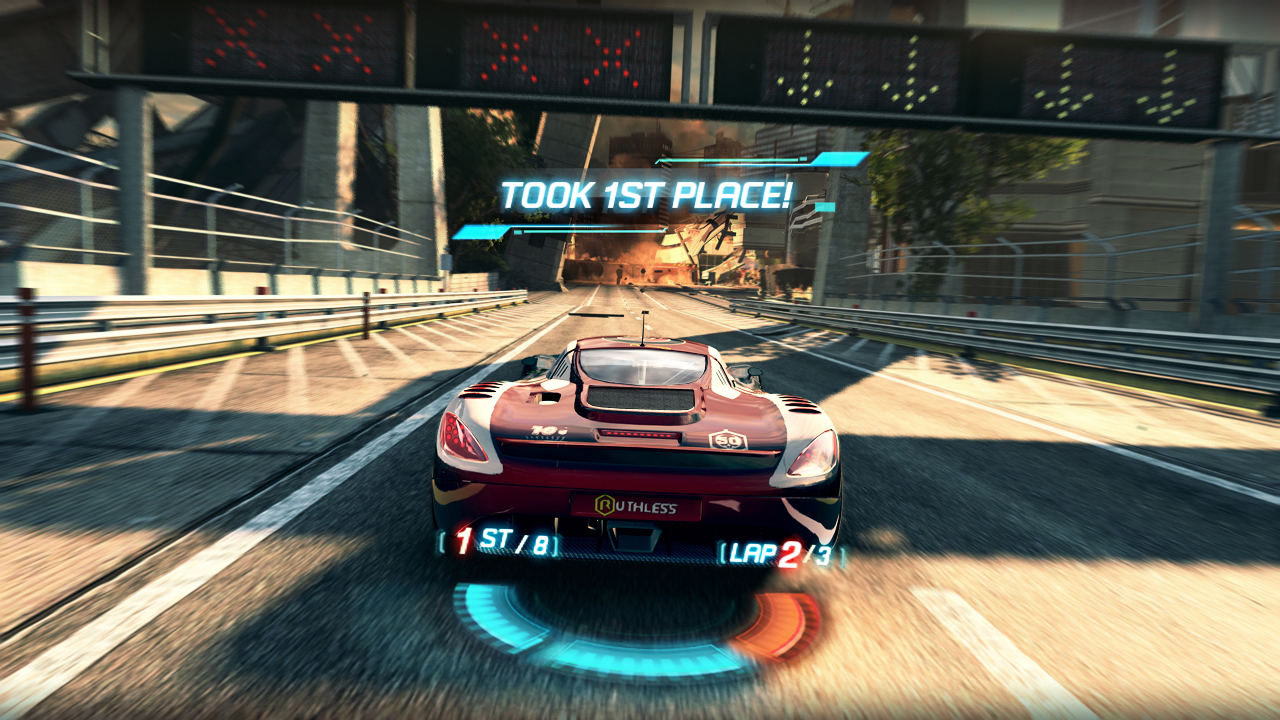
Chances are, you won't stay in first very long. For me, the single-player game actually maintained the illusion that it was putting up a fair fight until I reached about the halfway point. Maybe I was too distracted by all the bedlam, but that's about when I noticed that opponents whose vehicles I had thoroughly outclassed were consistently whizzing past me at the final turn in huge packs, turning my first-place medal win into a worthless fifth-place position. That was also about the point that I realized that, with no recourse against the racers behind you, being in first place in Split/Second is kind of dull, and occasionally frustrating.
This confluence led me to a weird, contrived gameplay style where I would try and outsmart the simple rubberband AI by deliberately hanging out in the middle of the pack for most of the race, only to really break out in the back half of the final lap. The constant chaos already makes it seem like you're barely in control of your fate; the obviously rigged competition makes your impact on the outcome at least feel diminished. Hell, maybe they should've gone for an evil executive subplot after all. The eight-player online multiplayer, as you might imagine, is unfettered by such AI issues, though it's still somewhat affected by the increased familiarity brought on by repetition.
One of the toughest parts of reviewing a video game is assessing how much value to place on, well, value. If you were going by the pure math of hours-to-dollars, Split/Second might not seem great, and in the long-term, there's not a huge amount of replayability here. Yet I can't help but place a high value on my first few hours with Split/Second, which were action-packed with more jaw-dropping thrills than any other recent game I care to recall. While I have a number of concerns about the overall execution of Split/Second, the lows are well worth tolerating for highs that are so good, so crazy, and so face-numbingly intense.