
May Magnanimity: Week 3
by mento
Hey all and welcome back to Week 3 of May Magnanimity, looking at the smaller games from Itch.io charity bundles that may have slipped everyone's notice, as they evidently did mine if I'm only playing them now many months (or years) later. Truth be told I'm stoked to be reviewing tiny Indies en masse again, as I'd often get through a good twenty or so of these bite-sized beauties in a single Ma...
Hey all and welcome back to Week 3 of May Magnanimity, looking at the smaller games from Itch.io charity bundles that may have slipped everyone's notice, as they evidently did mine if I'm only playing them now many months (or years) later. Truth be told I'm stoked to be reviewing tiny Indies en masse again, as I'd often get through a good twenty or so of these bite-sized beauties in a single May Madness and find plenty to write about. It's not like May 2023 saw any big, genre-defining releases to distract me or anything...
Bit of a quieter week overall, dropping from the usual six games to four. Not that I'm trying to keep to a quota as such, it's just that I happened to pick games this time that proved to be longer and more involved than I thought. I've realized trying to eyeball Indies and sort them into size and simplicity—what's straightforward enough to qualify for a rapid-fire feature like this, and what could better use a 1000-word IGotW blog to fully review—is a fool's errand, since simple presentations can often belie a considerable mechanical depth (the reverse is often true in the highest AAA tiers too, of course). Regardless, despite what these brief appraisals might otherwise lead you believe, these four games turned out to be a lot more intriguing than a cursory glance at their Itch.io pages suggested.
(As always, links to previous entries/games can be found at the end.)
MM13: Curse of the Crescent Isle DX
- Developer: Adam Mowery
- Year: 2015
- Status: Complete
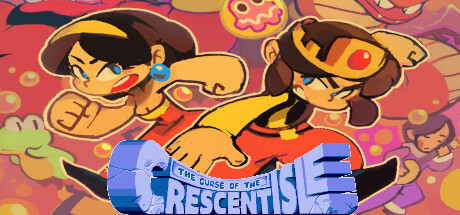
I took one glance at this game and figured it was some sort of riff on WayForward's Shantae; not necessarily an explormer but something along the same lines by way of puzzles based around alternative forms or powers. Turns out Crescent Isle's Arabic theme was hearkening back to a much older game: the FDS platformer Yume Kojo: Doki Doki Panic, the basis of Super Mario Bros. 2, in that all of Crescent Isle's puzzles revolve around the riding/lifting enemy mechanic from SMB2 by way of picking up enemies and using their abilities to make progress past various barriers. The story of the game concerns a kingdom enchanted by a curse and has you—as either the Prince or the Queen of said kingdom, another reference to Yume Kojo's close-knit family of playable characters—attempt to locate the Archmage behind the curse in order to lift it. He's also kidnapped your sister (or daughter) the Princess, due to be wed to a foreign royal, which is another incentive to chase him down. Because of the curse, the former denizens of your kingdom have all been transformed into creatures, which is why the game won't let you kill any of them. Instead, you simply abuse their innate powers to reach the end of each stage: an ice monster will freeze bodies of water, for instance, letting you cross over them safely. You can hold enemies either above your head or underfoot, both stances providing their own applications depending on the foe.
The game's a little on the glitchy side, where it feels like the ambitious mechanics maybe got the best of its developer and some issues proved unconquerable, but for the most part it takes this central conceit as far as it can go, throwing in some coin collectibles and a level select feature for longevity's sake. There's no splits in the path and I'm fairly sure the story with its late-game twist is the same no matter which character you choose. For that matter, the Queen does not have Princess Peach's floating jump or anything of the like to distinguish her from her son, so the choice of protagonist appears to be purely aesthetic. Visually it's going for that aforementioned 16-bit Shantae look with big colorful character sprites and backgrounds, which is a big improvement on the game's pre-"DX" artwork. It's a scrappy game full of minor imperfections and mechanical annoyances but is otherwise an imaginative (or let's say underexplored) idea taken to its zenith.

MM14: Pale Cachexia
- Developer: Argent Games
- Year: 2021
- Status: Complete
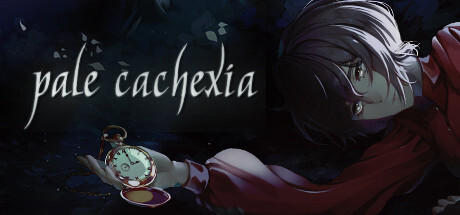
In what's becoming a recurring theme here on May Magnanimity, our second game is another GL-coded visual novel. This one styles itself as a "kinetic" visual novel, which means it has no interactivity of any kind save for the UI required to move to the next line of dialogue. It concerns Esther, a young woman afflicted with a wasting disease called the Pale Cachexia: operating similarly to multiple sclerosis, this condition saps the host's energy leading to days of chronic fatigue and muscle pain with no known cure and a limited number of ways to keep it in check. Esther, once a promising student, has been travelling around the world searching for a cure and in a last ditch effort has entered some foreboding woods to find the lost mansion of a brilliant, reclusive scientist who suffered from the same disease. Instead, she finds the house occupied by the long-dead scientist's teenage daughter, Seina, who has spent the last six years on her own and is excited to have a guest. The duo grow closer as Esther pores over the scientist's leftover notes for a cure, though she grows perturbed by how the former man of science sought answers from the world of the supernatural. She grows more perturbed still when she realizes he might've been onto something.
The game's going for a sort of saturnine Gothic melodrama angle, which had me recalling my time with The House in Fata Morgana, and while the game doesn't quite have the same pedigree it acquits itself handily with its writing, visuals, and music. The character designs for Esther and Seina (and Isaiah, Seina's father, who appears in several flashbacks) are expressive and detailed as are the many background scenes of Seina's mansion and the surrounding forest, the script is flowery and well-edited with a handful of $10 vocabulary words like "finical" and "conurbation", and the understated orchestral music nicely complements the story's tone. Understated might also be a word I'd use to describe the game as a whole, given it's an unhurried, gentle semi-love story between two lonely and self-defeating people gradually getting to know each other, at least one of whom is slowly dying. Definitely a night sitting in a graveyard drinking absinthe while listening to Bauhaus sort of vibe, though that's not to denigrate its subtle appeal if doomed (and mostly only subtextual) romances in vaguely supernatural settings are a thematic genre that speaks to you. I think I still prefer my visual novels to have more game in it by way of decision branches and such—a personal choice, not a grudge I hold against VNs that seek only to tell a linear story—but in spite of everything Pale Cachexia managed to keep my interest for its modest 3-4 hour duration, even if its pace was assuredly on the leisurely side.

MM15: Jetscout: Mystery of the Valunians
- Developer: Okshur
- Year: 2020
- Status: Ongoing
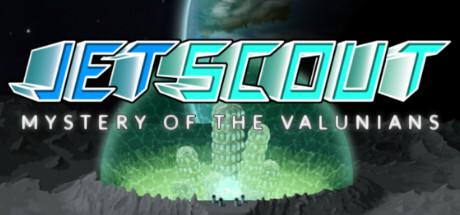
Bless the Indie devs looking to resurrect as many ancient game models as they can in their pursuit of the elusive "nostalgia plus" state of being, where archaic-style games can feel just like they used to if only because of years of subtle game design improvements are working hard in the background. Jetscout recalls Lunar Lander and its many imitators: a very specific style of aerial platformer where mastering thrust, momentum, and inertia are key to avoiding collisions with the surrounding environment. Jetscout has you tackle a series of vertical linear levels as a daring space explorer, carefully adjusting your speed and angle to move around obstacles and hazards. Those obstacles and hazards are distinct to every planet you visit, each of which can have two or more levels of increasing challenge, and the game tracks deaths when determining a score out of a possible three stars. Naturally, only a zero-deaths run qualifies for the full three stars. Thankfully, the default Normal difficulty gives you a single-use replenishing shield so as long as you make it back to a checkpoint (either the next in the sequence or the previous) after getting hit once there's no harm done. You also have to keep an eye on your fuel: this is also replenished at checkpoints, but too much thrusting can be deleterious to your well-being. Glad I paid attention to that lesson in health ed.
This is the sort of punishing, precise game where perfect can often be the enemy of good. It's similar in that way with RedLynx's Trials franchise, where you'll eventually learn to accept a few mistakes in the later courses because the skill ceiling required to achieve zero becomes prohibitively high. That said, perfectionists and completionists will probably hit burnout trying to max everything, and I'm in the same boat: there's the deep frustration faced with leaving a game incomplete or imperfect jutting right up against the equally deep frustration of spending hours trying to ace increasingly insane challenges. Either I conquer my brain worms long enough to settle for a satisfactory result over an ideal one or I drop it like I've done so many masocore games in the past. For now, I'm going to switch my main focus towards other games and will probably hop back in occasionally for as much as I can handle in a single session.
MM16: Rising Dusk
- Developer: Studio Stobie
- Year: 2018
- Status: Near Complete
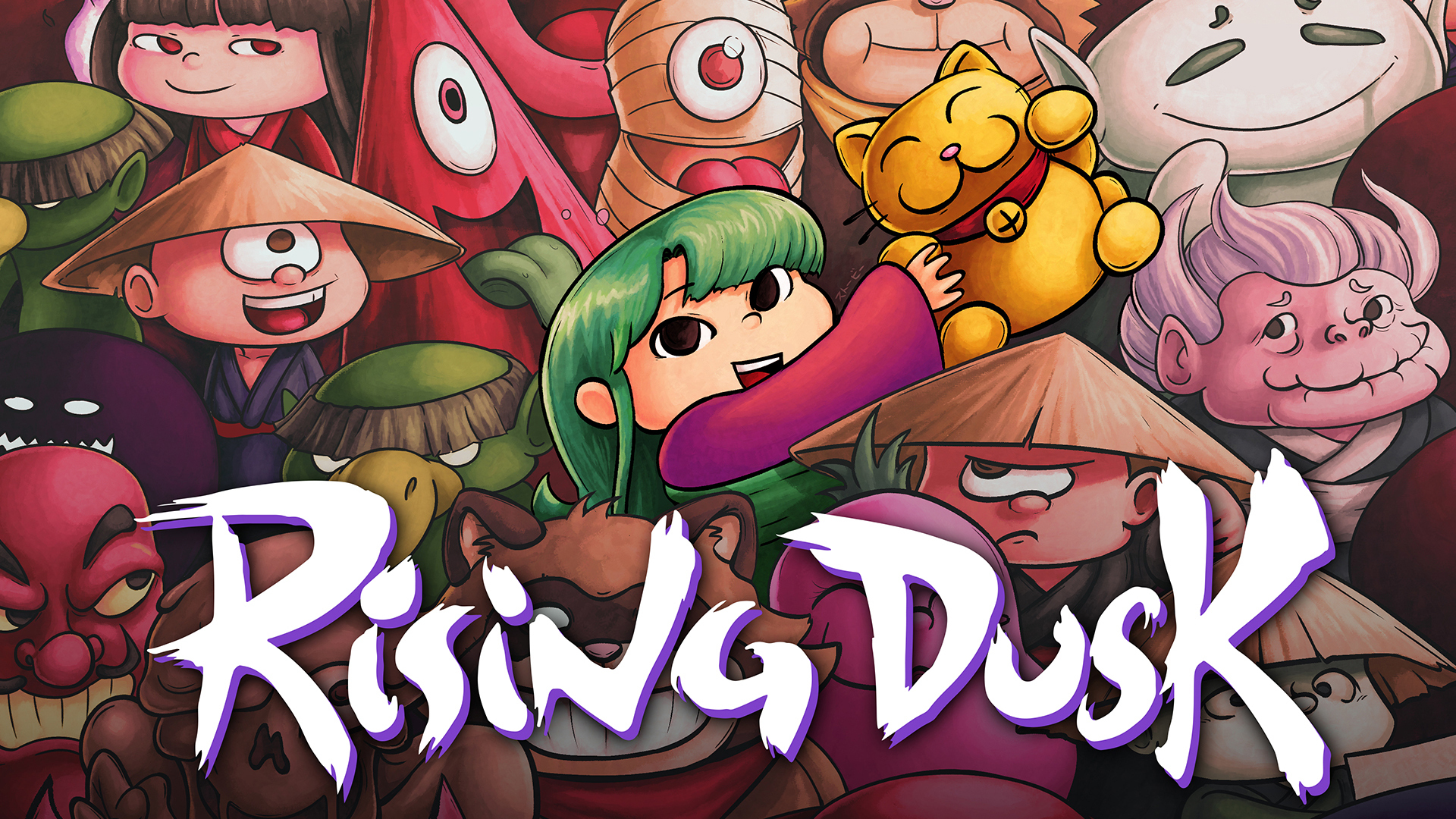
Playing both this and Curse of the Crescent Isle this week has produced a curious pair of bookends of innovative platformers expanding on a concept last explored several decades ago. Many years back Pac-Man wranglers Namco put out an arcade obscurity called Yokai Dochuki (localized as Shadow Land) which based itself on Japanese mythology and in particular that of Jigoku, the Japanese Buddhist equivalent of Hell. To escape his fate, the protagonist had to pass through levels inspired by different regions of Jigoku, but right at the end of the game the protagonist's soul was judged according to various factors, one of which was how much money the player had accrued. It seems Buddhism has a similar take as Christianity with regards to the pursuit of money being inherently sinful so earning too much throughout the game would stick you with one of the "bad" endings, like getting resurrected as an insect. Rising Dusk has a similar theme of Japanese yokai and yurei and other spirits as well as a similar moral lesson about the evils of greed: each of its levels are built in such a way where collecting coins can be detrimental as often as advantageous.
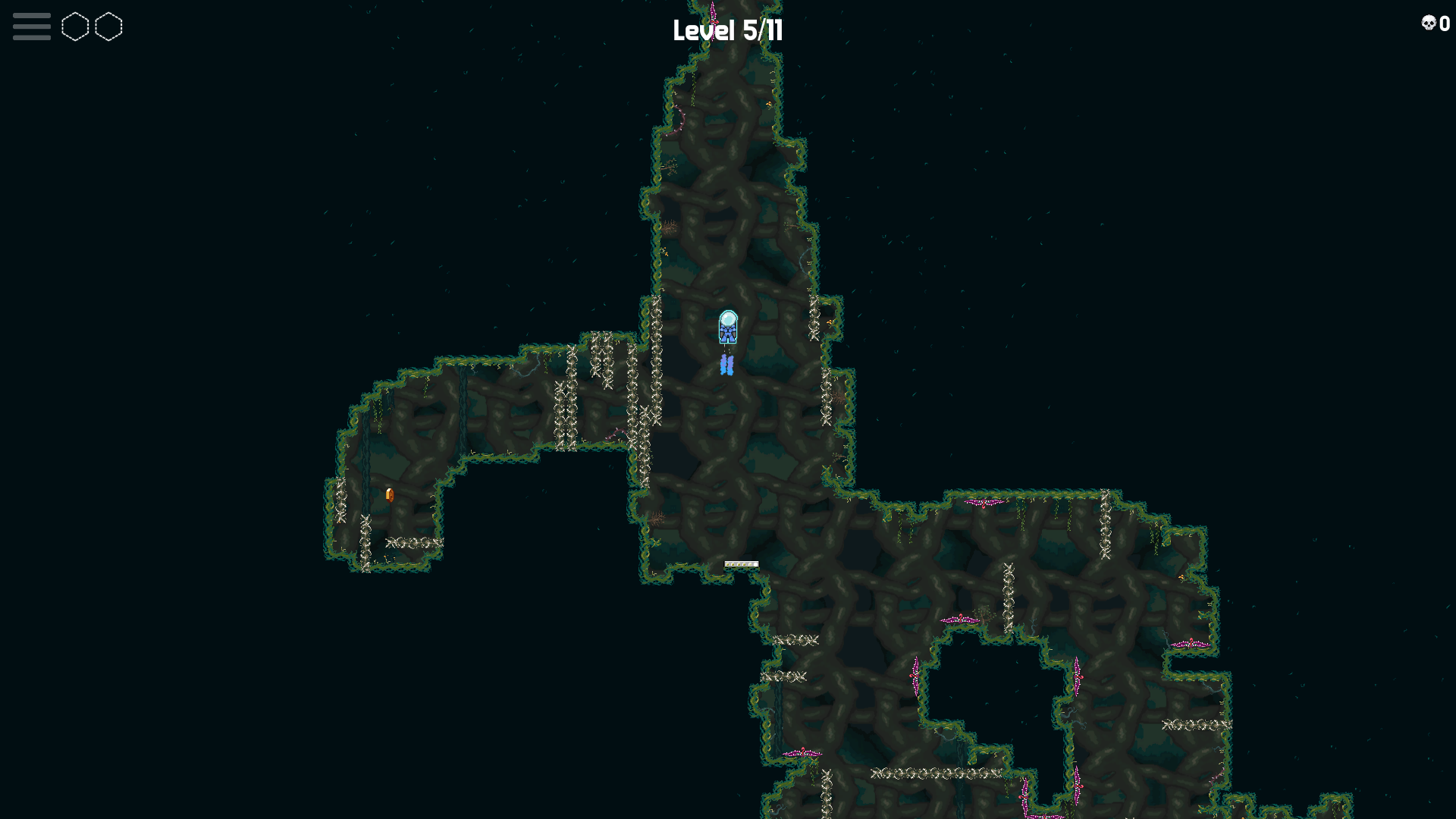
Styled like Super Mario World, complete with alternative level exits that open up its world map in surprising ways, Rising Dusk has you running around yokai-infested levels attempting to reach the end in one piece. A lot of the obstacles and platforms have numbers attached: this indicates how many coins you'd need to exorcise them, which can be useful if they're blocking your path but less so if they're the only thing stopping you from falling down a pit. It's been good practice so far to play a level avoiding every coin and taking note of what collectibles or critical path items require how much (or how little) cash on hand to reach. The thing is, you also need money to buy consumable items and a few other collectibles from the store, so it's not always a bad idea to grab a few coins on the way to the exit. A lot of the levels have special rules as well, often based on the kind of yokai they feature: if a level has tanuki, they'll try to steal coins from you and run off, and depending on the situation you might be totally OK with that. A level full of nurikabe (wall mimics also seen in Nioh, where they need to be placated with the right gestures) flips the rules where it's the other enemies that exorcise them with a touch rather than the player, which might mean drawing an enemy close enough to dispel a nurikabe sitting in the way. The game has no shortage of these ideas and it's been a great deal of fun sussing out each level's rules and how to reach its collectibles, even if the platforming itself can be a little rough. (Also, don't believe its HowLongToBeat entry: it's much longer than a two-hour game, easily double that.)

| Week 1 | And All Would Cry Beware!, Fossil Hunters, Marie's Room, Once Upon a Crime in the West, This Strange Realm of Mine, Miasma Caves |
| Week 2 | Summer Gems, The Adventures of Wolf and Hood, Ynglet, The World Begins With You, MiniNatura, Ecchi Sketch |
| Week 3 | Curse of the Crescent Isle DX, Pale Cachexia, Jetscout: Mystery of the Valunians, Rising Dusk |
| Week 4 | Vignettes, Clash Force, Fatum Betula, Dumpy and Bumpy, Amelie, Oh Jeez Oh No My Rabbits Are Gone |
| Bonus | Sector 781, The Black Iris, Gunmetal Arcadia Zero, Hatch, The Light at the End of the Ocean |