
Mega Archive: Part XLII: From Blades of Vengeance to James Pond 3
by mento
After our sojourn to the futuristic, prismatic land of compact discs we come back down to earth on ol' cartridge land for some more ossified Sega Tapes, freshly exhumed from the dirt of yesteryear. (I swear my opening metaphors are getting worse.) It's now December 1993 and the end of what has been a very exciting year for the Sega Genesis/Mega Drive , living its life at the peak of its popular...
After our sojourn to the futuristic, prismatic land of compact discs we come back down to earth on ol' cartridge land for some more ossified Sega Tapes, freshly exhumed from the dirt of yesteryear. (I swear my opening metaphors are getting worse.) It's now December 1993 and the end of what has been a very exciting year for the Sega Genesis/Mega Drive, living its life at the peak of its popularity without any cognizance of the generational tidal wave that will soon arrive to wash it and its super and/or turbo peers out into the sea of obsolescence to make way for the new 32-bit hotness already on the horizon. The Mega Archive does not yet recognize the existence of the "32-bit era" however, and certainly not this mysterious 32X we keep hearing about, so for now we're going to push on through whatever the holiday rush tossed our way as we spend this and the next two Mega Archive entries fully analyzing the most packed month for the system so far.
This month's batch of ten has a curious dynamic I don't think we've encountered before on Mega Archive: it gets progressively less exciting the further down the list you go. We have some verifiable bangers leading the pack and then, towards the end, a rich vein of forgettable detritus that you've come to expect and love from the Mega Drive during its busiest release seasons. Still, every game is someone's favorite, so I'll be sure to treat them all with the dignity and respect that they—and the teams that worked feverishly to make them happen—deserve. OK, and maybe a few deprecating jokes here and there. I have a quota to keep.
As always, be sure to keep up with this wiki project and its many previous entries by consulting the Mega Archive Mega Spreadsheet in Mega Google Docs World. Starring Alex Kidd. He's in there somewhere.
Part XLII: 521-530 (December '93)
521: Blades of Vengeance
- Developer: Beam Software
- Publisher: Electronic Arts
- JP Release: N/A
- NA Release: December 1993
- EU Release: 1993-12-17
- Franchise: N/A
- Genre: Action / Platformer
- Theme: "Bad" Fantasy B-movies from the '70s and '80s
- Premise: An evil queen who may or may not also be a dragon has taken over the world and only three stalwart warriors stand in her way. Just... not all at the same time. They don't really get along.
- Availability: It's a semi-rare collectors' item. EA doesn't want to resell it anywhere because they're embarrassed about the Huntress in her bikini armor, I suppose.
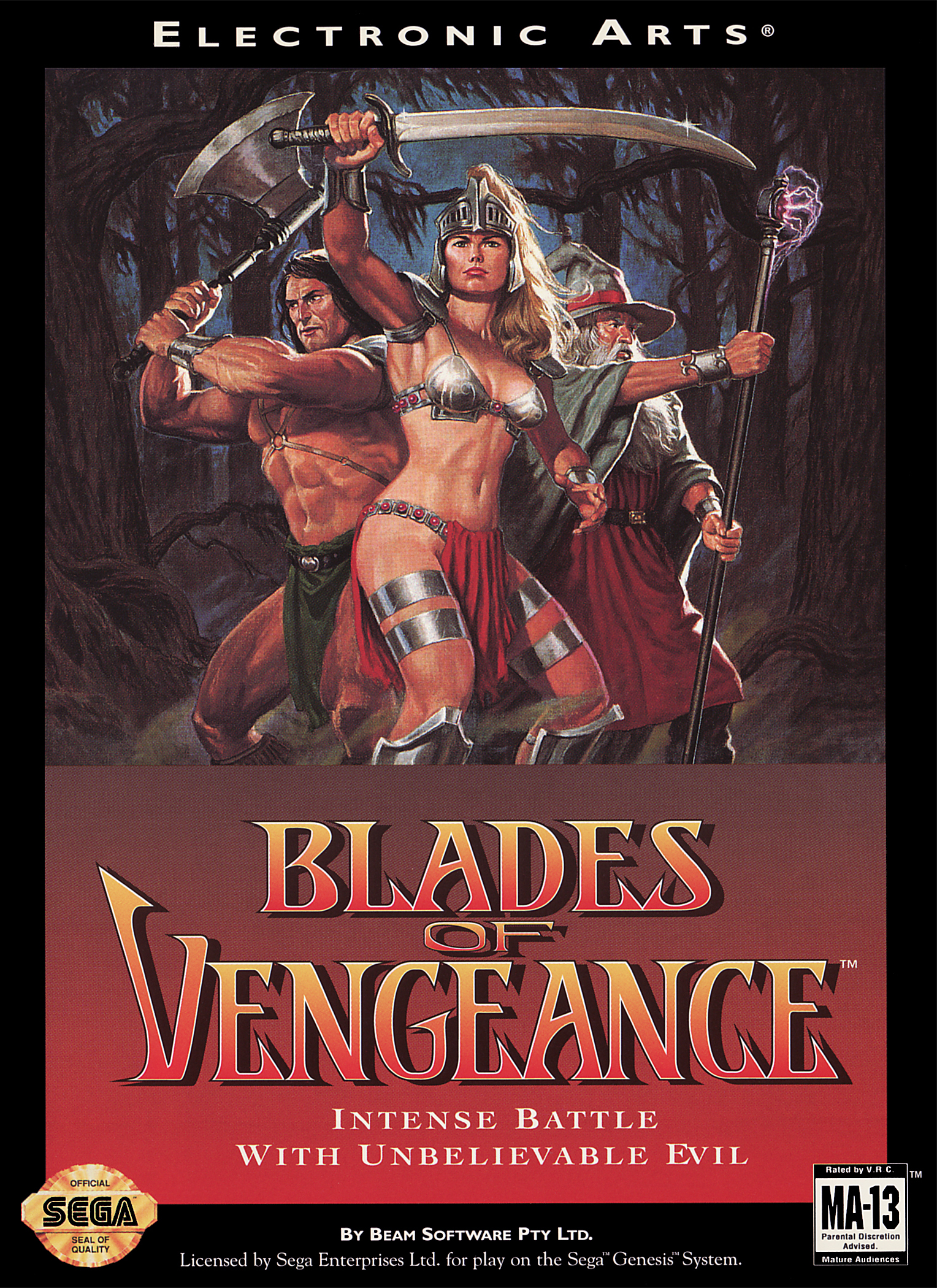
- Preservation: Maybe Blades of Steel for NES ruined my brain but every time I saw this title on the doc I just assumed it had something to do with hockey. Not that the NHL necessarily condones vengeance but I don't think they frown sufficiently hard on it either. All it takes is one Inigo Montoya type decapitating a six-fingered goalie and the league will be caught up in red tape for months. Oh, right, this game: Blades of Vengeance is a Rastan-type platformer where your brawny/sexy Frank Frazetta painting made flesh (or pixels) traipses across a grim, pseudo-Hyborian fantasy world chopping up orcs and lizardmen and what have you. Like a fellow Amiga-esque game on Genesis, Gods from The Bitmap Brothers, there's an emphasis on finding and hoarding consumable items that can serve to get you out of a pickle or else provide succor if you've been taking too much damage. I kind of figured from the screenshots with the playable characters having these giant character sprites that this might be some risible Sword of Sodan business but it's actually not half-bad. Flows and controls well, you're given a means to guard enemy attacks so stuff suddenly spawning from the edge of the screen don't feel quite as cheap to deal with, and the often well-hidden items that can be used at your leisure make a huge difference when exploring.
- Wiki Notes: Releases and screenshots. Something hinky was up with the page: there were tags for screenshots but no screenshots present, which meant the site gobbled them up at some point. Another reminder that our wiki sits on top of several older iterations of itself much like the Poltergeist house with its Indian burial grounds.
522: Castlevania: Bloodlines
- Developer: Konami
- Publisher: Konami
- JP Release: 1994-03-18
- NA Release: December 1993
- EU Release: March 1994
- Franchise: Castlevania
- Genre: Platformer
- Theme: Additional Sensitivity Training for Segway Knight
- Premise: With no Belmonts available, John Morris and Eric Lecarde set out to foil the latest resurrection of Dracula in the midst of World War I.
- Availability: It's on the first Genesis Mini. It's also included in the Castlevania Anniversary Collection from 2019, available on previous-gen systems and Steam. If you have a premium sub for Switch Online you can play it there too.
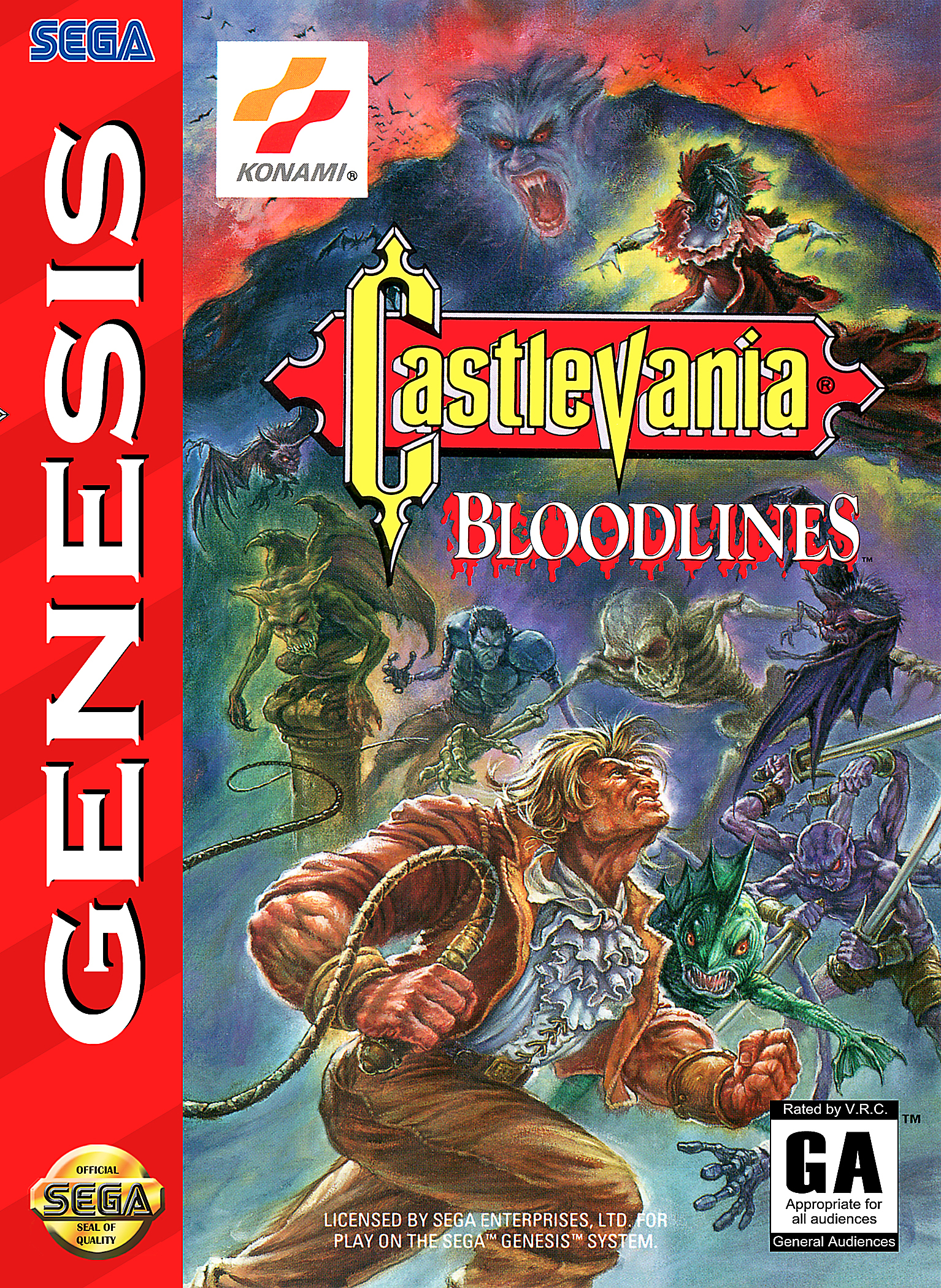
- Preservation: Here we have Konami's big vampire-slaying franchise making its long-awaited debut on the Sega Mega Drive (or for any Sega system), presenting one of a three-pronged approach with Konami releasing unique Castlevania games on Genesis, the SNES (with Super Castlevania IV), and the TurboGrafx-CD (with Castlevania: Rondo of Blood). Each game plays to their respective consoles' strengths, creating a sort of "testing of the waters" that the series would later go on to perform with its N64 (with Castlevania) and Nintendo DS (with Castlevania: Dawn of Sorrow) debuts and their console-specific features too. With regards to the Genesis, Bloodlines trucks along at a much faster pace befitting the home of blast processing and Sonic the Hedgehog, overall creating a more arcade-like feel compared to the steady, cautious approach of its NES forebears. Bloodlines also has some odd continuity, officially drawing into its world the events of the Bram Stoker novel to create John Morris, son of the book's vampire-slayer Quincey Morris, and adding a secondary protagonist in the form of Spaniard Eric Lecarde. Morris is the series-traditional whip-wielder while Lecarde offers an alternative with his spear and wind magic. Bloodlines's status in the Castlevania timeline was later cemented further with Castlevania: Portrait of Ruin, which features John's son Jonathan as a protagonist and also Lecarde himself as a middle-aged ghost whose twin adult daughters are vampirized henchwomen that you must destroy (or perhaps cure). It's also the most recent game in the series chronologically excepting Portrait of Ruin and the Sorrow duo set in the modern age: this means the game can tinker with some Victorian-era steampunk and other mechanical advancements for its monsters and level design, though in the past these anachronisms were always explained as vampire/demon culture and technology being light years ahead of that of the humans (the Netflix show even references this too). Sorry, this is the only Castlevania game we're ever going to get on this feature so I've no other opportunities to unload about Castlevania lore like this. As for the game, I believe you'll get all the details you could ever want by watching Giant Bomb's Vinnyvania series on it. Definitely one of the site's more memorable playthroughs of the franchise.
- Wiki Notes: Page was fine as-is. The original release date was the sticking point for me. SegaRetro always cites where they get their release data so I've no reason to believe they're incorrect here (nor the December 1993 edition of GamePro, from which they picked up the date) and yet there's a great many sources suggesting a near same-day global release in March which, well, coordinating something like that back in that era was much harder than it would be now. I went with the earlier date just to be safe.
523: Dr. Robotnik's Mean Bean Machine

- Developer: Compile / Sega
- Publisher: Sega
- JP Release: N/A
- NA Release: December 1993
- EU Release: January 1994
- Franchise: Puyo Puyo / Sonic the Hedgehog
- Genre: Puzzle (Competitive)
- Theme: Snooping As Usual
- Premise: Dr. Robotnik and his minions (the ones from the Adventures of Sonic the Hedgehog cartoon, specifically) are getting tired of being beaten up by a blue rodent, so they all decide to just get really good at Puyo Puyo instead.
- Availability: The first Genesis Mini has it. You also can buy it directly from Steam or play it on Switch Online with a premium sub. It's been in a bunch of Sonic compilations too.
- Preservation: I can't begrudge Compile letting Sega give their billion-yen bean-stacking franchise a Sonic-styled facelift given the same thing happened on SNES with Kirby's Avalanche. If anything, those two games gave a generation of western 16-bit gamers their first experience of flicking the- uhh, wait, flipping the beans and converted them into Puyo Puyo fans for life. Compile's Puyo Puyo franchise spun-off from their cutesy Madou Monogatari RPGs as has been previously discussed already (in Part XXVII to be exact) and went on to completely eclipse their origin in popularity, creating what is probably the second-most beloved competitive block-stacking puzzle game that perhaps saw its global appeal again peak recently when it was combined with the first-most beloved in the Puyo Puyo Tetris crossover series. Dr. Robotnik's Mean Bean Machine is more or less a reskin of that first Puyo Puyo to hit the Japanese Mega Drive with a bunch of Sonic cartoon characters to give westerners something recognizable to latch onto (and perhaps because playing a female kindergartner wasn't really a priority for most Genesis users at the time). Japanese players wouldn't get to see this version of the game until a 2000 PC compilation: I guess to them it had the same mythic status as the overseas Super Mario Bros. 2 ("they really reskinned that weird Doki Doki Panic game? Those Americans sure are kureijii").
- Wiki Notes: All good already. I've actually given this page a once over before, all the way back in 2015. I've no idea what wiki project I would've been on at the time. Possibly GDQ related?
524: Eternal Champions

- Developer: Sega InterActive
- Publisher: Sega
- JP Release: 1994-02-18
- NA Release: December 1993
- EU Release: 1994-01-16
- Franchise: Eternal Champions
- Genre: Fighter
- Theme: A Fight to the Opposite of Death
- Premise: A group of dead souls compete with one another to be sent back to Earth at the moment of their untimely demise. Just have to get past this one glowy guy first.
- Availability: It's on the first Genesis Mini and on Steam as a standalone game. There's also the enhanced Sega CD version, Challenge from the Dark Side.
- Preservation: Eternal Champions was designed by Sega of America, through their new intermediate InterActive, to be the first big native Sega fighter built from the ground up to compete with the likes of Street Fighter II and Mortal Kombat on the Genesis. Ironically, elsewhere in the world at that very moment in time, Sega of Japan was putting the finishing touches on the first Virtua Fighter arcade cabinet: a series which it would be fair to say went on to bury Eternal Champions and establish itself definitively as Sega's fighter game powerhouse. Still, though, does Virtua Fighter have a cyber-kickboxer or a biochemist vampire who fought in the 'Nam? Any 'Nampires whatsoever? No, didn't think so. The story of the game is that a group of vengeful souls fight each other in the underworld for a chance to be revived and complete their unfinished business on Earth, as facilitated by an enigmatic being calling itself the Eternal Champion. Said soul will also have to defeat him to prove their worthiness as he only has the energy for one shot at this and given his name it's not like he doesn't have all the time in the world to wait for a corpse who wants out badly enough. It's really an excuse to do time-travel without actually doing time-travel, letting the character artists play around with fighters from multiple chronological settings. Kinda feel bad for the caveman going up against the dude with the plasma rifle. After this, we'll still have three more MD games from Sega InterActive, all of which are licensed games involving cartoon cats. Good that Sega found an effective use for their new studio.
- Wiki Notes: Just cleaning up the releases.
525: F-117 Night Storm

- Developer: Electronic Arts
- Publisher: Electronic Arts
- JP Release: 1994-05-27
- NA Release: December 1993
- EU Release: January 1994
- Franchise: N/A
- Genre: Flight Simulator
- Theme: Night Storms are a Little Conspicuous. Why Not Just Call Your Stealth Bomber "Loud Thunder and Bright Lightning, Look at Me, Look at Me"?
- Premise: Fly a F-117 Night Storm, or EA's creative interpretation of same, into various 3D missions with what little polygonal power the Genesis can muster.
- Availability: Never ported or rereleased. Flight sims tend to age quickly.
- Preservation: If EA got anything right during the Genesis era—and they certainly did well for themselves make no mistake—it's in how proficient they were in the arena of "dad games". That is, the sort of games your dad would hypothetically enjoy if he partook in the hobby: sports, military vehicle simulators, and the occasional dense thinky strategy game were the fields in which EA excelled during the 16-bit era and beyond. Even though I myself am well within the average age range of dadness I still find every other EA game on here a snoozefest and the dry flight sim F-117 is certainly no exception. However, this game does interest me a little bit because EA, much like they did with the theoretical titular aircraft of F-22 Interceptor (which, at the time, didn't exist yet), had to invent a lot due to the specifications of the actual F-117 stealth bomber being a closely-guarded military secret. That meant nutty things like giving the stealth bomber a machine gun and missiles for dogfights, even though the whole point was to sneak into airspaces and drop bombs before anyone could discover its presence. From what it sounds like (and from what little I played) they fully went for realism over gameplay quality and the game paid the price for that. Though that said, the games press at the time still tended to prioritize graphics over everything else and regarded it well enough. It really was a miserable time for video game coverage. Not like now, where well-written reviews are both lauded and sought out by Gen Z-ers and the internet games press is as healthy as ever. Sigh. Maybe I am too much of a dad after all, even without the requisite offspring.
- Wiki Notes: A bit of everything. Much like internet usernames, any video game title with numbers in it is soon ignored and forgotten.
526: FIFA International Soccer

- Developer: EA Canada
- Publisher: Electronic Arts
- JP Release: 1994-06-10
- NA Release: December 1993
- EU Release: 1993-12-03
- Franchise: FIFA
- Genre: Soccer
- Theme: Soccer
- Premise: Soccer
- Availability: EA's still making these annually. Just without the "FIFA" brand these days. Presumably that also means they took out the feature where you only play as the team that offers you the biggest bribe.
- Preservation: EA had by 1993 cornered the market on most of the big American ball-grabbing pastimes but the real earner, globally speaking, was the noble sport of faking injuries for sympathy free kicks and yelling racial epithets from the crowd: that of soccer, otherwise known as football almost everywhere besides the USA. Joining forces with FIFA, the sport's absolutely incorruptible international governing body, EA created the FIFA brand and gave soccer their own twist with what was (until the 3D era) a visual trademark in its isometric perspective. The isometry made it easier to read who was close enough for a pass while still giving players enough space to set-up attempts on the opposing goal, including the usual chaos that results from corner kicks. As the franchise was still finding its feet(ball), it forwent national leagues and stuck primarily to the international sides seen in events like the World Cup while using fictional player names. Needless to say, there'll be plenty more annual FIFA games on Mega Archive from here on out: at least five by my reckoning. Yay.
- Wiki Notes: SNES double-dip. Some minor clean-up here and there.
527: Fun 'n' Games

- Developer: Leland Interactive Media
- Publisher: Tradewest (NA) / Sony Electronic Publishing (EU)
- JP Release: N/A
- NA Release: December 1993
- EU Release: January 1994
- Franchise: N/A
- Genre: Minigame Collection
- Theme: Games 'n' Fun
- Premise: Mario Paint was a neat idea but it only had the one kinda bad mini-game that was only fun for five minutes. Why not have several of those?
- Availability: There was a slightly later version for 3DO with CD enhancements if you really enjoyed wasting money. I figure you would if you already have a 3DO.
- Preservation: Fun 'n' Games would be the second art creation program for the Mega Drive after 1991's Art Alive but has instead chosen to follow Mario Paint's example in introducing more features as respites including music composition and mini-games. ADHD became a diagnosable condition in the early '90s and this game almost seems purpose-built to address it. As well as creating your own dubious artistic masterpieces with the Genesis Mouse there's also an early internet-esque dress up game, an "exquisite corpse" style mix-and-matcher, the aforementioned music tools, and the mini-games Mouse Maze (bad Pac-Man), Space Lazers (bad Star Raiders), and Whack-a-Clown (bad Whac-a-Mole). The last of those, the clown one, was apparently exclusive to the Genesis version of Fun 'n' Games so there's some added value for all you Sega owners. Truly the envy of the playground, being the only ones who could make poor old Pagliacci's day even worse.
- Wiki Notes: SNES double-dip. Just some Genesis-related screenshots and releases. Working on this page again meant I got to see my hand-drawn Bomby abom(b)ination in the background once more.
528: Greatest Heavyweights

- Developer: Malibu Interactive
- Publisher: Sega
- JP Release: 1994-05-27
- NA Release: December 1993
- EU Release: January 1994
- Franchise: N/A
- Genre: Boxing
- Theme: Defeating Dead Boxers Sure Sounds Easier Than Live Ones
- Premise: Put on the gloves and stick in that weird fluorescent gum thing because you're not only fighting the best boxers in the world but also the best that ever was.
- Availability: Licensing all this again sounds like it'd be a nightmare.
- Preservation: We're going to float like a butterfly and sting like when I pee in this, the seventh boxing game to grace the Sega Genesis. The engine of Greatest Heavyweights is based on that of Evander Holyfield's "Real Deal" Boxing and so it could be considered a sequel of sorts, however the idea here is that you're fighting against boxers both past and present: Holyfield returns, but we also have the likes of Muhammad Ali (licensed from Virgin Games for some reason), Joe Louis, Jack Dempsey, and Rocky Marciano. Mostly dudes that were not only long retired by 1993 but long dead also, making the game feel a little ghoulish in retrospect. Then again, if you were to invent time travel, why wouldn't you use it to beat up famous people for money? (Just a reminder: Acme Interactive, the developers of Real Deal Boxing, and Malibu Interactive are one and the same. It's just that they since got bought and merged into Malibu Comics as their game development branch.)
- Wiki Notes: Mostly everything, besides the body text which I just had to clean up a little for style guide purposes (2nd-person and past tense, the double whammy!). SegaRetro seems to think Sega took on development of this Real Deal Boxing sequel themselves, seizing the wheel from Malibu, but it's mostly the same people who worked on both so I'm not so sure. It does have a "Sega Sports" logo on the pre-title screen though, so I can see where they're coming from.
529: Home Alone 2: Lost in New York

- Developer: Sega
- Publisher: Sega
- JP Release: N/A
- NA Release: December 1993
- EU Release: N/A
- Franchise: Home Alone
- Genre: Platformer
- Theme: The Castle Doctrine for Grade-Schoolers
- Premise: Isolated and alienated in the great city of New York, a creative young man is pushed to the brink after being hassled by criminals, greedy business owners, and the homeless and decides to take matters into his own hands after procuring some power tools. Whoops, that's the premise of The Driller Killer. Weird that I got that confused.
- Availability: Licensed game, so nope. "Video games based on the Home Alone franchise" is probably the last item I'd put on my Digital Eclipse compilation vision board.
- Preservation: The movie Home Alone 2 showed up towards the end of 1992 two years after the previous and sees the precocious yet easily forgettable Kevin McCallister abandoned once again, only now in an unfamiliar city. While the first half of the plot deals with Kevin surviving in a town that, if film depictions across the 1970s and 1980s were to believed, is the last place you'd want to lose a child the second half falls into a familiar pattern of absolutely destroying the two idiot burglars played by Joe Pesci and Daniel Stern with household goods in a mid-renovation townhouse (owned by the same uncle who had the house in Paris from the first film; just how rich is this family?). What I always found wild about Home Alone 2 is that it has both a woman getting graphically groped in the street and Donald Trump and yet they're not part of the same scene somehow. This game is actually one Sega developed themselves in-house: it follows Dick Tracy and Jurassic Park as being licensed movie tie-ins that Sega put some decent amount of effort into crafting. That's not to say I would wholeheartedly recommend the modest platforming charms of Home Alone 2 on Genesis but it's maybe not the bottom-shelf, half-assed cash-in you might've anticipated (or would find on Nintendo systems thanks to Imagineering).
- Wiki Notes: SNES double-dip. Just screenshots.
530: James Pond 3: Operation Starfish

- Developer: Millennium Interactive / Vectordean
- Publisher: Electronic Arts
- JP Release: N/A
- NA Release: December 1993
- EU Release: 1993-12-14
- Franchise: James Pond
- Genre: Platformer
- Theme: A Fin-ale to this Gill-ology of Sea-cret Agent Platformers
- Premise: James Pond takes on his human namesake's most popular movie, Moonraker, by traveling to space to foil the latest scheme of Dr. Maybe. What? Nahhhh, Moonraker isn't terrible and embarrassing. It has lasers in it.
- Availability: Besides a regrettable iOS sequel in 2011, the James Pond franchise has been dormant(a) since the 16-bit era(y).
- Preservation: Here we are, the very last James Pond game we'll ever see on the Mega Archive. Just as well, as I ran out of fresh fish puns some time ago. Adjusting from the minor misstep of the sporty, button-mashy The Aquatic Games, the third-for-real James Pond game sees us back in classic platformer territory as the titular underwater agent's latest mission takes him to outer space and the moon, where there are no oceans (though I guess there's a sea of tranquility). New features include a playable frog companion (he needs to be rescued first) and a semi-open world progression with its alternative paths across an overworld map, similar to Super Mario World. Beyond that it doesn't really stand out as much as the previous game, Codename: RoboCod, having completely retconned the whole "James Pond is a cyborg now" plot development and returned him to being 100% fish. That also means no more of that visually repugnant but mechanically intriguing body-stretching feature that led to a lot of verticality in the level design. I dunno, as an Atari ST-owning Brit I'm ostensibly the audience for these goofy, self-deprecating fish platformers but I'm not sure I ever had the emotional investment to see any one of them through to the end. James Pond is no Dizzy, is all I'm saying.
- Wiki Notes: SNES double-dip. Minor clean-up.