Vanillaware's lush and layered visuals and the game's razor-sharp combat elevate Muramasa well beyond your average brawler.
There's an incredibly strong sense of style at work here. Since the ascension of polygons as the de facto method of rendering video games, I've often wondered: what if the switch from 2D to 3D had never happened? What would games look like today if all the time, money, and effort spent developing polygonal technology had instead been poured into the 2D sprites that had served us all so well through the 8- and 16-bit eras? (I've also fantasized about a world where FMV games are the dominant format, but that's not really relevant here.) Japanese developer Vanillaware's existence seems predicated on trying to realize that vision, and its latest, Muramasa: The Demon Blade, is an absolute visual triumph. Even if it didn't also offer a distinctive take on the dynamics of the traditional 2D brawler, Muramasa is such an incredible pleasure to see in motion that it could easily skate by in its good looks alone.
Much like how Vanillaware's PlayStation 2 action RPG Odin Sphere mined Norse mythology for its story and setting, Muramasa delves into the weird and mystical past of feudal Japan, a world populated with shoguns, evil monks, samurai, and ninja, as well as talking foxes, evil spirits, ethereal swordmakers, and demon gods. It's a surreal world where political intrigue and cultural hierarchies extend to the realm of the supernatural, and Hell is literally within walking distance.
There are two main quests in Muramasa, and each tells a different character's story. There's Momohimo, a young noble girl whose ill-fated plans for marriage are crushed completely when her body gets taken over by the spirit of a powerful and unpleasant swordsman named Jinkuro, who needs Momohimo's body to complete his sword-based plans. The other story concerns a disgraced young ninja named Kisuke who suffers from amnesia on a quest to find a special sword. Though they intertwine at a few key spots, the stories are largely independent from each other, and generally well-told, without smothering the player in overwrought melodrama or hammer-subtle broad comedy. Both plots definitely benefit from the florid use of Japanese mythology, and the (presumably cost-saving) decision to retain the original Japanese voice work also adds to the sense of verisimilitude. I'm not all that familiar with Japanese mythology, but this is all just bizarre enough to feel totally accurate.
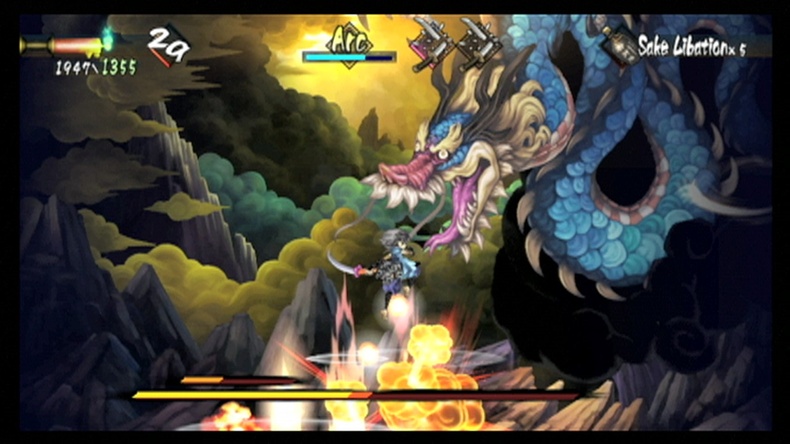
The importance of having the right sword for the situation cannot be stressed enough. All of this serves as a wonderfully colorful backdrop for you to murder all manner of corporeal and supernatural fools on. There's a simple elegance to the way Muramasa handles. This is, essentially, a three-button game--one to attack and block, one to unleash a sword-specific special attack, and one to switch between swords--with all movement assigned to the analog stick. It's pretty button-mashy throughout, but to mistake its simplicity for ease would be foolish. On the harder of the two difficulties, it's not long before careful management of your swords and health items are key to survival, particularly during the ridiculously detailed, screen-filling boss battles. What variety of action that Muramasa does offer largely comes from the various swords you'll handle over the course of the game. The name Muramasa is actually that of a pan-dimensional swordmaker who lends you his talents in exchange for the souls of your fallen enemies. Though you can only have three swords equipped at a time, there are over a hundred swords to be unlocked. There are two general categories of swords, and it's a speed versus power thing, though there are a number of unique special attacks to consider as well. There's a certain amount of mixing and matching of features being done to achieve that high sword count, but having the right swords at the ready can make all the difference in certain situations.
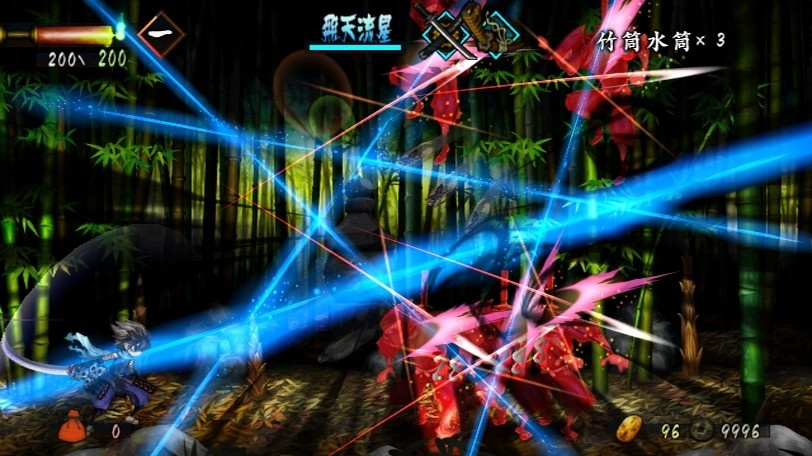
Though it features certain RPG affectations--such as experience levels, equipment upgrades, and a non-linear world map--Muramasa is essentially a brawler, albeit one with a somewhat unusual format. The basic flow of the game has you traveling from one location to another, with your progress regularly interrupted by some kind of ambush, be it by samurai, ninja, ghost, demon, or a swarm of hairy eyeballs. With a few exceptions, the battle sequences are contained events, once you must deal with before you can continue on your journey. It creates an interesting rhythm of tension-and-release--you'll fight furiously for 30 seconds, then sprint your way through a few beautifully rendered backdrops before squaring off with another gang of villains.
It's difficult to articulate just how breathtaking this looks in motion. Muramasa would be an interesting little curiosity if Japanese mythology and genre-blending were all it had to offer, but it's the game's hand-drawn art style that truly makes it something special. Owing much to both traditional Japanese watercolors and modern anime, Vanillaware has conjured up a visual style that is distinctly and throughly Japanese. The character animations are fluid, and all the environments, from rolling countrysides to dense, paper-walled cities, is rendered with incredible detail. The game also has a bit of an infatuation with the pseudo-3D effect of parallax scrolling. It's not uncommon to see up to ten distinct layers on a single screen, a move that goes well beyond simply trying to create a false sense of depth and becomes a prominent stylistic choice. The game's not shy about modern technology either, as there's plenty of lighting and particle effects subtly integrated into the picture. If there's one complaint I have about the visuals in Muramasa, it's that the Wii can't present them at a higher resolution. It looks great, but at 720p, it could've looked even better.
For all it's got going for it, though, Muramasa's problem is that it simply overstays its welcome. This is a good 14-hour game, and the gameplay cannot support that kind of play time. I found myself wishing that the game was about half the length it is, which would've left me satisfied, rather than fully exhausted. Playtime notwithstanding, Muramasa is a pretty special experience. There's a lot of craft in this game, and it manages to celebrate past glories while still feeling fresh and original.