Overview
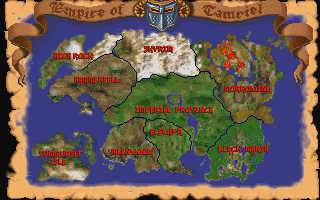 A map of Tamriel and its provinces.
The Elder Scrolls: Arena is the first game in the long running and award-winning Elder Scrolls series. Like the other games in the series, Arena is an open-ended first person RPG. The game was developed and published by Bethesda Softworks for the PC and released in 1994.
The name "Arena" comes from the original conception of the game, when it was to be a gladiatorial action game. The game would have the player's team of fighters competing against those of other cities, culminating in him becoming grand champion in the Imperial City. As more and more RPG elements crept into the game, it was decided to abandon the arena-fighting idea completely. Since packaging and other marketing materials had already been printed with the original name, it was retained. It was explained, in-game, by the idea that since the world of Tamriel was defined by brutal wars and conflict, both mortal and immortal, it was often called "The Arena" by its inhabitants. A trace of the game that might have been still exists in the final version, as a text file containing names of each cities' fighting teams, along with a brief description of each. The fourth game in the series, Oblivion, contains an homage to this idea, as the posters seen in the Imperial City arena closely resemble the box art of the deluxe edition of Arena.
Though the game missed its initial holiday release date, and its initial distribution was only 3,000 units, it managed to become a cult success based on word-of-mouth excitement by players. Despite a harsh reception by critics for its bugginess, and the high system requirements for the time, the game was successful enough to justify an even more ambitious sequel. This sequel, Daggerfall, would go on to introduce many of the gameplay features and lore elements that continue to define the series today.
Plot
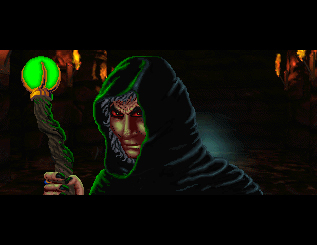 Jagar Tharn, the villain of Arena.
The traitorous battlemage Jagar Tharn has trapped Emperor Uriel Septim VII (the introduction of the game erroneously refers to him as Septim IV) in the realm of Oblivion and is impersonating his presence on the throne. Arena tasks the player with finding and assembling the eight pieces of the Staff of Chaos, a powerful artifact whose pieces have been scattered throughout Tamriel, one in each province. Only when the staff is complete can the player confront Tharn himself in the dungeon beneath the Imperial City and free the emperor.
Gameplay
Gameplay in Arena is very similar to future Elder Scrolls games, though much less refined. The player character is leveled up by defeating enemies for experience points, while future games in the series would become known for a skill-based leveling system wherein the player increases a skill the more he uses it. The player can explore the majority of the continent of Tamriel, except for the Imperial province of Cyrodiil, choosing to pursue the main story or take on sidequests. Wilderness areas, small towns, dungeons and other points of interest outside of larger cities are all randomly generated.
Tenth Anniversary
In celebration of the tenth anniversary of the Elder Scrolls series, Bethesda rereleased Arena as a free download, though modern systems require DOSBox in order for the game to run. A download for the game can be found here: http://theelderscrolls.wiwiland.net/?title=Arena_:_ArenaSetup_EN
Log in to comment