Overview
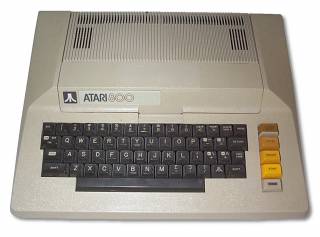 Atari 800.
Atari's 8-bit home computer line began with the Atari 400 and Atari 800 which were released in November 1979. The line was later expanded to include the more powerful Atari XL models and then the XE models. Atari's second cartridge-based console, the Atari 5200, is also based on the same hardware, resulting in many games appearing to be identical across all platforms.
Hardware
 Atari 800XL.
All models use a variant of the MOS Technology 6502 CPU, which is the same type of CPU used in many systems such as the Atari 2600 and the NES. The computers also include custom chips like the ANTIC display instruction processor, the CTIA/GTIA graphics chip and the POKEY audio chip. The Atari 400 and 800 were supposed to have 4 kB and 8 kB RAM respectively, and the names 400 and 800 were originally decided upon because of this, but both models were released with 8 kB of RAM since the price of memory had fallen when they were released. The 400 has a membrane keyboard while the 800 has a full-travel keyboard. The 800 also has two ROM cartridge slots instead of the single slot in the 400. In addition, the 800 also featured internal expansion slots for ROM and RAM, allowing users to expand the memory of their company or add features through third-party expansion cards. Despite this, the 400 outsold the 800 somewhat due to its lower price.
 Atari 130XE.
In the spring of 1983, the 1200XL was released which came with 64 kB of RAM, a sleek redesigned case and additional custom keys. Some older software was incompatible with the new OS however. The 1200XL also lacked any kind of expansion capabilities which hurt sales, and the 1200XL was only on the market for several months. Later in 1983, the 600XL and 800XL were released which replaced all previous models, including the 1200XL. The 600XL had 16 kB of RAM while the 800XL had 64 kB like the 1200XL did, with both the 600XL and 800XL sharing a similar design. A new hardware feature on both these models was a Parallel Bus Interface, which provided hardware expandability missing on the 1200XL. An expansion interface known as the Atari 1090 was planned for this port but was ultimately never released.
After the consumer divisions of Atari were acquired by Jack Tramiel in 1984, a new line of Atari 8-bit computers known as the XE series (XE standing for XL-Enhanced) was released alongside with the 16-bit Atari ST computer in 1985. They have a similar case design to the Atari ST line of computers but are otherwise identical on the hardware level to the old 8-bit computers, except for the newer Enhanced Cartridge Interface instead of the Parallel Bus Interface and the fact that the 130XE had 128 kB of RAM.
XE Game System.In 1987, after seeing the success of the NES, Atari introduced XE Game System, based on the XE hardware. It included a detachable keyboard, a joystick, a lightgun and the games Bug Hunt and Flight Simulator II. Because the XE Game System used the same hardware as the 8-bit computer, a lot of software and hardware for the Atari 8-bit computers are compatible. The XEGS also included a serial port so that software on disk and cassette could also be run in addition to cartridges. The system didn't sell as well as hoped, partly because of bad marketing and the fact that new releases for the system were few and far between.
In 1992, Atari officially dropped support for their entire 8-bit line of machines.
Models
Atari 400's membrane keyboard.- 400 and 800 (1979) – original machines in beige plastic cases. The 400 has a membrane keyboard, 800 has full-travel keys, two cartridge ports, monitor output, expandable memory slots (up to 48 KB). Later PAL versions used the 6502C processor.
- 1200XL (1983) – new case with aluminum and smoked plastic accents, 64 KB of RAM, only two joystick ports. Help key, four function keys. Older, often improperly written software, caused compatibility problems with the new OS. Discontinued after only 3-4 months on the market.
- 600XL and 800XL (1983) – replacements for the 400, 800 and 1200XL sans function keys. 600XL had 16 KB of memory, PAL versions had a monitor port, 800XL had 64 KB and monitor output. Both have built-in BASIC and an expansion port known as the Parallel Bus Interface (PBI).
- 800XLF (1984) – 800XL with Atari FREDDIE memory management chip and BASIC rev. C. Released in Europe only.
- 65XE and 130XE (1985) – A repackaged 800XLF with new cases and keyboards, styled to match the ST computers. The 130XE came with 128 KB of RAM and an Enhanced Cartridge Interface (ECI) instead of PBI. The North American version of the 65XE has no ECI or PBI.
- XE Game System (1987) – a game machine in a light beige case, with a detachable full-travel but slightly "mushy" keyboard (Atari STish)
- 800XE (1987) – the final machine in the series. Styling the same as 65XE and 130XE. A 130XE with 64 KB RAM. Mainly seen in Eastern Europe.
The memory expansion slots on the Atari 800.- Prototypes/Vaporware (never officially released)
- 1400XL – Similar to the 1200XL but with a PBI, FREDDIE memory management chip, built-in modem and speech synthesis chip. Cancelled by Atari.
- 1450XLD – a 1400XL with built in 5¼″ disk drive and expansion bay for a second 5¼″ disk drive. Code named Dynasty. Made it to pre-production, but was abandoned by Tramiel.
- 1600XL – codenamed Shakti, this was a dual-processor system with 6502 and 80186 processors and two built-in 5¼″ floppy disk drives.
- 900XLF – redesigned 800XLF. Became the 65XE.
- 65XEM – 65XE with AMY sound synthesis chip. Cancelled.
- 65XEP – "portable" 65XE with 3.5" disk drive, 5" green CRT and battery pack.
- 1090XL expansion system, 5 slots in a large case (never released, small numbers leaked out)
- 1055 3½" floppy drive
- XF351 3½" floppy drive
- XF354 3½" floppy drive
Peripherals
Atari 8-bit peripherals.There were a huge amount of peripherals released for the Atari 8-bit computers including cassette tape drives, 5.25" floppy disk drives, printers and modems. The most common peripherals were disk drives and cassette drives, and as a result most software for these computers are on disk and tape. Most peripherals use the SIO port and can be chained together to have more than one peripheral plugged in at once.
Log in to comment