Overview
 The Nintendo Entertainment System logo
The Nintendo Entertainment System (often abbreviated as "NES," colloquially referred to as simply "Nintendo," and dubbed as the "Control Deck" on boxes and in documentation), also known as the Famicom, was Nintendo's second attempt to attract home consumers, following the modest success of the Color TV Game in Japan.
In Japan and many other Asian countries, the NES was known as the Family Computer (or as it came to be later known, the Famicom); in some Asian countries, it was known as the Tata Famicom. It released in Japan in July 15, 1983, on the same day as Sega's SG-1000, which it beat with its technical superiority and stronger software library. The Famicom offered unrivalled technical power in its time for the lowest possible price, selling over 1.4 million units in its first year and establishing console gaming as a mainstream market in Japan, a country that was previously dominated by arcades and home computers (such as the PC-88, PC-98, FM-7, X1, and MSX).
The 8-bit video game console was released by Nintendo as the NES in North America, Europe and Australia in 1985. After the North American video game market crash of 1983, the NES was the perfect revitalization. It went on to become the best-selling video game console of all time (up until the PlayStation). Some of the Hollywood stars at the time who owned the NES at the time included Michael J. Fox, Robin Williams, Whoopi Goldberg, Tom Hanks, Bruce Willis, and Tom Cruise.
The NES introduced many conventions that have become standard, including game controller layout, D-pad, third-party software licensing, and the business strategy of selling hardware at a loss and profiting from licensed software.
History
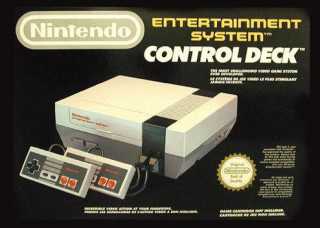 A boxed NES Control Deck.
The year was 1981 and after the success of Donkey Kong and its successful release on the ColecoVision where it quickly became the killer app for the console Nintendo turned to then head of its video game division Masayuki Uemura to design a cartridge-based home console. While most of the companies engineers continued to work on the Game & Watch product line, Uemura set to work researching and designing what would later become the Nintendo Entertainment System. As more and more engineers began to transition over to help Uemura design the machine several key discussions arose to determine the internal workings of the machine.
Selecting the CPU:
The most significant decision made being the choice of CPU used in the console. Uemura wanted the CPU to be small enough to allow a sound chip to be integrated onto the board to reduce costs and due to Nintendo's relationship with chip manufacturer Ricoh whose 6502 processor met the requirements the initial reaction was to use the Ricoh 6502 processor. Within the company however several of the engineers disputed this choice in favour of the Z80 processor to allow the source code of the game Donkey Kong to be used. As the chief engineer though Uemura selected to use the Ricoh 6502 processor and so the company was forced to develop Donkey Kong from scratch. Another key decision would be the selection of the color palette of the console and so Uemura went to Shigeru Miyamoto to assist with the color choice by asking him what and how many colors would be needed to recreate his games.
The design of the controller:
Another heated aspect of the design within the company was that of the controller. Having designed arcade games in the past, several of the engineers believed a joystick controller (similar to that of the Atari 2600) should be the included with the console. One engineer who worked on the project however having just assisted the Game & Watch team with the creation of the Donkey Kong Game & Watch took the control unit created for it, removed the screen and connected it to a Famicom system as a test. Realising that the Famicom controllers should utilise the revolutionary D-pad created for the Donkey Kong Game & Watch and that the D-pad was intuitive enough to use that players could focus on the screen opposed to the controller so it was decided that the controller design should incorporate a D-pad over a joystick.
The decision to use cartridges for games:
The choice to use cartridges came from the decision that the sole purpose of the console would be to play video games meaning that the data on the cartridge wouldn't need to be altered after release. Thus the company decided to use ROM data and styled the Japanese cartridges after audio cassettes to allow Japanese consumers to use pre-existing household furniture and containers to store their game collection.
The origins of Famicom red:
The iconic Famicom red color choice came when the discussion of what color to make the console arose and due to Nintendo president Hiroshi Yamauchi's favourite color being red the decision was made to use the same shade of red as the president's scarf.
The origins of the name Famicom:
The Japanese name of 'Family Computer' (later Famicom) was not given to the console until shortly before its release and came from a conversation between Uemura and his wife. Uemura, who often discussed his work with his wife, explained one evening that the console was still without a name and despite personal computers already existing in Japan that the console shouldn't be seen as a "personal" device and instead one for the entire family. Thus Uemura explained it should be called the "Family Computer" to which his wife responded "Okay but it has to be Famicom. You have to make it shorter.". Liking the name "Famicom" Uemura took the idea straight to company president Yaumauchi the next day and explained the reasoning behind the name but Yaumauchi was not in favour of the name claiming "No, it's not a good idea to shorten the words at the beginning. If people want to start calling it that later, that's okay, but at the start we need to call it 'Family Computer'.".
The initial Japanese release:
The console was first released in Japan on July 15, 1983 with the three launch titles of Donkey Kong, Donkey Kong Jr., and Popeye available. The console sold around 400,000 units in its first year though approximately 100,000 units were returned as faulty due to the initial wave of consoles being prone to crashes due to defects in some of the graphics chips created by Ricoh as well as the issue of owners damaging the controllers of the console which were hard-wired into the console to save on costs over implementing a joypad connector to the console. This decision was later reverted to allow for damaged controllers to be easily replaced via simply buying and plugging in a replacement controller.
By the end of 1983 the initial wave of the Famicom stock had sold out but when retailers in February of the following year kept on requesting additional stock the console was resupplied complete with a new motherboard to fix the issue with the graphics chips and the Famicom swiftly became incredibly popular.
Entering the American market:
In an effort to enter the North American market, Nintendo negotiated with Atari to release the Famicom as the Nintendo Advanced Video Gaming System but the deal would fail to materialise. In June of 1985, Nintendo unveiled the North American version of the Famicom (the Nintendo Entertainment System) which had undergone several cosmetic changes from the original Famicom system. For instance, the console was stylised to make it look more like a VCR and was colored with shades of grey to make it blend in better with the traditional television setup. Its controllers were also redesigned to accommodate for the larger hands of American children, the controllers were made detachable from the console based off the past experience with the non-detachable controllers of the Famicom and the problems which arose due to this design aspect. The built-in microphone of the controller was removed to save costs and because of the belief that the intent to use the microphone for karaoke would not be as appealing as it was in Japan.
On October 18, 1985, the NES was released, along with eighteen launch titles. Two boxed sets were released, the Deluxe Set (console, R.O.B., Zapper, two controllers, Duck Hunt, and Gyromite) and the Control Deck (console, two controllers and Super Mario Bros.).
Nintendo initially had a hard time selling the NES to retailers due to most believing the video game home console market to have died with the crash of 1983. Realising this Nintendo marketed the NES as a toy opposed to a video game system. They packed in a light gun and a robot with the console and people started to pay attention. In December of 1985 Nintendo went to toy stores around New York City to try and sell the NES negotiating that if the consoles don't sell they will buy them back. This gave Nintendo a foothold but they still required getting the NES into the hands of more people if the product was to be a success.
The company then contacted Worlds of Wonder, a toy company who made two of the most popular toys of 1985, Lazer Tag and Teddy Ruxpin, claiming if they could get Nintendo into the same big department stores as their toys were in that they could have a percentage of Nintendo's sales. Worlds of Wonder agreed to this deal, so whenever a store called and wanted to order a toy, they would require that store to order 500 NES consoles. With this deal in place Nintendo had now made their first steps into the American market.
The NES was an enormous success in Japan and North America, dominating the competition in both regions. In comparison to its considerable success in Japan and North America, however, the NES had much less success in Europe and South America, with Sega's Master System being significantly more successful than the NES in these regions. (Ref) ("Retroinspection: Master System", Retro Gamer, issue 44, pages 48–53)
US Cumulative Sales
- 1985: 90,000 (New York City) (ref) (ref)
- 1986: 1,190,000 (+1,100,000) (73% market share)
- 1987: 4,190,000 (+3,000,000) (70% market share)
- 1988: 11,190,000 (+7,000,000) (85% market share)
- 1989: 20,390,000 (+9,200,000) (80-90% market share)
- 1990: 27,590,000 (+7,200,000) (90% market share)
- 1991: 30,000,000 (ref)
Licensing
 Nintendo's seal of quality
Nintendo's licensing techniques were both revolutionary and for a time, illegal. Nintendo had a veritable monopoly on the market at the time, so they encouraged developers to make games for their console. But, developers had to sign a contract stating they would only develop games for the NES. Also, a chip was instituted into the NES called the 10NES. If this same chip was not found in the cartridge, the game wouldn't load. Eventually, however, these business practices were ultimately outlawed.
Despite Nintendo's efforts, unlicensed games were still created for the system. Designers found ways to bypass the 10NES chip. One such way was to short circuit the chip, temporarily ceasing its function. However, Atari Games created unlicensed software for the NES under the name Tengen. Tengen didn't want to be held liable for short-circuiting and possibly damaging the NES, so they devised a chip (nicknamed Rabbit) that disabled the 10NES chip. It was later discovered that their patent was acquired illegally, and thus, they were sued by Nintendo and lost.
Launch Games
Japan - July 15, 1983
North America - October 18, 1985
Europe - September 1, 1986
Technical Specifications
- CPU: 8-bit microprocessor (by Ricoh, based on MOS Technology 6502 core) operating at 1.79MHz on NTSC systems and 1.66MHz on PAL systems.
- Memory: 2 kB main RAM (random-access memory), 2 kB video RAM, 49,128 bytes ROM (read-only memory)
- Video: Custom-made picture processing unit (by Ricoh) named RP2C02 (in NTSC models, operates at 5.37 MHz) and RP2C07 (in PAL models, operates at 5.32 MHz)
- Color palette of 53 colors (48 colors and 5 grays), 25 colors on one scanline
- 64 sprites displayed on the screen simultaneously (sprites can be either 8 x 8 pixels or 8 x 16 pixels)
- Display resolution is 256 x 240 pixels (effective resolution of 256 x 224 pixels)
- Audio: Ricoh RP2A03 on NTSC systems and Ricoh RP2A07 on PAL systems. Has 5 separate audio channels. Two pulse-wave, one triangle-wave, one white-noise and one DPCM channel.
NES-001 vs. NES-101
The box of NES-101After the success of the NES, Nintendo introduced the NES-101, a new budget priced 'entry level' model of the console on October 15, 1993. Known as the top-loader, this version is nearly identical to the original model, but it has several key differences. The main difference, and the reason for its nickname, is the fact that cartridges are loaded into a slot on the top of the console, rather than through a tray at the front. It also sported a different color scheme and more round edged controllers similar in design to those of the Super Nintendo Entertainment System. It also featured a redesigned logo and modified circuit boards to improve the video output.NES-101 was known as HVC-101 in Japan, and was released on December 1, 1993.
Accessories
| Nintendo Zapper |
|---|
| The Zapper was a light gun that came bundled with the NES later on in its life span. The gun originally was gray, however to make it appear less threatening the zapper was later changed to orange. The Zapper is best known as the controller for playing Duck Hunt. | |
| NES Advantage |
|---|
| The NES Advantage was an arcade stick for the Nintendo Entertainment System. It was released to help ease the change form a traditional stick to the new idea of a D-pad. The advantage also functioned as a turbo controller. | |
| Power Pad |
|---|
| The Power Pad was a specal controller released for Track and Field on the Nintendo Entertainment System. | |
| NES Max |
|---|
| The NES Max was a popular controller because its built in turbo function was a new feature at the time. | |
| NES Four Score |
|---|
| The NES Four Score was a wired splitter that made it possible fore four players to simultaneously play on the NES. It offered options for turbo (for all connected players), and the ability to switch between two player and four player. | |
| R.O.B. |
|---|
| R.O.B., an acronym for Robotic Operating Buddy, was the console's most infamous accessory. He was supposed to move colored discs to aid the player in compatible games, but he was so slow that it made gameplay almost impossible. Only two compatible games were ever released: Gyromite and Stack-Up. | |
Clones and Emulation
PlayChoice-10
PlayChoice-10Nintendo also released the PlayChoice-10. The PlayChoice-10 was an arcade cabinet that contained full versions of ten NES games. This was to capitalize on the success of arcades at the time, as well as compete with Sega's arcade versions of the Sega Genesis and Sega Master System. In addition to Nintendo's own games, many third party games also appeared on the PlayChoice-10.
Emulators
Japanese FamulatorAfter the release of the NES a lot of companies made emulators for retro gamers. One example is the new release of the NES Emulator
"Famulator" in Japan created by "Cyber Gadget". The Famulator is a slimmer, thinner, and lighter version of the original NES. Although the models look totally different the cartridges fit perfectly and run perfectly. The Famulator was priced 2,980 Japanese Yen, which adds up to roughly 30 American Dollars, creating a cheap and small NES for retro gamers. The Famulator comes with two controllers with the typical A & B buttons but an add on with AA & BB which are just double the speed of the regular A & B buttons. The Famulator also includes the normal cables for connection to a display.
Sharp Famicom Twin
Sharp Famicom TwinSharp made their own version of the Famicom, which combines the Famicom and Famicom Disk System in one unit. The system comes in two colors. Red with black highlights and black with red highlights. They later released a Turbo version in black with green highlights and red with blue/grey highlights. The Famicom Twin was licensed by Nintendo and also contains most of the original hardware with few changes.
PolyStation
The PolyStation was a unique clone released in China, designed to look like Sony's PlayStation, but emulate the NES's hardware. The PolyStation's packaging also falsely represented the product, showing screenshots from other consoles such as the SNES, the Genesis, or the PlayStation, or describing advanced features that the NES is not capable of doing. The console has appeared under a variety of names, and sometimes even includes packaged pirated games.
Dendy
The Dendy logoOne of the more popular clones of the NES, the Dendy rose to popularity in Eastern Europe in particular due to the fact that an official NES never made it to that region, and importation was expensive. Over two million Dendy consoles sold in Russia by 1996, many for under the equivalent of $50 USD. The Dendy differs slightly from the NES in terms of hardware, containing a slightly different chipset. There were several variations of the Dendy, such as Dendy Classic and Dendy Junior. Cartridges were typically bootleg versions of official games, or even compilations, and were similar in appearance to the Famicom cartridges.
Log in to comment