Recent
Images
News
Videos
Community
Guides


In 1976 Fairchild Electronics came up with the idea of using ROM (read-only memory) cartridges for their own "Channel-F" videogame system. With this innovation, each videogame could be completely unique; however their game system was too primitive and never caught on. The big news however was just ahead: By December 1977 Atari released the programmable Video Computer System, the Atari VCS (which was later renamed the Atari 2600.
Near the same time, in early 1977, Magnavox had developed a non-programmable game console that they called the Odyssey 2. It would not have the ability to add new games through cartridges, but instead would have 24 built in games, and allow up to four people to play simultaneously. Soon afterward, however, the videogame market became crowded with a number of other entries all of which had to compete not only with each other, but also with the large number of inexpensive hand held electronic games. The resulting market difficulties convinced Magnavox not to market this incarnation of the 24-game Odyssey 2.
In 1978 Magnavox released a new videogame system for the home market: The Odyssey 2. This new unit bore no relation to the scrapped 24-game system. Instead, it was a fully programmable home video game system that was designed to use 2K ROM game cartridges. Like the Atari VCS, the CPU of the Odyssey 2 was powerful enough such that each game could be a completely unique experience, with its own background graphics, foreground graphics, game play, scoring and music. The potential was enormous, as an unlimited number of games could be individually purchased. Like the Atari 2600, the Odyssey 2 allowed any game player to purchase a library of videogames tailored to his or her own interest.
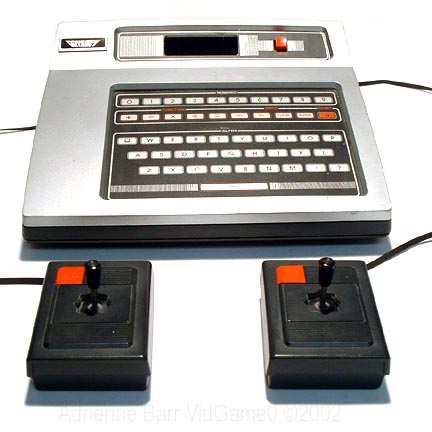
Unlike any other system at that time, the Odyssey 2 also included a full alpha-numeric touch pad keyboard, which was to be used for educational games, selecting game options or programming. This was a major selling point of the system.
For hand held controllers, the Odyssey 2 utilized the classic joystick design of the 1970s and 80s: A moderately sized, self centering eight way joystick. It was held in the left hand, and manipulated with the right hand. In the upper corner of the joystick was a single 'Action' button. A credit to the designers at Magnavox, three or four years later, with Atari, Intellivision, and a number of third party companies producing hardware, many people still felt that the Odyssey 2 joystick was one of the best designed.
By 1981, Atari and Intellivision sales had grown in leaps and bounds beyond the Odyssey 2. Nevertheless, Philips kept on supporting the Odyssey 2. Their programmer's slow but steady improvements in game play and graphics made sure that Odyssey 2 owners could always count on more and better games being made available. Even without massive third party support, by 1983 over a million Odyssey 2 units were sold in North America alone.
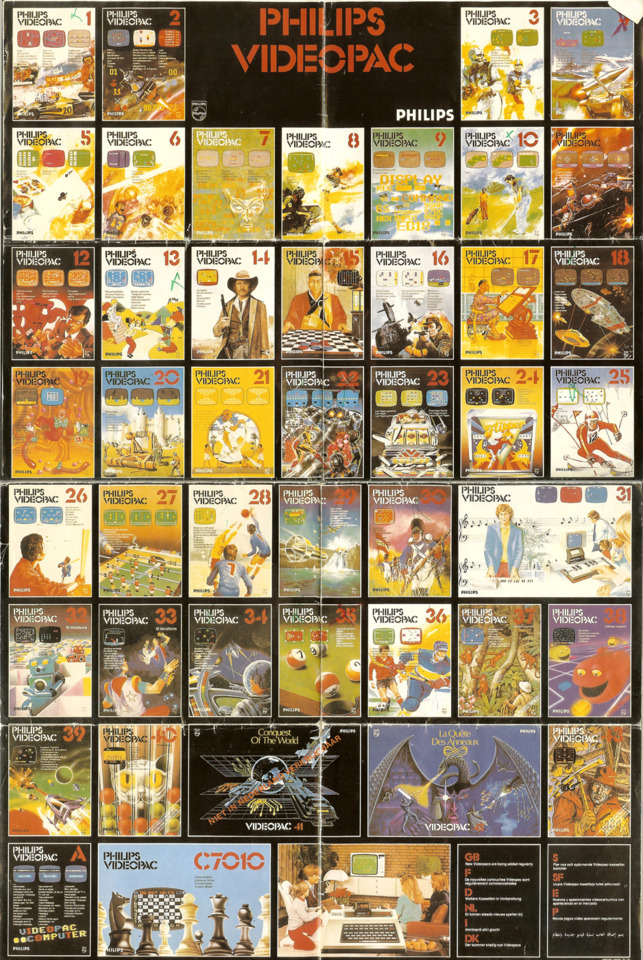
It is less well known that the Odyssey 2 was even more popular in Europe, where it was marketed by Magnavox's parent company, Philips Electronics. In Europe (and in other parts of the world as well) the Odyssey 2 was sold as the Philips G7000 Videopac console. In France, it was known as the Philips C52. In Brazil it was known as the Odyssey, as the original Odyssey was never released in Brazil.
There hasn't been any recent activity for this object.


The Odyssey 2 was Magnavox's second console, which competed with the Atari 2600 and Fairchild Channel F.
Backstory
In 1976 Fairchild Electronics came up with the idea of using ROM (read-only memory) cartridges for their own "Channel-F" videogame system. With this innovation, each videogame could be completely unique; however their game system was too primitive and never caught on. The big news however was just ahead: By December 1977 Atari released the programmable Video Computer System, the Atari VCS (which was later renamed the Atari 2600.
Near the same time, in early 1977, Magnavox had developed a non-programmable game console that they called the Odyssey 2. It would not have the ability to add new games through cartridges, but instead would have 24 built in games, and allow up to four people to play simultaneously. Soon afterward, however, the videogame market became crowded with a number of other entries all of which had to compete not only with each other, but also with the large number of inexpensive hand held electronic games. The resulting market difficulties convinced Magnavox not to market this incarnation of the 24-game Odyssey 2.
Technical Design
In 1978 Magnavox released a new videogame system for the home market: The Odyssey 2. This new unit bore no relation to the scrapped 24-game system. Instead, it was a fully programmable home video game system that was designed to use 2K ROM game cartridges. Like the Atari VCS, the CPU of the Odyssey 2 was powerful enough such that each game could be a completely unique experience, with its own background graphics, foreground graphics, game play, scoring and music. The potential was enormous, as an unlimited number of games could be individually purchased. Like the Atari 2600, the Odyssey 2 allowed any game player to purchase a library of videogames tailored to his or her own interest.
Unlike any other system at that time, the Odyssey 2 also included a full alpha-numeric touch pad keyboard, which was to be used for educational games, selecting game options or programming. This was a major selling point of the system.
For hand held controllers, the Odyssey 2 utilized the classic joystick design of the 1970s and 80s: A moderately sized, self centering eight way joystick. It was held in the left hand, and manipulated with the right hand. In the upper corner of the joystick was a single 'Action' button. A credit to the designers at Magnavox, three or four years later, with Atari, Intellivision, and a number of third party companies producing hardware, many people still felt that the Odyssey 2 joystick was one of the best designed.
Sales
By 1981, Atari and Intellivision sales had grown in leaps and bounds beyond the Odyssey 2. Nevertheless, Philips kept on supporting the Odyssey 2. Their programmer's slow but steady improvements in game play and graphics made sure that Odyssey 2 owners could always count on more and better games being made available. Even without massive third party support, by 1983 over a million Odyssey 2 units were sold in North America alone.
It is less well known that the Odyssey 2 was even more popular in Europe, where it was marketed by Magnavox's parent company, Philips Electronics. In Europe (and in other parts of the world as well) the Odyssey 2 was sold as the Philips G7000 Videopac console. In France, it was known as the Philips C52. In Brazil it was known as the Odyssey, as the original Odyssey was never released in Brazil.
Technical Specifications
- CPU: 8-bit Intel processor running at 1.79 MHz
- Memory: 64 bytes CPU-Internal RAM, 128 bytes Audio/Video RAM
- Video/Audio: Custom Intel video and audio processor
- Video: 160 x 200 resolution, 15 color palette (sprites may only use a max of 8)
- Audio: Single channel, capable of noise output
Odyssey 2 games
Edit
| Name | Platforms | Developer | ||
|---|---|---|---|---|
|
Space Monster |
ODY2 | Magnavox | |
|
Laser war |
ODY2 | Magnavox | |
|
Flipper Game |
ODY2 | Magnavox | |
|
The Quest For The Rings |
ODY2 | ||
|
Golf |
ODY2 | Magnavox | |
|
Electronic Billiards |
ODY2 | Magnavox | |
|
|
Comando Noturno! released on Jan. 1, 1985 |
ODY2 | GST Video | |
|
Air Battle released on Jan. 1, 1985 |
ODY2 | ||
|
|
Secret of the Pharaohs released on Jan. 1, 1984 |
ODY2 | ||
|
|
Clay Pigeon! released on Jan. 1, 1984 |
ODY2 |
| Platform Name: | Odyssey 2 |
| Release Date: | Dec. 2, 1978 |
| Online Support: | False |
| Install Base: | 2,000,000 |
| Original Price: | $200 |
| Producing Company: | Magnavox |
| Total Games: | games |
|
Spider-Man first in Spider-Man |
1
|
|
|
Pick Axe Pete first in Pick Axe Pete! |
1
|
|
Green Goblin first in Spider-Man |
1
|
|
Q*Bert first in Q*Bert |
1
|
|
Coily first in Q*Bert |
1
|
|
Wrong Way first in Q*Bert |
1
|
|
Popeye first in Popeye |
1
|
|
Ugg first in Q*Bert |
1
|
|
Sam first in |
1
|
|
Frogger first in Frogger |
1
|
|
Golf Course first in |
1
|
|
Stairway first in |
1
|
|
New York first in |
1
|
|
North America first in |
1
|
|
The United States of America first in The Oregon Trail |
1
|
|
Atlantis first in |
1
|
|
Single-Screen level first in Tennis for Two Simulator |
4
|
|
Temporary Invincibility first in Pac-Man |
3
|
|
2D first in Tennis for Two Simulator |
3
|
|
Game Over first in |
3
|
|
Jump first in Donkey Kong |
2
|
|
Tie-In first in |
2
|
|
Aliens first in Space Invaders |
2
|
|
Unbeatable Games first in Tennis for Two Simulator |
2
|
|
Cheat Code first in Manic Miner |
2
|
|
Instant Death first in |
2
|