Overview
Created by former 2K China employees Justin Ma and Matthew Davis, FTL is a space simulation at its core. What sets FTL apart from others in the genre is its abstracted playstyle; the game plays more like a strategy game or RPG than a flight simulator. The game was designed to recreate the experience of crew management in sci-fi shows like Star Trek and Firefly.
FTL was released September 14, 2012 on the PC and Mac, after a wildly successful Kickstarter campaign. The iPad version of the game was launched April 3, 2014, as part of the Advanced Edition update, which includes a new race, new variations of all the ships, and new equipment and events.
Gameplay
 The Start
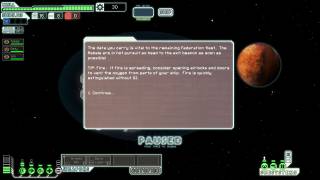
FTL follows the journey of a ship on a mission to determine the fate of the noble Galactic Federation, which has all but been destroyed by savage Rebel terrorists. Players guide this ship through seven sectors, navigating from jump beacon to jump beacon to reach the exit at the end of the sector. Each sector could be made up of roughly 10 to 20 beacons. While balancing their resources (fuel, scrap, missiles and drone parts) players must clear the sector or risk being caught by the Rebel fleet. This is not a game over, but instead a series of very difficult enemy encounters. On top of this, each jump beacon brings about a new encounter, be it a random enemy encounter, neutral mercenaries and traders, or even friendly Federation allies willing to lend a helping hand. Some of these encounters are puzzles, requiring the player to have certain races or equipment aboard their ship, choose a certain dialogue option, or use a specific weapon during a battle. In sector eight, players reach the Federation holdout where they must defeat the attacking Rebel Flagship to win the game. This is a protracted rule of three boss fight.
FTL is a roguelike with permadeath, and a poor decision or ill luck could mean the end of the ship and that particular run. There is no hard-save system, although players can suspend their current run and return to it later.
Ships
 The Hangar
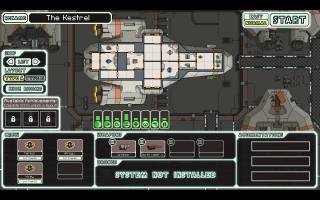
There are ten types of spaceships in FTL, each with its own specific style of gameplay. Only one ship, the Kestrel, is unlocked at the start, and the other ships are unlocked through special quests and events. Each ship has a fixed layout, although a different variant of that ship (with a slightly different layout, skin, and starting equipment) can be unlocked by achieving 2 of the 3 ship specific achievements.
The ten ships are:
- Kestrel Cruiser (The Kestrel / Red-Tail): A standard if slightly old ship with missiles and acceptable shields. The B variant has four weak lasers instead of one strong laser.
- Stealth Cruiser (The Nesasio / DA-SR 12): An agile ship that starts with a cloaking device, but lacks shields. The B variant starts with a level 2 cloak and the incredibly powerful Glaive beam.
- Mantis Cruiser (The Gila Monster / The Basilisk): A Mantis ship that uses teleporters to board enemy ships. The B variant starts with no weapons but has a boarding drone in addition to a teleporter.
- Engi Cruiser (The Torus / The Vortex): An Engi ship that focuses on drones and ion weapons. The B variant only starts with one crew member but has three drones for automated repairs and boarding defense.
- Federation Cruiser (The Osprey / Nisos): A bigger and more powerful version of the Kestrel equipped with an artillery beam. The B variant starts with slightly weaker weapons but an upgraded artillery beam.
- Slug Cruiser (Man of War / The Stormwalker): A Slug ship with the ability to automatically repair hull breaches and starts with a beam weapon capable of taking out the enemy crew without damaging the ship. The B variant starts with a teleporter
- Rock Cruiser (Bulwark / Shivan): A Rockman ship with superior armor and missiles that can occasionally negate damage. The B variant starts with an unique shield-piercing laser and fire bombs.
- Zoltan Cruiser (The Adjudicator / Noether): A Zoltan ship with a powerful shield that can only recharge with every jump. The B variant has stronger weapons but a weaker shield.
- Crystal Cruiser (Bravais / Carnelian): A special ship crewed with Crystal aliens and using powerful shield-piercing crystal weapons. The B variant starts with no weapons and is focused on boarding the enemy ship, an easy task thanks to the unique "lockdown" ability of Crystal aliens.
- Lanius Cruister (Kruos / The Shrike): The Lanius cruiser starts with a few of the new systems introduced in the Advanced Edition expansion, namely the Cloning Bay and Hacking system. Layout B starts with Mind Control instead of Hacking.
Systems and Subsystems

Every ship is comprised of a number of different systems and subsystems, each performing a different task in and out of combat. These systems require power (which is limited) to operate, and can be upgraded with scrap recovered over the course of the game. Upgrading a system increases its potential, but adds additional power requirements. Players can also purchase additional systems and subsystems at stores throughout the galaxy. A system can be disabled (partially or fully) through attacks, but can always be repaired to full operation by crew members or repair drones. Finally, some systems can be manned by your crew for an additional bonus.
Systems:
- Shields: Absorbs incoming laser attacks and negate some beam damage. Can be manned, decreasing the time it takes for downed shields to recharge.
- Engines: Dictates rate at which FTL recharges and ship's chance to dodge incoming attacks. Can be manned, increasing the chance to dodge.
- Life Support: Replenishes oxygen; if unpowered, breathable air drains constantly and the crew will suffocate. Oxygen also drains out of rooms connected to an open airlock by open doors and from rooms containing a hull breach.
- Weapons control: Powers the ship's weapons. Can be manned, decreasing the time it takes for weapons to charge.
- Drone control: Powers the ships offensive and defensive drones.
- Medbay: Heals injured crew members who stand within the Medbay room.
- Cloaking: Renders the ship invisible, increasing the chance to dodge by 60% and halting the enemy ship's weapons from charging for the duration of the cloak. Ships can still charge and fire weapons while cloaked.
- Crew Teleporter: Transports crewmen to enemy ships to destroy systems or kill personnel.
- Artillery Beam: A weapon unique to the Federation Cruiser that automatically fires a powerful beam that ignores shields. Increased power decreases recharge time.
- Hacking: Allows the hacking of a targeted system. The hacked system will shut its doors to the crew of the affected ship. When triggered, the actual hacking process will cause a different effect depending on the targeted system.
- Mind Control: Temporarily take control of an enemy.
- Clone Bay: Automatically clones dead crew with skill penalty. It replaces the Medbay of the ship.
Subsystems:
Subsystems, unlike primary systems, are automatically powered to their maximum available level for "free", without diverting energy from the reactor, though they can still be damaged and disabled.
- Piloting: Must be manned by a crewman to execute FTL jump or dodge enemy attacks; autopilot upgrades allow a lesser dodge bonus even when unpiloted.
- Sensors: Sensors grant the player information about their own and their enemies' ships; without sensors, players can only see what's happening inside rooms that contain a crewman. Upgrades grant the player increasing amounts of intel about enemy ships. Notably, sensors don't function at all inside nebulae, making them dangerous areas for all species save the Slug.
- Door Control: Allows the player to open or close any bulkhead door on the ship. Can be upgraded for two increasingly durable levels of blast doors, which slow the progress of boarders and halts the spread of fire.
- Reactor: Your pool of energy for all above systems and subsystems. Does not have a physical location within the ship, cannot be damaged or targeted.
- Battery: When triggered, will provide additional power to the ship's reactor.
Augmentations
All ships come with 3 slots for augmentations, which gives various bonuses to the ship. Augmentations can be bought (or sold) in shops littered throughout the game, and could also be found as part of random events. Some ships come equipped with unique augmentations from the start (the Zoltan Cruiser and its Super Shield for example).
Generic Augmentations
- Adv. FTL Navigation: Allows you to warp to any previously visited warp beacon.
- Automated Reloader: Weapon cooldown is improved by 15%.
- Damaged Stasis Pod: Does nothing, but is part of the sequence needed to unlock the Crystal Cruiser.
- Drone Recovery Arm: Deployed combat drones are recovered after the conclusion of combat.
- FTL Jammer: Doubles enemy FTL charge speed.
- FTL Recharge Booster: Increases FTL drive charge speed by 25%
- Long Range Scanner: Gives warning of environmental hazards and enemy ships in adjacent systems. The Stealth Cruiser starts with it.
- Repair Arm: Repairs your hull whenever you collect scrap, at a cost of 15% scrap reduction.
- Reverse Ion Field: Protects your ship from ion damage and gives a 20% chance to negate it entirely.
- Scrap Recovery Arm: Increases all scrap drops by 10%.
- Stealth Weapons: Weapons fired while cloaked no longer drains cloak energy.
- Weapon Pre-Igniter: Weapons are ready to fire immediately after an FTL jump.
Ship Specific Augmentations
- Engi Medi-Bot Dispersal: Medical nano-machines automatically heal crew, even when not in Medbay, though at a much reduced speed compared to crew actually in Medbay. Engi Cruiser A only.
- Drone Reactor Booster: Increases movement speed of in-ship drones by 50%. Engi Cruiser B only.
- Rock Plating: Gives a 15% chance to ignore hull damage (ship systems will still take damage) Rock Cruiser only.
- Titanium System Casing: Gives a 15% chance to ignore system damage (hull will still take damage). Stealth Cruiser A only
- Mantis Pheromones: Crew Movement speed is increased by 25%. Mantis Cruiser only.
- Slug Repair Gel: Hull breaches are automatically repaired. Slug Cruiser only
- Zoltan Shield: A special shield that absorbs 5 points of damage and blocks teleporters. Is recharged whenever the ship jumps to a new beacon. Zoltan Cruiser only
- Crystal Vengeance: Gives a 10% chance of returning damage to the enemy whenever your ship is damaged. Crystal Cruiser only.
Combat
CombatIn FTL, players do not have direct piloting control of their ship. They instead control the individual systems and weapons of the ship, while directing the ship's crew to perform actions, like fighting fires, repairing hull breaches, and manning systems in the various rooms on board the ship. The player also has to balance the ship's limited power supply between the offensive and defensive systems. Combat is in real-time, but can be paused at any moment. There is no control of the ship's movement in combat, as both the player's and enemy's ship are displayed in static frames. Combat lasts until one side surrenders, escapes, or is destroyed.
Unless the player is equipped with specific augmentations, they will be unable to repair the hull of their ship without visiting a store or running into a special event, which gives combat a long game as well as the battle-to-battle scenarios.
There are many different types of weapons in FTL, each with a different balance of power consumption, reload time, and damage amount and type. Weapons start each encounter uncharged (unless the player has a special augmentation), and need to power up to fire. Some weapon types include:
- Bolt Lasers: Basic weapon types that cannot go through shields, but can take out one level of shielding per hit.
- Beam Lasers: Directed energy weapons that deal area damage in a line and never miss. However, they are blocked by shields, which take down a damage point per level of shielding up.
- Ion Weapons: Do not deal hull damage, but drains a system of its power and can temporarily "lock down" a system, preventing it from functioning. They are especially good against shields.
- Missiles: Goes through shields and deal a lot of damage, but require missile ammunition to operate.
- Bombs: Similar to missiles, bombs bypass defensive drones by teleporting directly to the target room on the enemy ship, and can perform more specialized tasks, like setting the enemy ship (or the player's) on fire.
- Flak: Available only in the Advanced Edition, they fire a blast of shrapnel across an area. Flak weapons are blocked by shields and have a higher chance to miss, but shred shields as each shrapnel takes down a level of shielding.
Drone CombatA ship can also carry drones, which require a drone control subsystem and drone parts to operate. Drones provide offensive or defensive bonuses until they are destroyed, power is lost, or the drone system is disabled. Drones can fulfill many different tasks like missile and boarding defence, hull and system repairs, and offensive operations. Most ships do not start with a drone system, but one can be purchased in a store.
Crew
There are eight different races in FTL, each with their own advantages and disadvantages (save for humans, who have none). Each race has its own type of ship, but will often have members of other races. All ships can hold up to a maximum of eight crew members.
The ship's crew manages the various systems on board, providing additional benefits to the systems they are working on, and helping to repair broken systems and fend off boarders. Performing these tasks will increase their skill levels in that particular task, and crew members can master a particular skill (up to two levels), making them very proficient in that task. Crew members can die and be permanently lost in random encounters, but the Cloning Bay allows them to regenerate with a minor loss in skill levels. Generally, having a crew of mixed alien races will open up more encounter options.
| Races | Traits |
|---|
| Human | |
| Engi | - Repair rate doubled
- Combat damage halved
|
| Mantis | - Combat damage doubled
- 1.2x move speed
- Repair rate halved
|
| Rock | - Decreased damage from fire
- Movement speed halved
- Health increased to 150
|
| Slug | - Psychic powers function as sensors, even within nebulae
|
| Zoltan | - Provides power to the currently manned system
- Health reduced to 70
|
| Crystal | - Unexplained "Lockdown" power
- Reduced suffocation damage
- Movement speed reduced by 20%
- Health increased to 125
|
| Lanius | - Reduced Movement
- Are not affected by oxygen loss
- They slowly drain the oxygen of the room they are present in
|
Development
Mantis ShipsJustin Ma and Matthew Davis claim that the idea for FTL came about when they both got sick from working on sports titles that their former employer, 2K China, was developing. Taking inspiration from television shows like Firefly and Star Trek and board games such as Red November and the Battlestar Galactica board game, Ma and Davis created a unique space game that drew much attention at IGF China 2011 where FTL won a finalist award. They received two honorable mentions at IGF 2012.
Following this modest success, the team launched a Kickstarter campaign that ended up meeting their conservative $10,000 goal in a matter of hours. Thanks to a well-received OnLive demo and massive positive response from fans, the FTL Kickstarter closed at over 2000% of the initial goal.
A beta version of the game was released via Steam for select Kickstarter backers on June 14, 2012 along with this FAQ. The game was released September 14th, 2012 on Steam and GOG.com, and players can buy a DRM-free version at the official website, which also comes with redeemable Steam keys.
Advanced Edition
As part of the iPad release, a free update for the PC and Mac versions of FTL came out on April 3, 2014. The Advanced Edition introduces a new alien race, the Lanius, and adds new content and events written by guest writers Tom Jubert and Chris Avellone. The iPad version of the game includes the Advanced Edition content as part of the package.
Music
FTL Original SoundtrackIn addition to the many different features above, FTL boasts a standout soundtrack created by Ben Prunty. This OST features a mixture of ambient sounds and fast, electronic beats.
The game's soundtrack was nominated for IGN's Best Overall Music and Best PC Sound of 2012. Additionally, it was recognized as being among Kotaku's Best Video Game Music of 2012, one of the Top Ten Video Game Soundtracks of 2012 on The Game Scouts, one of Complex magazine's 25 Best Video Game Soundtracks on Bandcamp, and one of NeoGAF's Official Game Soundtracks of the Year 2012.
System Specifications
PC System Requirements:
- OS: Windows XP / Windows Vista / Windows 7
- Processor: Intel 2.60GHz Core 2 Duo / AMD Athlon X2 2.7GHz
- Memory: 512MB
- Graphics: GeForceFX5200, RADEON 9500
- Hard Drive: 300MB
Mac System Requirements:
- OS: Mac OS X 10.5.8 or above
- Processor: Intel 2.0GHz
- Memory: 1GB
- Graphics: 1280x720 minimum resolution, OpenGL 2.0 Support, and recommended dedicated graphics card with 128MB of RAM
- Hard Drive: 175MB
Log in to comment