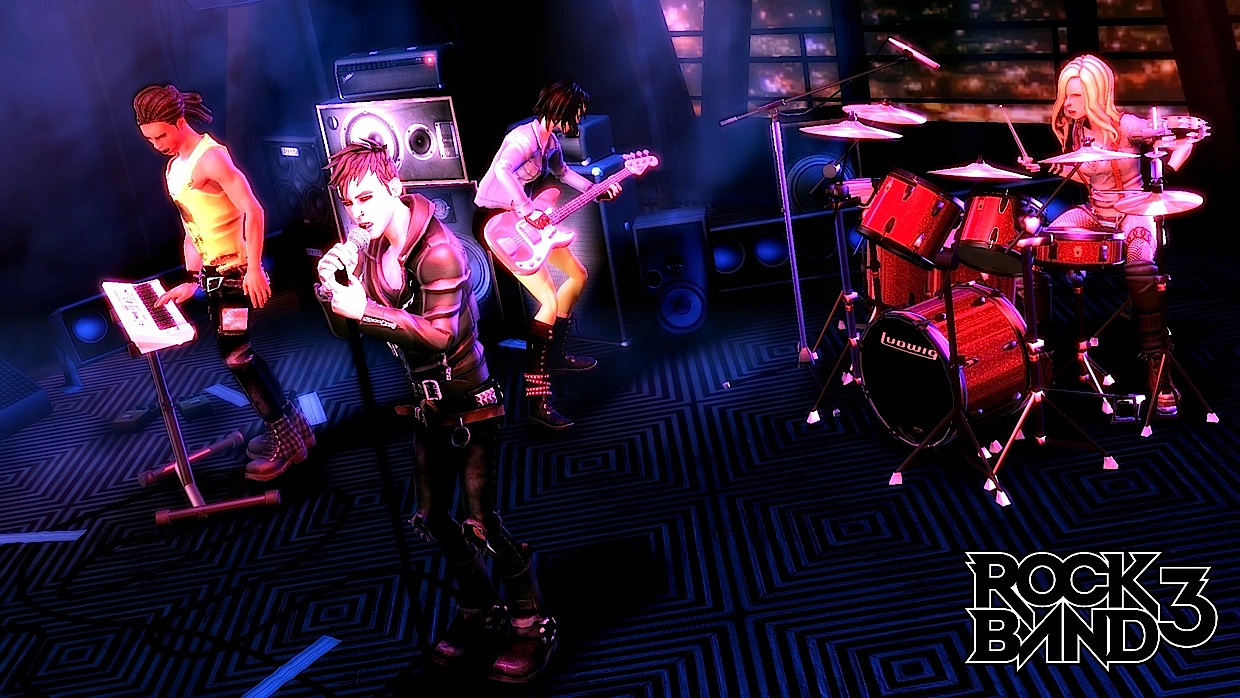
And yet here we are. Still, I think it's fair to say that the fierce competition between Activision and Harmonix these past four years has been good for the evolution of the genre, but has also left some folks feeling a certain sense of rhythmic fatigue. Today, even as an ardent fan of the genre, I have significant doubts about its continued longevity, never mind its role as a savior of the struggling music industry. I give this lengthy preamble here, not just for my personal nostalgia's sake, but to let you know what was swirling through my head as I first put Rock Band 3, Harmonix's latest and most heedlessly ambitious title, into my Xbox 360. This is still an iterative experience in a lot of significant ways, but Harmonix has, if you'll pardon my French, gone completely, utterly balls-out, delivering an experience that keys directly into the ways people actually play Rock Band, while also making what I have a hard time imagining as anything other than the final instrumental addition to the hardware lineup, and expanding on the core conceit in ways that address the perennial, and perhaps, misguided critique that rhythm game players should just pick up some real musical instruments, for God’s sake. Frankly, the only real slight I have against Rock Band 3, and part of the reason for this brief history of rhythm games, is that I come away feeling like I’ve experienced the end game for the genre, as I'm having an exceptionally hard time figuring out where it can all go from here.
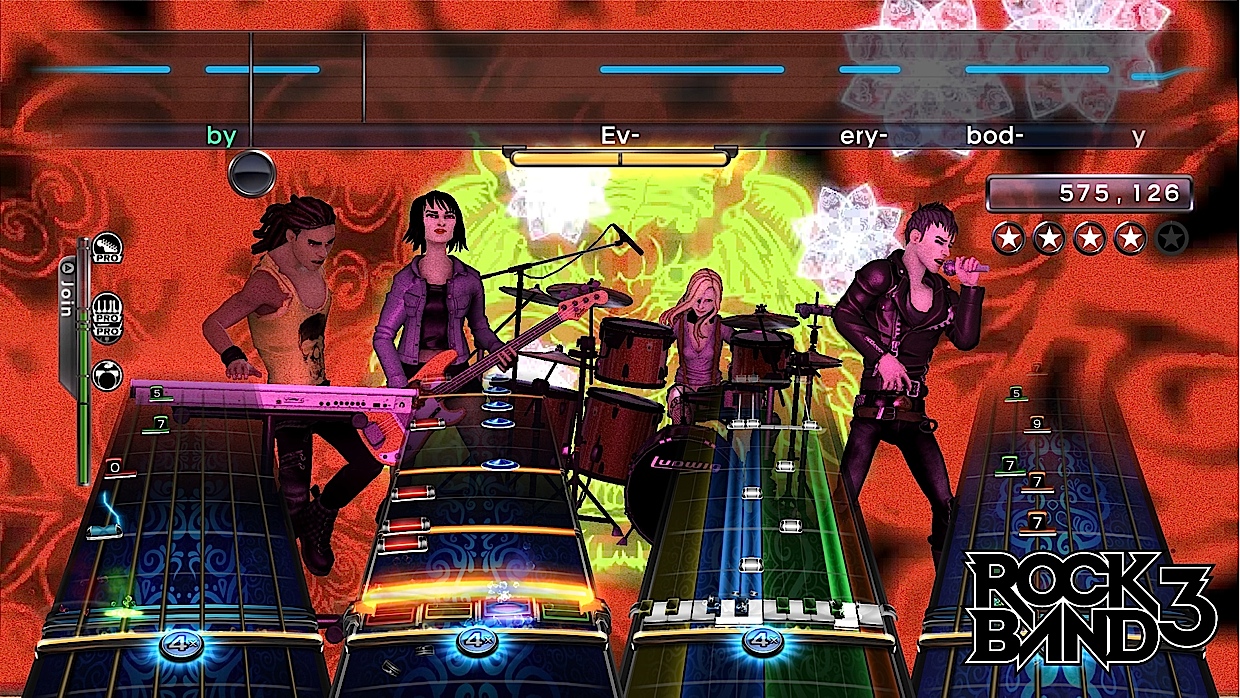
None of this is new, but what's significant is how it's all structured, as there's no longer any real distinction between progress your band makes in the tour mode or in random play. It all goes in the same bucket, which, in a way, kind of strips much of the gameiness out of the package, or at least keeps it from distorting the way you'd prefer to approach the game. There's a series of road challenges for the tour experience, with each challenge mapping to a specific regional, national, or international tour for your band. Part of what I really appreciate about the road challenges is that, while each stop comes with a predefined setlist, you're also always presented with alternate options such as playing random or custom setlists from specific eras, genres, or combinations thereof. Not once did I feel like I was facing a bunch of songs that I had no interest in playing, which is a huge step for such a mode.
At first blush, the lack of stuff like explicit, instrument-specific careers made Rock Band 3 seem a little spare to me. But all that stuff is still there, it's just organized into a generalized set of goals that encourages much more à la carte consumption. There are goals for band achievements and specific instrument achievements, goals based on performance in specific sets of songs. There are even sets of goals specific to downloadable songs, and the songs you can import from past Rock Band games. It provides all the sorts of objectives you'd expect and then some, so if you want those sorts of directives to help shape where you spend your time with Rock Band 3, they're there. They just don't get in the way when you just wanna get some friends together and rock out.
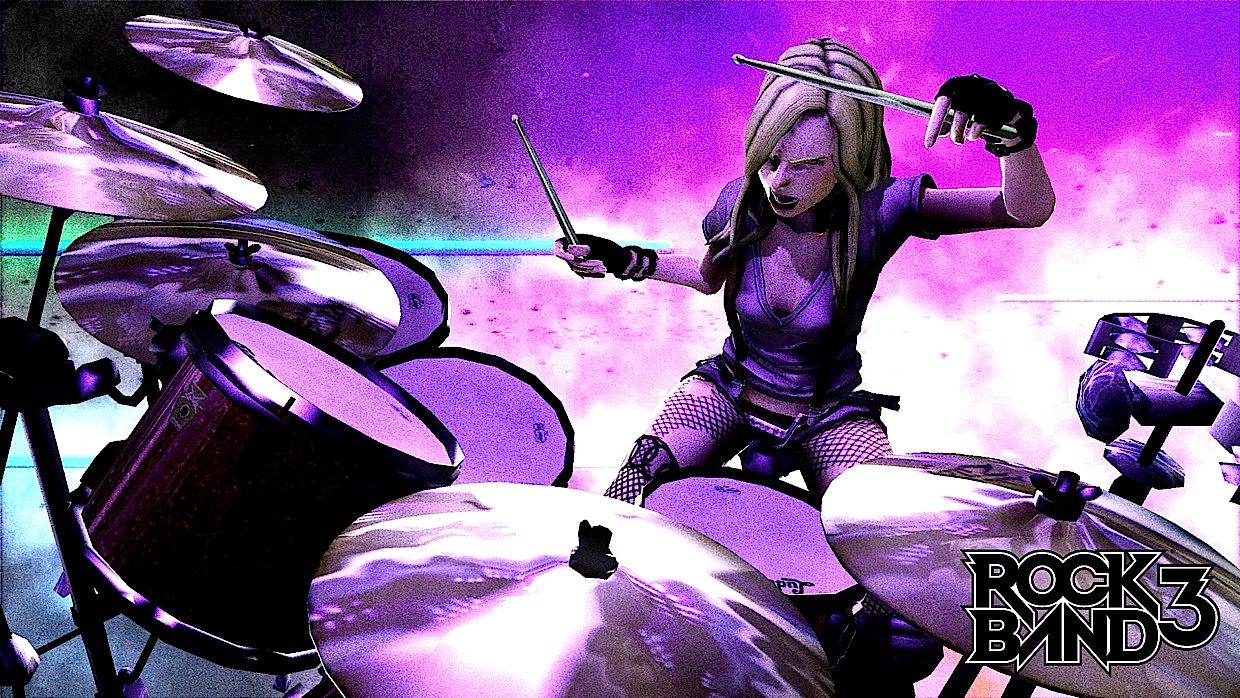
Completing your goals, in turn, increases your fanbase, unlocking bigger and better road challenges, as well as awarding you with new instruments and wardrobe to deck out your band in, eliminating the cash economy of Rock Band 2. Character creation runs just as deep here as it did in Rock Band 2, and while there's a significant amount of shared wardrobe and hairstyles, the underlying look of the characters has been altered. For lack of a better word, they look a little harder--still caricatured, but not quite as cartoony, and the overall look of the game just generally has more grit to it. Navigating the wardrobe for these ruffians and ne'erdowells has been streamlined, and while it's all still sorted into a series of different styles, it's easier to just page through, say, all of the shirts you might have available.
For the hardware, there are three, significant new pieces to consider. Most accessibly, and perhaps because of this, most importantly, is the keytar controller. This new controller features an abbreviated set of ebonies and ivories, a small touch-ribbon for some mild effects-bending, and a button for activating overdrive. It can be held like a keytar, from a standing position with the strap slung over your shoulder, though when first getting to know the instrument, I found it much easier to play from a seated position. Though there are two octaves worth of keys on the controller, for regular Rock Band play, you need only worry about five specific ivory keys near the middle. (We'll get into the pro mode business in a minute.) Aside from the fact that you're using your right hand instead of your left to follow the notes, this five-note configuration makes it very analogous to guitar notation in Rock Band, to the point that, should you find a song that has no specific keyboard charting, you can simply choose a guitar or bass part to play instead. Though you're not strumming anything with your off hand, there's a weight to the keys that makes it a little more physically demanding on your fingers. The fact that there are keys surrounding the five you're trying to hit, rather than the five isolated buttons found on the neck of a guitar controller, can make it harder to move the position of your hand and play by feel. Still, I regularly found myself choosing to play guitar and bass parts with the keytar controller, even when I had a capable guitar controller sitting right next to me, simply because there's something about the keys that makes it feel more like a musical instrument.
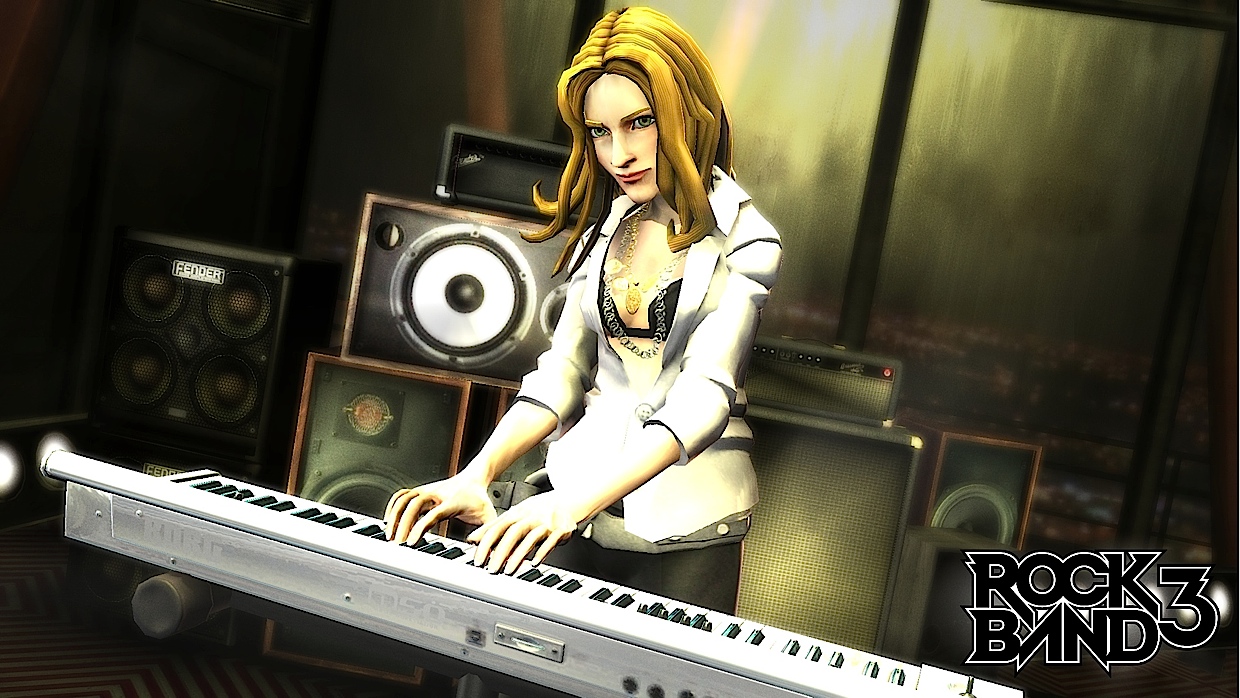
There's the full easy-to-expert gradation in difficulty within the pro mode, as well as a series of patient tutorials that introduce basic musical concepts like scales and chords and so on. As someone who's been playing this style of rhythm game for a long, long time, I'd settled into the difficulty settings I'm comfortable with a while ago, but pro mode reveals a whole new set of challenges to undertake. At its highest end, the difficulty seems insurmountable to me, someone with little in the way of actual musical skill, but it still starts off approachable enough.
The actual on-disc music of Rock Band 3 seems largely informed by the hardware additions, the keytar specifically. Songs like The Doors' "Break On Through," Dire Straits' "Walk of Life," J. Geils Band's "Centerfold," Huey Lewis and the News' "Power of Love," and Elton John's "Saturday Night's Alright (For Fighting)" are just fun songs, but they seem particularly notable because of their prominent keys. Still, it's a varied soundtrack without feeling schizophrenic, and while there are definitely songs geared more towards some instruments than others--INXS's "Need You Tonight" is a fine jam, but there's barely enough keyboard parts to justify paying attention--everyone gets their fair due.
So with Rock Band 3, Harmonix has introduced the keyboard, the last of the common rock instruments, as well as a set of instruments that eliminate the distinction between playing a game and playing an actual instrument, wrapping it all up in a package that makes itself almost entirely passive to the way you want to play Rock Band 3. Like I said at the top, I'm not sure where else there is to go, but I don't really care. I'm having too much fun right now.