
Mega Archive: Part XLI: From WWF Royal Rumble to Battletoads/Double Dragon
by mento
Welcome back to another wintry edition of the Mega Archive, still plugging away through the remnants of November 1993 as we head into the final month and the final stretch of this "arc" of the feature. In contrast to the misery so far this November, this entry's actually pretty promising: there's a number of games here which I'd consider worth checking out and even many of the ones that aren't...
Welcome back to another wintry edition of the Mega Archive, still plugging away through the remnants of November 1993 as we head into the final month and the final stretch of this "arc" of the feature. In contrast to the misery so far this November, this entry's actually pretty promising: there's a number of games here which I'd consider worth checking out and even many of the ones that aren't are historically noteworthy for one reason or another. The very last game of this group will also be the first of the December games, which we'll be seeing for the rest of this (2024) year. Decembers are pretty busy times for video games due to the holiday rush, or at least that used to be the case before every website and publication decided to hold their GOTY deliberations in December making it hard for any game released that month to get its bona fides. More of a "them" problem than an "us" problem though, gotta say.
I realize I say "eclectic mix" on this feature so often the words have lost all meaning but this really is another example of how Mega Drive had shaken off its early days of nothing but arcade ports and shoot 'em ups and embraced a great variety of genres (if not nearly as many RPGs as I'd prefer). We have a wrestling game, two football games (sigh), two mascot platformers, a pinball game, a quiz game, a top-down shooter, a mahjong game, and a crossover brawler: definitely nothing that would indicate a pattern or an overwhelming trend. We'll be heading back to the Mega CD next month for its penultimate entry for 1993, and then we're intravenously mainlining the December Mega Drive onslaught for most of the rest of the year.
Be sure to keep track of all the Mega Comings and Mega Goings with the Mega Archive Mega Spreadsheet. (I gotta stop saying "mega" before I turn into the Captain N version of Mega Man.)
Part XLI: 511-520 (November '93 - December '93)
511: WWF Royal Rumble

- Developer: Sculptured Software
- Publisher: Flying Edge (NA/EU) / Acclaim Japan (JP)
- JP Release: 1994-03-25
- NA Release: November 1993
- EU Release: 1993
- Franchise: WWE
- Genre: Pro Wrestling
- Theme: Are You Working Shoots, or Shootly Working?
- Premise: The stars of the WWF circa 1992 march into the ring one at a time to compete to see who will be the last man standing. And who'd have guessed it, it's usually one of the last guys to go in because they're not exhausted yet. Why, I do believe I've stumbled upon a flaw with the Royal Rumble format.
- Availability: Half these dudes are dead (or disgraced) so I doubt it'll get rereleased. Just play whatever the newest WWE is instead.
- Preservation: The second of four WWE games for the Genesis saw several improvements over its predecessor, WWF Super WrestleMania, including an expanded cast and compatibility with the six-button controller. I imagine it would've been hard to do a proper Royal Rumble with Super WrestleMania's measly eight characters; instead, American wrasslefans have their who's who of the talents leading WWE at the time so I'm sure that was great for them. For some reason I'd completely forgotten that LJN was an Acclaim label: that notorious rainbow icon was on all the SNES versions of the game while the Genesis/Mega Drive games were instead put out by Flying Edge, Acclaim's Sega-specific publishing label. I guess anything you can do to conceal that it's an Acclaim game can only help its sales figures in the end.
- Wiki Notes: SNES double-dip, so just some minor edits. This page had something I hadn't seen in a while: Screenshots attributed to two or more systems. For the record, this isn't permitted. It's not representative: even if the two versions are near identical, unless the hardware's the same (or it's an emulation, like Virtual Console) there's going to be differences. Anyway, I don't care enough about WWE to create a bunch of separate screenshots for each system. I'll leave that to one of the site's many wrestling marks.
512: Zombies Ate My Neighbors / Zombies

- Developer: LucasArts
- Publisher: Konami
- JP Release: N/A
- NA Release: November 1993 (as Zombies Ate My Neighbors)
- EU Release: 1994-01-21 (as Zombies)
- Franchise: Zombies Ate My Neighbors
- Genre: Top-Down Shooter
- Theme: Every B-Movie At Once
- Premise: Monsters have taken over a small suburban town and it's up to teens Zeke and Julie to save as many of their neighbors as possible. Of course, some lives are worth more than others. That's always a good lesson to impart to kids.
- Availability: You can get the 2021 remaster Lucasfilm Classic Games: Zombies Ate My Neighbors and Ghoul Patrol on almost anything current.
- Preservation: ZAMN was always one of those games that was worth sticking into your Mega Drive or SNES but never something you could honestly expect to finish without a whole lot more dedication and cautious play than you were probably willing to invest. In that sense, it felt like a true arcade experience for the home console despite not actually being an arcade conversion. Though developed by an entirely separate team within LucasArts, it's evident that its parodic B-movie leanings were inspired by the adventure games going on elsewhere in the company, especially the thematically similar Maniac Mansion, Day of the Tentacle, and Zak McKracken. I guess Star Wars itself is kind of a pastiche of old sci-fi schlock too. Due to its violent (but cartoonishly so) imagery the game was sanitized to heck for its European release, hence why they removed any mention of humans being devoured from its title. Wusses. No clue why the Japanese Konami published the game in all regions besides their own but I'm thankful to them for doing so. It's not like LucasArts couldn't do it themselves though. Were they really that strapped for cash?
- Wiki Notes: SNES double-dip. Just needed a PAL release. This is one of those older pages that has errors associated with it, so don't try editing it (if you do, ignore the "we removed your wiki privileges" warning).
513: Cosmic Spacehead
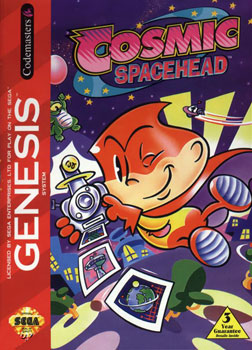
- Developer: Supersonic Software
- Publisher: Codemasters
- JP Release: N/A
- NA Release: 1993-11-02
- EU Release: November 1993
- Franchise: N/A
- Genre: Adventure / Platformer
- Theme: What 100 Galactic Credits Gets You at the Zebulon Red Light District
- Premise: Linus "Cosmic" Spacehead visited Earth in his previous game and wants recognition for his discovery from his fellow space aliens, but no-one believes him because he's a tiny idiot who sucks. Help him on his quest to return back but with a camera this time.
- Availability: Out of print. Present day Codemasters won't touch a game if it doesn't have rally cars.
- Preservation: Growing up on a steady diet of games from the Dizzy lineage, I was always poised to appreciate what Cosmic Spacehead was doing here by combining a standard graphic adventure game format that uses a cursor and selection of verbs for hotspots in the vicinity with a so-so (and oddly difficult) 2D platformer which was used to bridge the gaps between the adventure game areas. Actually, one of my favorite recent Indie games did something similar—Lair of the Clockwork God—so it's an idea that was definitely ahead of its time. I will say that one issue with this hybrid format is that they tend to get in each other's way a lot: you're probably going to prefer one side of it over the other, and that other will only serve to distract from what you're into. Still, though, it's a novel concept and one that definitely doesn't show up too often on consoles like the Mega Drive. UK-based Supersonic Software, our developers here, was founded by former Codemasters people and often worked with them: their other two Mega Drive games were both Micro Machines-licensed racers made on the bigger company's behalf. Supersonic pivoted to mobile games around the 2010s and were eventually absorbed into the Tencent collective hivemind.
- Wiki Notes: Just some clean-up and a header image. Or maybe a spaceheader image?
514: Janou Touryuumon

- Developer: Sega
- Publisher: Sega
- JP Release: 1993-11-05
- NA Release: N/A
- EU Release: N/A
- Franchise: Janou Touryuumon
- Genre: Mahjong
- Theme: Mahjong
- Premise: Pick up a tile and put down a tile (no, not that one, dummy, that one there) in this game beloved by grandmas and yakuza the world over, though mostly in Asia.
- Availability: If tracking this version down is too tough you can always buy the original for the NEC PC-98. I mean, you could.
- Preservation: Man, I thought I had my fill of mahjong games when working on the full SNES/SFC game list but it's actually kind of refreshing whenever one pops up on the Mega Archive since they're comparatively way more rare on this platform. This would be only the fifth mahjong game for the system so far—a less than 1:100 ratio—and is a fairly traditional and serious sim that doesn't go for any bells and whistles such as pretty girls or an anime style (or, as is often frequent, pretty anime girls). This series was on home computers originally where it was developed by Game Arts—I guess they were too busy with Lunar to port it themselves—and this port is actually based on the second of those: Sega just dropped the numeral so it wouldn't confuse people. I struggled a bit with that name, despite seeing "Touryuumon" recently with an unrelated board game series for WonderSwan, since it uses fancy archaic kanji to make itself sound important (a recurring theme with mahjong games) but I think it roughly translates as "Mahjong King Gateway to Success", as in "this will be the gateway to turning you into a king at mahjong". At least that's my interpretation: as with pachinko and shogi/chess, many mahjong video games purport to make you better at the real thing which is fair enough considering how much gambling is involved. Probably get your return on investment pretty quick if a video game you bought made you an expert. From what little I played, half the modes seem to be tutorials so I'm sticking with my guess.
- Wiki Notes: Whomever created the page seemed convinced it was one of those AO-rated strip mahjong games but I couldn't really find any evidence of that (and believe me I tried). It's way too dry: the only standard by which it could be perceived as adult is that anyone under 40 would probably fall asleep after five minutes of playing. I won't deny it might have some well-hidden H-game mode (even one TCRF doesn't know about) but it'd be kind of unusual for an official MD game Sega put out themselves.
515: Party Quiz Mega Q

- Developer: Sega
- Publisher: Sega
- JP Release: 1993-11-05
- NA Release: N/A
- EU Release: N/A
- Franchise: Party Quiz Mega Q
- Genre: Trivia/Quiz
- Theme: TV Game Show
- Premise: How do you make a quiz more tense? By trying to answer questions about a culture you know little about in a language you can barely read.
- Availability: It was made available again recently. Kind of. See below for a more detailed explanation.
- Preservation: Here we have the second Japanese quiz game for Mega Drive following the Sega MegaNet's Riddle Wired and one that, well, you can't really anticipate winning without a certain degree of Japanese fluency. It has a comedic TV quiz show aesthetic with colorful opponents and a few intriguing question delivery methods—sometimes you get letters coming in one at a time, or in a random order, or with alternating flashing colors, or with an obfuscating wavy filter over it—and a whole bunch of different formats from round to round, including a grid of questions inspired by Jeopardy!. In addition to the standard quiz mode there's also one where you can select the types of round you'll see and the order they arrive, in case you had favorites. Party Quiz Mega Q was chosen for the second Mega Drive Mini line-up in Japan but was split into two games each with a modernized set of questions: one was purely about Sega games and hardware (similar to that real tough, hardcore fans-only 60th anniversary test that was going around a few years back) and the other a more general one about 2022-era news, trivia, and pop culture. My favorite part of this game is how it's able to have multiple choice questions labelled A, B, C, and D and have a corresponding controller button for each. Which button is D? The D-pad, of course.
- Wiki Notes: New page! Been a while. Wasn't sure if those new variants should get their own pages too, but then I'm pretty sure we don't have platform pages for those mini-consoles regardless.
516: Madden NFL '94
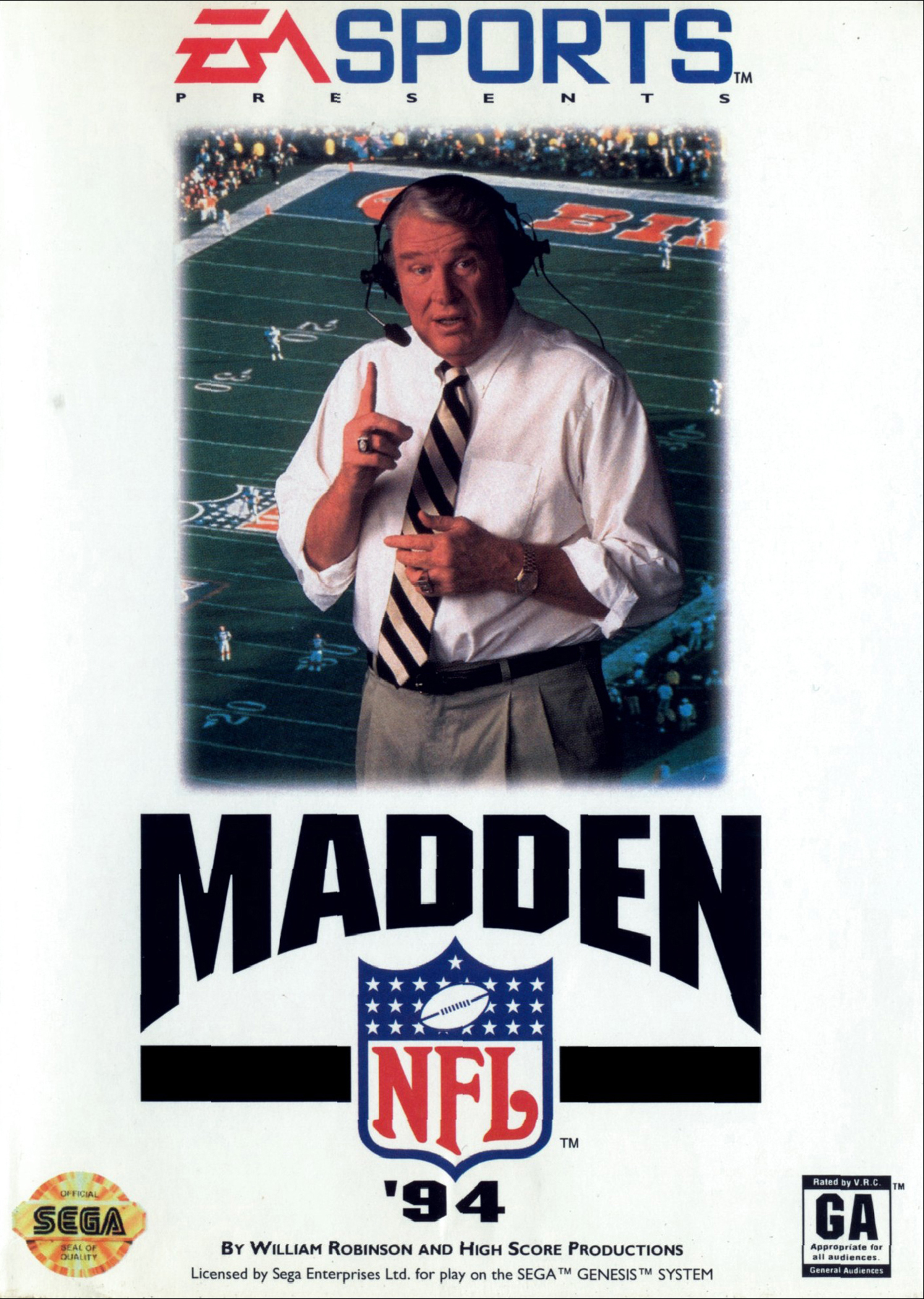
- Developer: High Score Productions
- Publisher: Electronic Arts
- JP Release: 1994-02-18
- NA Release: 1993-11-19
- EU Release: 1993-11-12
- Franchise: Madden NFL
- Genre: Football
- Theme: Football
- Premise: Football
- Availability: Might be surprised to hear this series is still going. Just get the new one, going by the annualized sports game mathematical formula that states "newest one = the best one". Quod erat telestrandum.
- Preservation: Here the big guy is, every November like clockwork. It'd be fair to say that Madden, despite being a multiplatform affair, represented the American Sega Genesis almost as strongly as Sonic the Hedgehog in the eyes of many such was the EA Sports label's grasp over that market. I've nothing really to add at this point: This is the fifth Madden game for the platform (fourth if you only stick to the core annualized entries) and despite a few noteworthy feature additions and the return of the NFL license (but not the NFLPA, so no player names) it's mostly the same business as usual. It was apparently the first Madden game to do the 180 degree panoramic camera rotation whenever ownership of the ball switched, rather than the single-frame change which I guess confused a lot of players who blinked at that moment, and that scan would become something of a visual motif for this series and other football games going forward. Another fun fact: this was the first (and last) Madden game to reference the year 1994 in its title ("phoning this in"? What are you talking about?).
- Wiki Notes: SNES double-dip. Updated releases and added new screenshots since the old ones were scratchy jpgs.
517: Sonic the Hedgehog Spinball

- Developer: Sega Technical Institute / Polygames
- Publisher: Sega
- JP Release: 1993-12-10
- NA Release: 1993-11-23
- EU Release: 1993-11-15
- Franchise: Sonic the Hedgehog
- Genre: Pinball
- Theme: Getting Flipped Off By Robotnik
- Premise: Sonic takes on his toughest mission yet—navigating the most improbably-annoying building security system since the Raccoon City Police Station.
- Availability: You can play it on Steam, through the Switch Online service, or on the first Sega Genesis Mini console. It was on mobile too, and in the Ultimate Genesis Collection compilation for 360/PS3.
- Preservation: The two things you rarely want to hear together are "STI" and "balls" but in this case it's not quite so catastrophic, even if it's still perhaps somewhat painful. Sonic Spinball is, I believe, the first Sonic spin-off or at least the first non-platformer one—we'll be getting the second in the very next Mega Archive, incidentally—and stars Sonic at his most spherical, at least outside the inflation tag on DeviantArt (man, two gross sex jokes already. Sonic just brings it out of me, what can I say?). Goal is to defeat Robotnik's "Pinball Defense System" from the inside by acting as the ball, eliminating hazards and enemies with Sonic's indomitable spin attack. The reception to this game was somewhat muted if I recall, probably because everyone was jonesing for Sonic 3 and weren't keen on what was seen as a desperate half-measure, but the brand was strong enough to make it a big seller for the holiday period in lieu of that big anticipated full sequel, which would arrive shortly after in February 1994. The Mark Cerny-founded STI were of course instrumental in completing work on Sonic 2 alongside Sonic Team and at this time were also busy helping same with the finishing touches on Sonic 3. Polygames, meanwhile, allegedly did most of the programming; we last saw them in the previous entry with the conversion of Atari's race driving arcade game Race Drivin'.
- Wiki Notes: As with almost anything Sonic, the page is already one of our most robust. Didn't need to do squat.
518: Outback Joey

- Developer: Western Technologies
- Publisher: HeartBeat Corporation
- JP Release: N/A
- NA Release: 1993-11-24
- EU Release: N/A
- Franchise: N/A
- Genre: Platformer
- Theme: Instead of Cadillacs and Dinosaurs, it's Cardiacs and Marsupials
- Premise: A mascot platformer where the player's elevated heart rate is the key to winning. Could get ethical.
- Availability: Sure, if you have $5,000 handy and can wait it out for copies to surface on eBay.
- Preservation: Outback Joey is an Australia-bound mascot platformer that has a familiar plot of its titular animal hero chasing down human poachers to rescue his friends. What sets it apart from the system's many other mascot platformers is that it was only sold as a pack-in for a heart rate monitor peripheral that could send data about the user's current status to the game. Oddly enough the N64 had one of these heart rate doodads too: the SETA Corp game Tetris 64 was compatible with it and, like this game, an elevated heart rate will make the game tougher to handle which really would also produce more stress and thus an even less manageable playthrough. Feels like they maybe didn't think this whole affair through. Consumers agreed, and with a lack of sales both the game and peripheral have become increasingly rare over the years to the extent that Outback Joey commands four figures in online auctions. Western Technologies is no stranger to video game hardware: they helped Sega put together the development kit for western Genesis developers and also had a hand in creating their proprietary light-gun the Sega Menacer.
- Wiki Notes: New page, so... needed everything. To my chagrin I was unable to source my own screenshots and I didn't want to steal from other sites. Hopefully another wiki user can figure out how to emulate it properly.
519: Tecmo Super Bowl

- Developer: Tecmo
- Publisher: Tecmo
- JP Release: 1993-11-26
- NA Release: 1993
- EU Release: N/A
- Franchise: Tecmo Bowl
- Genre: Football
- Theme: Football
- Premise: Football
- Availability: Out of print. I'd love to see Koei Tecmo make a football game today though. You wouldn't think football could work with 2,000 Chinese infantry per team but it somehow does.
- Preservation: Tecmo Super Bowl is the 16-bit follow-up to the venerated NES classic Tecmo Bowl, and is itself a very well-regarded football sim that even in this new incarnation sticks to its guns regarding its archaic horizontal perspective and tiny player sprites when so many other franchises were trying to go big and realistic with a bird's eye view. The game's probably better for focusing on the gameplay though, saving the graphical flourishes instead for the animated cutaways after major events like touchdowns, field goals, or QB sacks. Tecmo knew implicitly what sold on the Mega Drive, so they made sure to port over every sports game they had in development. Ninja Gaiden? EA didn't become a multi-billion business by hocking ninjas. It's all sports, all day, baby. This is Tecmo's second Genesis game after Tecmo World Cup '92 (soccer having slightly more international appeal) and we'll be seeing at least two more Tecmo Super Bowls after this in addition to baseball, hockey, and basketball. Honestly, hearing that the strategy sim-focused Koei had merged with Tecmo was like discovering that the quiet history geek girl in your class ended up marrying the captain of the football team after highschool.
- Wiki Notes: SNES double-dip. Just some screenshots.
520: Battletoads & Double Dragon: The Ultimate Team
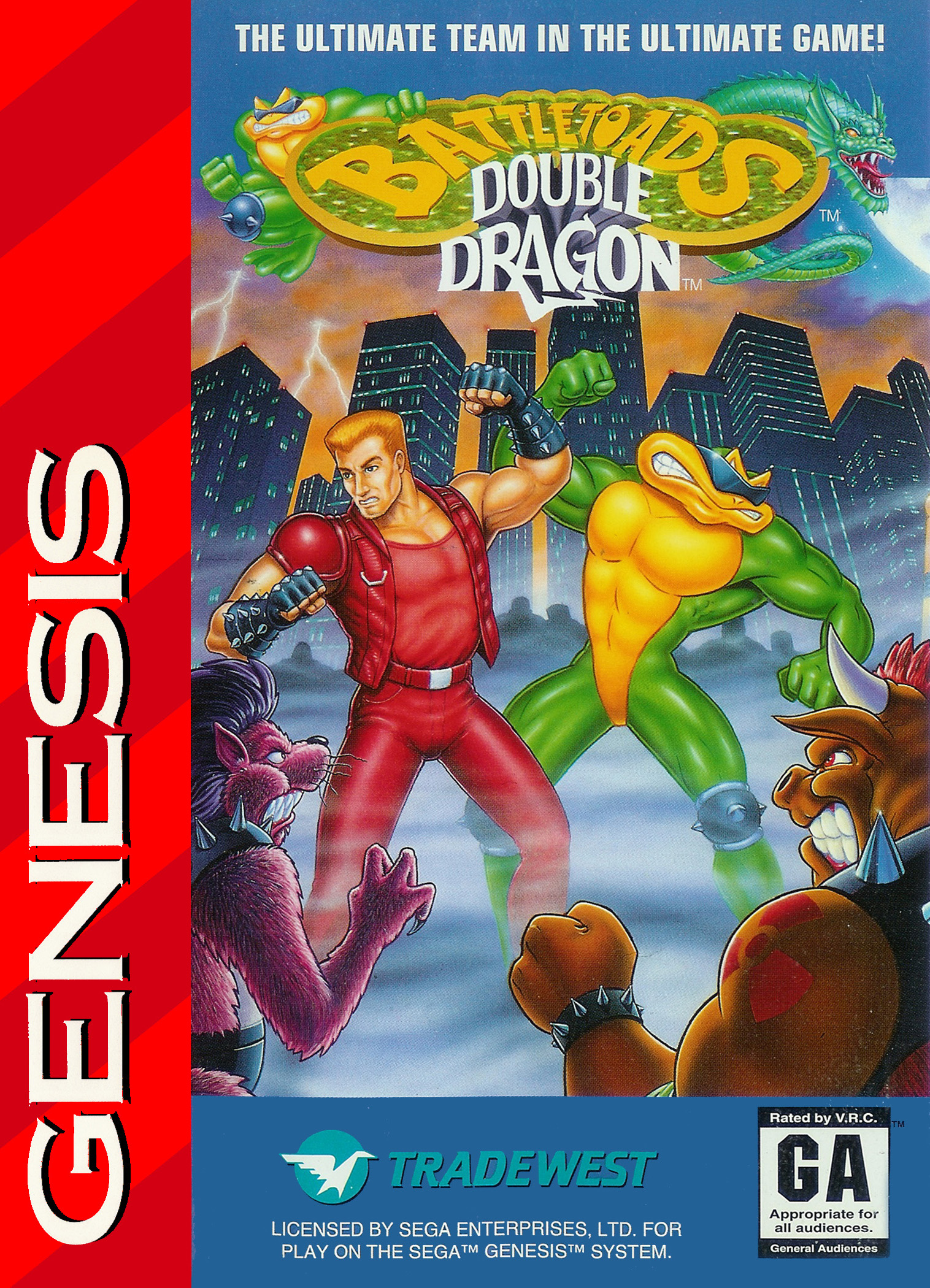
- Developer: Rare
- Publisher: Tradewest
- JP Release: N/A
- NA Release: December 1993
- EU Release: N/A
- Franchise: Battletoads / Double Dragon
- Genre: Brawler
- Theme: Dragons and Toads Together at Last
- Premise: Billy and Jimmy are a little out of their element when a group of mutant amphibians ask the pair to join them up in space to fight a bunch of alien monsters.
- Availability: Retro-Bit Publishing acquired the rights to publish physical versions of the NES game. Dunno if they intend to do the same for this version too.
- Preservation: Crossovers are nothing new in video games—we had a Marvel superheroes one just last entry—but how Rare managed to convince Technos Japan to go halfsies on a Battletoads game must've required a certain amount of convincing. That isn't to say Technos isn't fond of cartoon-level violence—they are the Kunio-kun guys after all—but I wasn't sure Rare had the international cachet to pull that off given we're still on the other side of Donkey Kong Country (a 1994 jam). Regardless, since Rare are the developers here we're mostly talking Battletoads with a few Double Dragon characters thrown into the mix, including not just the inestimable Lee brothers but also the likes of Abobo, Roper, and the Shadow Boss (now no longer Jimmy; though that was just in the NES version) as well as a bunch of generic street goons. That also means gimmicky levels that aren't about brawling: one memorable sequence has you take on the Dark Queen's mothership in a shoot 'em up. Your appreciation of this game will purely come down to how much you enjoy Battletoads as a franchise which, well, those people certainly exist. This would be the last Rare game for this or any Sega platform (barring a bizarre Brazil-only port of Battlemaniacs for Master System): after DKC Nintendo bought a significant amount of Rare's shares and they became second-party developers, making quite the name for themselves on SNES and especially on N64.
- Wiki Notes: SNES double-dip. Screenshots.