
The Dredge of Seventeen Rising: Redredgence (Part Three)
by mento
The Dredge is back! 2021's hottest 2017-themed blogging feature returns for a single month of additional catch-up gaming from one of this industry's most legendary years, all in the service of fine-tuning the internet's largest and greatest 2017 GOTY list . Be sure to check Part One here for a more thorough explanation of whatever this nonsense is all about. Dishonored: Death of the Outsider (...
The Dredge is back! 2021's hottest 2017-themed blogging feature returns for a single month of additional catch-up gaming from one of this industry's most legendary years, all in the service of fine-tuning the internet's largest and greatest 2017 GOTY list. Be sure to check Part One here for a more thorough explanation of whatever this nonsense is all about.
Dishonored: Death of the Outsider (Arkane Lyon, 2017)

Our final Dredge revisit is this standalone expansion to Dishonored 2, the "immersive sim" (boy oh boy do I not care for that term) first-person stealth assassination game that sees the series out on a more or less definitive note, given that its subtitle refers to eliminating the enigmatic deity that gave the franchise's protagonists (and some of its antagonists) their sneaky superpowers. Set shortly after the second game, wherein the mercurial former assassin Billie Lurk assists either Emily Kaldwin or Corvo Attano in taking back the Empire of the Isles from a powerful witch usurper, this game sees Lurk reunite with her mentor—the "Knife of Dunwall" Daud, who initiated this whole revenge story by sticking a blade in the back of Emily's Empress mother Jessamine—and be given her hardest assignment yet by the dying and remorseful former master killer. Within five missions set across five large areas, though with some overlap between the second and third, Lurk must uncover the secrets of the Eyeless cult, acquire the eerie blade that created the Outsider deity in the first place, and then locate him at the end of the world and put him out of his (and everyone else's) misery.
Jumping back into the world of Dishonored is once again a complicated treat. I can't say I have any particular affection for stealth games in general—I've bounced off the series that could be said to be Dishonored's chief inspiration, Thief, a number of times—but the worldbuilding and sense of a lived-in place with a lot of secrets to find and bonus objectives (and loot) to procure does make the exploration a great deal of fun, even if you're frequently forced to keep off the easier routes on ground level due to an ubiquitous guard presence. With incentives for staying silent and unseen, everything takes that little bit longer when you're looking for plunder to fund upgrades to your tech or abilities via the black market or the series' passive skill-bequeathing "bonecharms": supernatural totems carved from scrimshaw as befitting the game's whale oil-powered steampunk setting. However, given her bloody background, Billie's not really one to worry about leaving a trail of corpses in her wake so that "chaos" aspect that comes from a high bodycount is less integral in this game than it was in the two previous where being a little too bloodthirsty can lead to some serious repercussions down the line, so I've found that to be more liberating along with acquiring all my powers relatively early into the game. Should point out that this series has always had the option for you to "go hard" in your missions but always with that caveat that you'll see some sort of karmic retribution for it later; I'm also the kind of an obsessive idiot, as we've previously established many times, that needs to get as many achievements as possible and that includes, as it so often does in this franchise, a zero-detections run. Since you need to do at least two playthroughs to acquire all of them here (and that I'm playing on EGS, where my achievement count is immaterial) being all gung-ho about achievements has been less of a factor this time, perhaps fortunately.
 Rats were usually a bad sign in prior Dishonored games, since they had an unfortunate habit of devouring any bodies (unconscious or otherwise) left lying around. I guess they figured we didn't need them any more if we stashed them in a dark corner somewhere. In Death of the Outsider, they instead work as cryptic informers, offering cute little tips like 'there's a secret underground entrance around here' or 'cheese give me cheese, cheese now i want the cheese where is the cheese give it give it'.
But yes, as is often the case with Dishonored you can spend several hours just poking around offices and apartments above ground level as the cops of this world never feel the need to look up—the houses do tend to have egress-blocking spikes across most of the walls though, so they are at least somewhat aware that there are supernatural assassins roaming around rooftops on a regular basis—and completing bonus "contracts" for some additional funding. These contracts typically require you to perform an action in a specific way: pickpocketing an item from a guard without any kills or being spotted; taking a stolen item back from a group of thieves; knocking out a bartender in a pub full of gangsters and quietly depositing him in a crate on a nearby rooftop without anyone spotting you (that wasn't easy); and several others in that vein. The rewards are often worth it, but so too is just having to puzzle out a way where a hit or a theft won't jeopardize the contract or, indeed, the main story objective you're here for in the first place. A particularly thorough player might even find themselves demarcating a centrally located room and just knocking out or killing every guard and packing them in there like insensate sardines—I know there's plenty that play Hitman and other stealth games under a similar criteria. Dishonored has always had that freedom to tackle its objectives through whichever paths you choose, violent or pacifistic, invisible or with all your guns and gadgets blaring, and though Death of the Outsider does feel a little more restrictive given its slightly higher difficulty level (it was meant to be an epilogue of sorts to a sequel after all—if you're that deep into the story, you're probably well-versed enough in mystical murdering by that point) there's usually some clever alternative paths to consider.
One highlight so far was the third mission, which has you performing a bank heist for the mystical knife needed to off the Outsider. There's multiple routes into the bank, including from the roof access using a painter's lift or through the sewers, but the defenses and personnel inside the bank will make navigating around to the vault that much more complicated. What you can do if you paid enough attention to the briefing at the start of the mission is to locate the clinic of the pharmacist the cult had bumped off, follow a breadcrumb trail to an auction for a bottle of highly soporific laudanum once brewed by that pharmacist, and then pour its contents into the air vent on top of the bank to send everyone inside to sleep. It's not a foolproof plan—the bank guards and active tellers are light snoozers, so even the "ping" of a cash register opening would be enough to rouse them; you also have the traps and robot guards to be wary of, since obviously neither are going to be affected by knock-out gas—but it does make the heist itself that much more tolerable and, given the hoops you had to jump through, it doesn't so much feel like cheating as it does working smarter rather than harder.
 Karnaca, which is where most of Dishonored 2 was set in as well, still looks as resplendent (if drily hot) as ever. Missions two and three are set in this more bougie uptown area that looks down (figuratively and literally) on the rest of the city.
Dishonored, like Thief and Deus Ex before it, always feels like it's bending over backwards to accommodate players of any skill level or their predisposition towards the stealth genre. It provides so many grenades, mines, guns (of the subtle pneumatic wrist-cannon kind), and other violent means of removing patrolling guards permanently that going loud feels like a viable solution to most problems, even if you might need to go out of your way to find these tools or at least pillage enough to buy them from the black market, while also giving you three innate supernatural abilities that instead seem to encourage being more of a sneaky little so-and-so. These three include Displace, a modified version of Blink that lets you set a teleport point for later that you still need an unobstructed line of sight to activate—this can be very handy for setting up a quick escape ahead of time; Foresight, which essentially lets you fly around the area as a ghostly drone to tag enemies and items of interest to avoid any nasty surprises (you can also set Displace targets in this mode too); and Semblance, which lets you imitate a NPC one time for a short duration, though this duration is frozen if you don't move—extremely useful if you need to do or grab something where there's a lot of guards roaming around, provided they don't have their wolfhounds around to sniff you out through your disguise. The game is wise enough to limit you to these three, with some bonecharms adding extra utility, so that you're never overly overwhelmed with options for whatever specific style of subterfuge you're searching to secure.
Even if I'm always filled with an inscrutable sense of anxiety whenever I'm dropped in a new environment for the next mission there's an inescapable appeal to gradually getting the lay of the land, having a plan come together for your immediate goals (contracts or the main mission), and being in a potentially sticky situation and cogitating your way out of it with perhaps some trial-and-error quick-save/quick-load business to see what you can actually get away with. Taking out a room full of goons without anyone ever detecting you or pulling a Hitman by eliminating a target in what might be the least dignified way possible still has its visceral appeal even if the set-up might've been painstaking and required a great deal of patience to assemble, akin to the delayed gratification of setting up and knocking down a thousand dominos. I also still love the worldbuilding of Dishonored, carrying on from Arkane's similarly intriguing spin on a fantasy version of an environmental post-apocalypse in Arx Fatalis, where you have quotidian concerns like a vast disparity between the haves and have-nots in the midst of a 19th-century world full of unusually anachronistic technology like forcefields and robot sentries coupled with the supernatural skullduggery weaved by an unknowable eldritch deity created thousands of years ago by the equally inscrutable machinations of ancient cultists. The first rule of a truly immersive video game world is to make its origins compelling enough to want to explore it from top to bottom, and that's always been Arkane's greatest strength as builders. Death of the Outsider, with its stated objective of getting real deep in the weeds about the series' most uncanny elements, certainly pulls that off with aplomb.
 The bank is full of big zappy traps like that Tesla coil thing on the right there. They can't get you if you go on the light fixtures over their heads though. Famous thing about electricity is that it can only flow downwards, not up. Ask a physicist.
[To Be Determined]
One last trio of 2017 games that I swear I'll check out before the heat death of the universe—or, more pressingly, the regular death of me, a mortal human (currently).
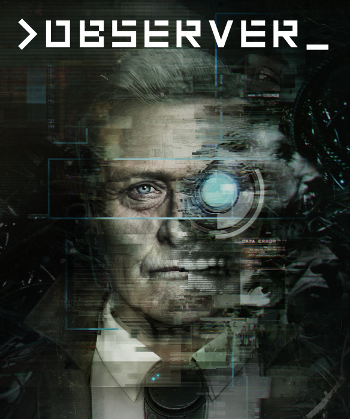 One of many Bloobs to perhaps warrant a second look after the success of Silent Hill 2: The Resilencing.
- Observer: Prior to Bloober Team knocking it out of the park with the Silent Hill 2 remake to the moderate surprise of anyone who'd played Layers of Fear or its sequel, Observer had been considered their best game. Set in a near-future version of Poland that had been clobbered by a "nanophage" plague and rescued, by some definition of the term, by a corporation that promptly took control, the player is put in the gumshoes of an "observer": a member of Krakow's law enforcement capable of hacking into brain implants as a means of interrogating crime suspects. Dealing with themes of dystopia, police overreach, and humanity's place and sense of alienation in an increasingly digital world, Observer was also one of the final projects of actor Rutger Hauer—fittingly the same sort of identity-crisis cyberpunk thriller that put him on the map back in 1982 with Blade Runner—who passed away in 2019. Bloober has never been a group one might trust to handle heavy themes but given their sterling work with SH2 (purportedly; I've yet to play it but it did get SH perfectionist Jess "VoidBurger" O'Brien's stamp of approval) it might be something I ought to check out.
- Blackwood Crossing: On the subject of surreal first-person adventure games with their darker sides, PaperSeven's Blackwood Crossing was brought to my attention after a bit of perusing into the most positively rated games on Steam from 2017 (research? Moi? It happens). A surreal coming-of-age drama about a couple of kids on a train. It gets kinda trippy fast from what I can tell, though of course with a game like this it's best to know as little as possible going in. I've dropped it on my Steam wishlist (to die, really, since that thing's almost a thousand games strong now) and I'd bet it'd find a good spot somewhere around Detention, Rakuen, Finding Paradise, What Remains of Edith Finch, and all the other potentially significant "emotion" adventure games that have found their way on there.
- Nex Machina: Getting as far away from dense story-based games with serious messages and oodles of dialogue, we have another arcade synesthesia smorgasbord from epilepsy-entrepreneurs Housemarque. A top-down twin-stick shooter made in the Smash TV or Robotron mold, it marries its older format with various state-of-the-art game development tricks to create a sensory-overloading experience that may or may not send me into a jittery coma. Only one way to find out, I suppose. In all seriousness, I do occasionally get bitten by the bug that are the older school gaming experiences—a field that also includes belt-scrolling brawlers like the recent TMNT: Shredder's Revenge, boomer shooters like Prodeus or Hands of Necromancy, or anything that resembles the Arkanoid-likes I used to be addicted to—and a super modern and sharp one of those sounds like it might hit the spot.
That'll do it for the Dredge for another season! As I've intimated previously, even with these three consequential entries—and the nine potential future additions—there's still so much more I want to tackle before I can put a button on 2017 and its vast vault of valuables (sorry, I'm atypically alliterative this afternoon; I assume it's my annoyingly assertive allergies that are answerable).
I did also promise a few tentative list placements for these three, didn't I? Taking in the current rankings, I'd put Dragon Quest Heroes II somewhere around the early teens where the similarly exceptional action-RPGs Tokyo Xanadu eX+ and Zwei: The Ilvard Insurrection can be found, while both Metroid: Samus Returns and Dishonored: Death of the Outsider go a little further down in the late 20s with Uncharted: The Lost Legacy, What Remains of Edith Finch, and Life is Strange: Before the Storm—three more great games led by kickass (or at least heavily pregnant) female protagonists. I'll have to see Death of the Outsider to its conclusion (I'm partway through Mission 4) before I decide exactly whether it's just above or below Metroid, but all three of these Dredge candidates passed the goal of reaching the top 40 at least, so my kudos goes out to their creators. I'll have the updated list at the end of the year, as I do with all the "GOTY (Adjusted)" lists (provided I have enough to add to make it worth the hassle of rearranging everything), so maybe I'll see my way to a few more possible 2017 barnstormers before 2025 is over, all "off the record" style.
Man, it's a good thing a bunch of really well-rated RPGs didn't come out this month to highlight just how little room I have to play everything I want, huh? Still, it was inarguably time well spent. As was, I hope, reading about several extra reasons why 2017 was such a fine year for gaming that we won't soon forget. Catch you with something a little more contemporary next time, duderinos.