Overview
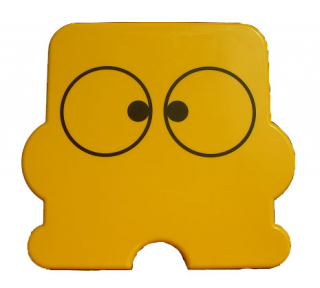 Disk-kun, the add-on's mascot character
The Famicom Disk System was part of a line of add-on systems produced exclusively in Japan for its version of the Nintendo Entertainment System called the Famicom. Its claim to fame was that its games were released on a medium similar to floppy disks. The disks, having two sides, originally contained more space than what a Famicom cartridge was capable of holding. They were also much cheaper to produce, a characteristic meant to lure developers to the platform. The Famicom also features a microphone in the controller, which certain games used, such as an updated version of the original Zelda. Despite the Disk System's moderate success, the majority of the Famicom's library still remained in cartridge form exclusively. Nevertheless, several of Nintendo's series were started on the Famicom Disk System and later entries in the series were available on more mainstream Nintendo platforms.
The Disk
 A yellow famicom disk system game
The Famicom Disk System's games contained internal features impossible to replicate on cartridges. The most notable of these features was their rewriting capability. Aside from being applied to conventional tasks, such as saving progress, certain disks could also have their games entirely overwritten for a small fee.
The disks themselves were either a yellow or blue color and have the word Nintendo etched in at the bottom, with the blue version containing a shutter, whereas the yellow does not. Most disks have stickers on both sides that contain the title of the game as well as a large "A" or "B" (alternatively "Side A" or "Side B") on the left side of the sticker which tells the player the side of the disk. Typically the player needs to put Side A in first to boot up the game and once they start a game or load a saved file a message will appear on the screen telling the player to switch sides. At this point the player needs to eject the disk and flip it over to side B to start the game. Some disks are one sided meaning side B is blank and doesn't have a sticker on it. Games that have a blank side B do not need to be flipped over at any point.
Sharp Twin Famicom
 Twin Famicom
Sharp Corporation released the Twin Famicom in Japan on July 1, 1986, less than five months after the release of the Famicom Disk System. The Twin Famicom combines the Famicom and Famicom Disk System into one system and is officially licensed by Nintendo. The system has a switch just below the cartridge slot that allows the player to switch between using the Disk System or the Famicom. When switched to the Disk System the cartridge slot locks to prevent players from attempting to use both slots at the same time. Similarly, if switched to the Famicom the Disk System slot locks for the same reason.
The original release of the system came in two different colors red with black highlights or black with red highlights. There was also a re-release that came in a slightly different case design, turbo controllers, and two new sets of color schemes. The first color scheme is black with green highlights and the second is red with blue and gray highlights.
Overseas Conversions
Because Nintendo opted to not distribute the Famicom Disk System outside of Japan, all of its games which received international releases required technical modifications so that they could function on regular cartridges. Ultimately few of these games retained their ability to save games due to the costs of incorporating batteries into the cartridges. ( The Legend of Zelda is one exception, as it still employed battery-backed saving.) Instead, many games, such as Metroid, employed passwords to record players' progress.
The original protagonists of Doki Doki PanicThe American version of Super Mario Bros. 2, however, is the most famous of these conversions. Because the original sequel in Japan was deemed to be too difficult for most players at the time, Nintendo chose to bring over what was originally a completely different game instead and retrofit it as a Mario game. The game which was chosen to do this was Doki Doki Panic, an Arabian-themed platformer which had been produced for a television station's special event. The protagonists in the game, a family, were replaced with Mario, Luigi, Peach, and Toad. Additional technical alterations were made in specific areas of the game, mostly pertaining to specific sprites' animations. Enemies which were part of Doki Doki Panic remained in the new version, with many of them, such as Birdo and Bob-omb, appearing in subsequent Mario games afterwards. This rendition was later released in Japan as Super Mario USA.
Series Originating on the Famicom Disk System
The original Metroid for the Famicom Disk System
Log in to comment