Overview
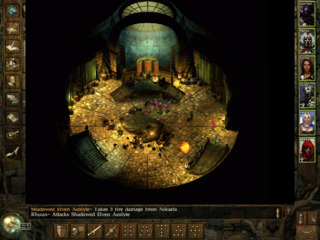 A combat heavy game, focused on loot
Icewind Dale is an Dungeons & Dragons RPG released in June 2000 by Black Isle Studios. Though based on the Infinity Engine, which powers the Baldur's Gate series, Icewind Dale is less focused on story and character development than those games. Even though it's mechanically identical to Baldur's Gate, Icewind Dale is more spiritually similar to the Diablo series, in that the primary driver for the game is combat, leveling up the party, and collecting more-and-more powerful equipment.
From the get-go, the player creates a party of up to six characters, which fall into the classes offered in the 2nd Edition AD&D Rules. There is little-to-no backstory for any of the characters, unless the player chooses to create one, and limited personality to each party member beyond their stats. In contrast, Baldur's Gate allowed the player to create one main character with all of the other party members being predefined and joining the party as they were encountered.
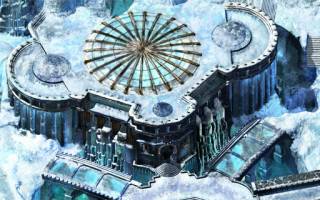 There's no shortage of snow in Icewind Dale.
There is little backstory to the entire game. The player's band of adventurers have arrived at Icewind Dale, looking for work, and are asked to investigate strange goings-on in a nearby town. This sets the party off to battle hundreds of different enemies and save the North. The party doesn't affect the outcome of the story much, as the only option is to cut down everything in their path. Thus, considerations like moral alignment are rendered moot. The party is a buzzsaw, cutting through anything it encounters.
While Icewind Dale shares its name and location with the trilogy of books by R.A. Salvatore's, there is no overlap with its story beyond passing mention of a few events and characters, such as Drizzt Do'Urden. Because the game takes place during the Time of Troubles, the Drizzt character is busy elsewhere and not in the neighborhood of the locations in the Icewind Dale game. However, if you want to meet Drizzt in a game, check out Baldur's Gate.
Soundtrack
 Icewind Dale Soundtrack Front Cover
The award-winning soundtrack was composed by Jeremy Soule and arranged by Charles Deenen, Scott Everts, Adam Levenson and Ron Valdez. When asked about which scores he was most proud of, Soule mentioned Icewind Dale. GameSpot awarded it the 'Best Music' award in 2000 and said
Each game nominated this year has excellent music that works well, but the musical score for Icewind Dale is unmatched in both quality and scope.
# - Track Name - Duration
01 The Tale Of Icewind Dale (Movie 1) 4:55
02 Icewind Dale Theme 1:49
03 Easthaven In Peace 1:14
04 Hrothgar's Home 0:58
05 Temple Of Tempus 1:48
06 The Lost Caravan 1:14
07 Drums Of The Dead 1:16
08 Avalanche At The Pass (Movie 2) 1:22
09 Kuldahar Theme 1:21
10 Arundel's Home 1:04
11 Vale Of Shadows 1:23
12 Lysan's Lair 1:21
13 Kresselack's Tomb 1:09
14 Kresselack's Lair 0:48
15 Temple Of The Forgotten God Entrance 0:52
16 Temple Of The Forgotten God Interior 0:49
17 Heartstone Shrine 0:21
18 The Dragon's Eye 1:31
19 Yxunomei's Lair 0:33
20 Severed Hand Entrance 0:45
21 Severed Hand Interior 1:31
22 The Mage Tower 0:56
23 Lerrel's Daughter 0:19
24 Lerrel's Astrolab 0:39
25 The Heartstone Gem (Movie 3) 1:07
26 Upper Dorn's Keep Entrance 1:02
27 Upper Dorn's Keep Interior 1:19
28 Drow & Orog Gate 1:21
29 Umber Hulk Labyrinth 1:29
30 The Wyrm's Tooth Entrance 0:45
31 Aquarium Of Alkonos 1:30
32 Frost Giant Cave 1:19
33 Lower Dorn's Deep 1:23
34 Svirfneblin Refugee Camp 1:08
35 Marketh's Palace 1:01
36 Artisan's District 0:48
37 The Fallen Temple 1:00
38 Belhifet's Doom 1:20
39 Return To Easthaven 1:17
40 Easthaven In Pieces 0:58
41 Success 2:28
In addition, the CD also contained 10 bonus tracks not listed on the back cover, bringing the total duration of the CD to 64:16.
Availability
On October 6, 2010 CD Projekt announced and released the game along with its two expansions, Heart of Winter and Trials of The Luremaster, for their digital distribution service GOG.com (Good Old Games) for $9.99 US. This version is guaranteed to be both Windows Vista and Windows 7 compatible.
PC Requirements
Original Requirements
Minimum
- CPU Type: Pentium II
- CPU Speed in MHz: 233 MHz
- RAM: 32MB
- Hard Drive Space: 600MB
- Sound Card: DirectX certified
- CD Drive Speed: 4X
- Graphics Type: SVGA
- Color Depth: 16-bit
- Graphics Resolution(s): 640x480
- Compatible Devices: mouse, keyboard
- Software (DirectX 5.0, etc.): DirectX 7 or higher
Multi-player
Good Old Games version
- Windows XP or Windows Vista
- 1 GHz Processor (1.4 GHz recommended)
- 256MB RAM (512 recommended)
- 3D graphics card compatible with DirectX 7 (compatible with DirectX 9 recommended), Mouse, Keyboard.
Log in to comment