Overview
John Romero's Daikatana (also known as simply Daikatana) is a science-fiction/fantasy first-person shooter developed by Ion Storm and published by Eidos for the PC and Nintendo 64 (ported by Kemco) on April 14, 2000. It was re-released on Steam on October 1, 2013. Designed by id (and Ion Storm) co-founder John Romero, the game is known for being a critical and commercial flop due to both its overhype and continuous obsolescence thanks to its complicatedly-long development cycle, aggressive marketing, outdated graphics, and reliance on its flawed A.I. companions.
Players control Hiro Miyamoto, a martial arts instructor in a futuristic, dystopian Japan (set in 2455 A.D.) where the world is run by powerful corporations (the most powerful owned by the ruthless Kage Mishima). After learning from a feeble old man (Toshiro Ebihara) that the current timeline is actually an alternate timeline after Kage has taken control of the Daikatana (a powerful, magical sword that allows its wielder to travel through time), Hiro (along with Toshiro's daughter Mikiko and a mercenary named Superfly Johnson) must recover the sword and, while traveling throuhg time, return Earth to its normal state.
The game is known for having four separate time periods (ranging from the magical fantasy past to the technological sci-fi future), each with their own unique architecture, enemy types, and player arsenal (5-6 unique weapons per time period). These include future Japan (circa 2455 A.D.), ancient Greece (1200 B.C.), medieval Norway (560 A.D.), and near-future San Francisco (2030 A.D.). The game also includes an RPG-like experience system, where players can level up their character throughout the course of the game (or a single multiplayer match) and acquire significantly boosted strength, speed, and vitality.
Gameplay
Daikatana is primarily a first-person shooter in the style of John Romero's previous work on titles such as Doom and Quake. The focus of the setting is based around traveling through time with the power of the Daikatana, from dystopian, futuristic Japan to ancient Greece, the Dark Ages of Europe, and near-future San Francisco. An attempt was made at improving on the traditional formula by the player having two AI-controlled sidekicks - Superfly Johnson and Mikiko Ebihara. At any given time, the player can direct each sidekick to follow, wait, attack and take objects, but their AI was extremely poor, and if either of the sidekicks died, the game was over. Despite the heavy marketing focus on these sidekicks, this aspect of the game was specifically cited by many reviewers as a major negative towards Daikatana.
In the Nintendo 64 version of the game, Superfly and Mikiko do not appear outside of cutscenes and are thus not part of the gameplay; ironically, this lack of one of the most touted features of the PC version was seen as one of the best parts of the otherwise poorly-reviewed N64 version.
Levels
2455 CE (Common Era): Japan
- 01. Marsh
- 02. Sewer System
- 03. Solitary
- 04. Crematorium
- 05. Processing
- 06. Icelab
- 07. The Vault
1200 BCE: Ancient Greece
- 08. Lemnos Ilse
- 09. Catacomb
- 10. Athens
- 11. Acropolis
- 12. Lair of Medusa
560 CE: Medieval Norway
- 13. Plague Village
- 14. Passage
- 15. Dungeon
- 16. Wyndrax Tower
- 17. Crypt of Nharre
- 18. Gharroth's Throne
2030 CE: San Francisco
- 19. Alcatraz
- 20. Beneath The Rock
- 21. Tower of Crime
- 22. Mishima's Lab
- 23. Mishima's Hideout
- 24. S.E.A.L. Training Center
Story
The game begins in the year 2455 AD, where the world is run by corporations - the most powerful owned by the ruthless Kage Mishima. The opening sequence depicts a young martial arts teacher named Hiro Miyamoto practicing late one night in his dojo. A sick, old man named Toshiro Ebihara appears on the dojo's doorsteps claiming to be a descendant of a group of skilled warriors known as the Ebihara Clan. He explains that centuries ago the Mishima's were a powerful clan that ruled with an iron fist and a bloody sword that only the Ebihara clan would dare oppose. In response to this the Mishima clan employed the services of a legendary swordsmith, an ancestor of Hiro. The swordsmith crafted a sword so powerful, it had the ability to manipulate time itself. The blade was named the "Daikatana" and through the blade, the swordsmith saw the evil that would befall the world if it was ever given to the Mishima clan. Instead, the swordsmith offers the Daikatana to the Ebihara clan and they promptly use it to utterly decimate the Mishima tyranny. Seeing how dangerous the sword could be in the wrong hands, the swordsmith threw the Daikatana into the centre of a volcano.
Toshiro then goes on to explain that in his youth, he was wealthy and funded an expedition to the volcano to recover the Daikatana, but after Kage Mishima learned of this he stole the Daikatana and used its power to travel back in time to make his clan powerful once again. The current, bleak timeline where Mishima rules most of the world is not the way the world is meant to be. Toshiro also claims that Kage Mishima is responsible for the "MMP" virus that plagues the world and keeps the population under his control, as only he owns the vaccine. Hiro, unsure exactly where he fits into all of this is then asked by Toshiro to rescue his daughter, Mikiko, who has been training all her life to use the Daikatana and has recently been captured by Mishima's forces. As Hiro is about to decline, assassins suddenly appear taking the two men by surprise. Hiro is knocked unconscious and Toshiro is mortally wounded.
When Hiro awakes, Toshiro is on the verge of death. He convinces Hiro to save Mikiko and Hiro, hiding inside a coffin carried by a Mishima truck, he begins his quest.
Development
Daikatana was meant to be what John Romero originally wanted Quake to be. Largely inspired by Chrono Trigger and The Legend of Zelda: Ocarina of Time, Romero wanted Quake to be a first-person action-RPG with a time travel theme, but the rest of id Software wanted it to be a sci-fi gothic FPS. In the end, it turned out to be neither, and was instead a fairly standard shooter with much the same imagery as Doom, just with primitive polygonal graphics instead of sprites. After some major arguments against the team at id, Romero was fired from the company and later formed Ion Storm (along with long-time pal Tom Hall).
From very early on in the game's development, Daikatana was aggressively advertised as the brainchild of John Romero, a man famous for his work at id Software in the development of Wolfenstein 3-D, Doom and Quake. Time magazine gave Romero and Daikatana glowing coverage, saying "Everything that game designer John Romero touches turns to gore and gold." One infamous early advertisement for Daikatana, created by marketer Mike Wilson and approved by Romero, was a red poster with large black lettering proclaiming "John Romero's about to make you his bitch", a reference to Romero's signature trash talk during gaming. Nothing else was featured on this poster but a small tag-line reading "Suck It Down," an Ion Storm logo and an Eidos logo. The advertisements tarnished the company's image.
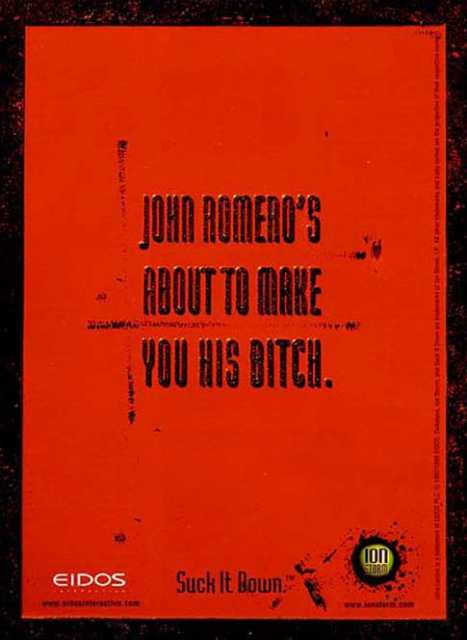 The infamous Daikatana ad
Romero originally completed his design concept for Daikatana in March of 1997. The design document that he had come up with called for a large amount of content. Included in this document were details for 24 levels, 12 weapons and 64 different types of monsters. Despite this utterly huge undertaking Romero remained convinced that development for the game could somehow be completed within the frame of 7 months, in time for Christmas '97.
Romero's growing company Ion Storm had licensed the already-established Quake engine to power the game. id software had completed content development for the much less ambitious Quake in the frame of 6 months with 9 artists. John Romero figured that given these numbers , he could complete the same amount of work on Daikatana in the period of seven months with eight artists. John Carmack at id Software, was quoted in a June 1997 issue of TIME magazine as saying that there was "no chance" Romero would finish a game with 35 weapons and 64 monsters by Christmas 1997. Naturally, he turned out to be right.
"It's just inside the edge of possible to do a commercial first-person shooter in 12 months. Raven [Software] did it with Heretic 2, but that is the only positive case. Even if I thought John had exactly the same positive conditions that Raven had, it wouldn't have been possible to build the company from scratch and still do it. With the combination of John's issues that led to us firing him and the huge game design he was proposing, the idea of getting it done for Christmas 1997 was just patently ludicrous."
-John Carmack
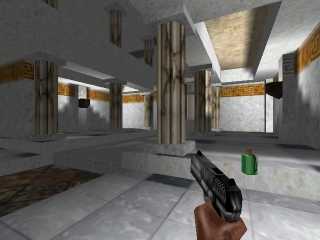 Daikatana Alpha in 1997
The truth of the matter was that Romero didn't have enough of an established, experienced team to handle the project. At the time that all of this was going on, Ion Storm was still being built as a company, hiring in new staff, many of which were only mod makers and not experienced game designers/ programmers. Ion Storm first showed Daikatana at E3 1997, and the game was still running in software mode, which made it look underwhelming at the time. Romero went to see the id Software booth and was stunned by Quake II's dynamic colored lighting, and believed there was no way Daikatana could compete against Quake II's hardware acceleration. He decided to license the new Quake II engine to stay ahead of the competition, but there was one problem: id's contract specifically stipulated that a licensee couldn't use the new engine until id's game was released in December 1997, the same time Daikatana was scheduled to release. The switch forced Ion Storm to scrap eleven months worth of development.
 Romero, pictured in Ion Storm's lavish offices.
Romero was confident that the game engine switch would reach the March 1998 deadline (only three months after the previous deadline!) but little did he know it was not that easy. In fact, his staff was against the switch and hated the decision. Romero seemed to have no idea how much work it was going to take just to implement the bare essentials of his four-hundred-page Daikatana design document. Eidos was displeased with Ion Storm's slow progress and the executives were worried that the company were spending millions of Eidos's money lightly. Compounding the belief that Romero was passive in his involvement was the perception that he wasn't working as hard as he could on Daikatana. It all started with John Carmack's comment to TIME magazine in 1997 that "after [Romero] got rich and famous, the push to work just wasn't there anymore." The online community also picked up on this theme, and before long Romero was depicted as a playboy with little interest in doing more than deathmatching all day long.
Romero denied the claim that his heart wasn't in Daikatana, saying, "I'm here more than anyone in this company, period. Eidos is here every day and they know how hard I work." Besides Eidos, Tim Schafer, the designer of Grim Fandango and Psychonauts, said that Romero definitely did care about making a good game. According to Schafer, there was only one thing to say about Romero's interest in his game: "The dude cares."
"In crunch mode on Grim [ Fandango], I sometimes wouldn't answer my e-mail until two in the morning. When I did, there would often be a response from John within a second, or even a phone call. I'd be like, 'John, it's two AM here in California; it must be like four in Texas. What are you doing at work?'" [Romero then replied] "I'm working on Daikatana. It's going to rock."
-Tim Schafer
Tensions began to arise between Romero and his staff and he fired a few of them one by one. In November 1998, eight members of the Daikatana team left Ion Storm in frustration and formed their own company: Third Law Interactive (originally Bloodshot Entertainment). In January 1999, Daikatana's basecode completed its switch to the Quake II engine. The switch had been scheduled to only take weeks, instead taking an entire year. Although plans had been made to have the game done by February 1999, they missed their deadline and were forced to push the game back still further. A demo of the game was released, but it underwhelmed many players due to the fact that it only included multiplayer death match, something that has ironically been lost on modern developers, who frequently put out multiplayer-only demos for no apparent reason. Ion Storm tried to make up for the demo's disappointment by making a more impressive singleplayer demo for that year's E3.
Unfortunately, last-minute changes to the game's code and other issues had the game running at a less-than-impressive 12 frames per second. At this time Eidos became fed up with the project, given that it had funded the game for $25 million at that point. In June, 1999 Ion Storm and Eidos came to an agreement which resulted in Eidos receiving majority ownership of the company. In August, 1999, Daikatana's lead programmer Steve Ash left the company and Shawn Green (ex-id Software member) was his replacement.
The Daikatana development teamDaikatana was officially and finally released on April 14th, 2000, and after all the anticipation, excitement, and hype the game built over the years, Daikatana received overwhelmingly negative reviews. GameTrailers.com named Daikatana as the second most disappointing game of the decade, surpassed only by the MMORPG Star Wars: Galaxies.
Reception
Romero buys the first copy of DaikatanaDaikatana only sold 200,000 copies upon release. Several common criticisms include:
- Poor AI implementation: One of the main criticisms was the enemy and sidekick AIs, which were profoundly unintelligent. Sidekicks would ignore orders from the player and get themselves killed by environmental hazards, including seemingly innocuous level elements, such as doors. Most enemies displayed minimal strategy and would simply charge the player head-on.
- Hard difficulty: Romero admits that he made a marketing blunder by making Daikatana a very difficult game with few save points and many death traps (although the saving system was much improved through a patch) Many players found the first opening level difficult and annoying, with its swarms of mosquitoes and squishy stampedes of robotic frogs.
- Outdated graphics: Running on the already-outdated Quake II engine, Daikatana looked technically unimpressive when compared to other games that were out at the time, such as Quake III: Arena and Unreal Tournament (which used brand-new game engines)
Daikatana was considered to be one of the biggest disappointments in video game history because it did not live up to the hype Romero and Eidos created. It tarnished Ion Storm's reputation because of its poor quality and Romero's lavish rock-star lifestyle, which included the company's multimillion dollar office on the top floor of a Dallas skyscraper.
Eidos reported a major loss of profit from the game's development costs and sales and fired many of the Ion Storm staff; including Romero, Tom Hall and Stevie Case. The three formed Monkeystone Games, a small company focusing on mobile games. Many believe the fallout from Daikatana sidelined Romero's career in the high-end PC gaming industry forever.
Romero has said in recent interviews that he regretted some of the decisions he had made with Daikatana. He was actually against the "bitch" ad at first because he would never call anyone "his bitch" in his whole life. He admitted his regret for not rejecting it when marketer Mike Wilson presented him with the idea, as it ruined his connection between the fans and the community.
"You know, I never wanted to make you my bitch, not you, not them, not any of the other players and, most importantly, not any of my fans. Up until that ad, I felt I had a great relationship with the gamers and the game development community, and that ad changed everything. That stupid ad. I regret it and I apologize for it. You know, when the ad was first presented to me, I knew it was risky, and I didn’t want to do it. It didn’t make sense. I mean, there’s the whole culture of smack talk that goes with games, and especially the FPSes, and that was something I was known for. While the game could have been better on a number of levels, that ad and the hype that preceded and followed it was clearly a marketing failure and that was followed by my failure to stop it. Even if I had come out with a brilliant game, it wouldn't have mattered. The ad nearly insulted everyone who read it."
- John Romero
The Nintendo 64 version received particularly harsher criticism than the PC version. Due to its rushed development, the graphics were poor, with blurry textures and a short draw distance. The characters Superfly and Mikiko were removed from gameplay but could still be seen in cutscenes. The version of Daikatana for the Game Boy Color however, was surprisingly well-received by the critics, and is considered one of the better titles for the handheld console.
Music
The Daikatana soundtrack was released on October 6th, 2005 and the music comprised of classical, electronic, chorus, rock, and metal genres. It came in two separate discs (dubbed Volumes 1 and 2) and it was published by Dominus Animae, As of now, the soundtrack is out of print. All music was composed by Will Loconto, Stan Neuvo and Will Nevins, except Slow Doom by Bobby Prince.
Volume 1
Total Tracks: 17
Total Time: 53 minutes
1. Daikatana Saga - Swamp Adventure (1:38)
2. Mishima Groove - Trailer Mix (4:17)
3. Menu 1 (2:02)
4. Menu 2 (1:28)
2455CE Japan
5. Modern Muck (2:24)
6. Forgotten Sludge (4:04)
7. Kick Action (4:05)
8. Mishima Groove (4:03)
9. Slow Doom (3:09)
10. Facerake (2:04)
11. Hardcore (4:02)
1200BCE Greece
12. Myth Epoch (4:05)
13. Deep Descent (4:07)
14. Long Journey (4:04)
15. Grandeur (4:06)
16. Titans (1:49)
17. Medusa (2:11)
Volume 2
Total Tracks: 23
Total Time: 61 minutes
560CE Norway
1. Plague Times (4:05)
2. Iced Passage I (1:37)
3. Iced Passage II (1:15)
4. Choice of Path (1:37)
5. Horror Alone (4:07)
6. Haunted and Terrifying (4:04)
7. Evil (2:20)
2030CE San Francisco
8. Bust Out (4:14)
9. Rock The Rock (3:23)
10. Gangland (3:33)
11. Modern Mystery (4:50)
12. Caution (6:15)
13. Siren (2:56)
14. Stalked (2:01)
15. Credits (3:59)
Additional Materials
16. The Catacombs (1:36)
17. Lonely Hearts (3:46)
18. SewerCo Crawl (1:33)
19. Alcatraz Headbanging (1:32)
20. Tower of Crime (1:41)
21. Wasteland (5:00)
22. Kick (2:56)
23. River of Blood (2:50)
Trivia
- The protagonist Hiro Miyamoto was named after legendary game designer Shigeru Miyamoto, with his first name being a play on the word "hero", as he was the player character.
- The organ music ("Slow Doom") being played in the Mishima Crematorium is the level music from Doom's E1M1 (titled "At Doom's Gate" by Bobby Prince)
- In the Tower of Crime level, a Dopefish can be found swimming in a big sewage tank beneath the level. To find him, the player must to turn on the "noclip" mode cheat and progress underground in order to find it.
PC System Requirements
Minimum
- System: Pentium-200 or equivalent
- RAM: 32 MB
- Video Memory: 4 0
- Hard Drive Space: 200 MB
Recommended
- System: PII 300 or equivalent
- RAM: 64 MB
- Hard Drive Space: 400 MB
Log in to comment