Overview
The Metroidvania style of gameplay focuses on free exploration of one large 2D open world. It is so named as a portmanteau of "Metroid" and "Castlevania" as the style was largely popularized by the Metroid and Castlevania franchises.
The game world in a Metroidvania game is designed in a non-linear fashion, allowing players to explore the world. However, there are usually limitations to a player's exploration, such as out-of-reach areas or areas blocked by an obstacle only destructible by a certain attack. Such limitations are subject to completing certain objectives or finding new tools, and backtracking to and revisiting older areas are hallmarks of this style of game. There are other free exploration designs besides the Metroidvania, and it could be argued that the original Legend of Zelda had an incredibly similar design mindset. The primary difference is the camera view. Most games that allow free exploration use a 3D or overhead (a.k.a. top-down) view. In the case of a Metroidvania game design, the layout is that of a side-scroller. In addition to being a side-scroller, it is the first game type that allowed the player to explore both right and left in addition to climbing upward and falling down.
When the Metroidvania style of play was created, it conflicted with a number of established video game concepts. For example, there were no longer any levels. Since the game was non-linear and allowed free exploration, levels ceased to exist. Instead, the game is broken up into areas, or worlds, that are all seamlessly connected. Each of these areas typically have a unique visual style and/or musical score to give the area definition. Scores were also taken out. This was replaced with speed running. Speed running focuses on the amount of time a game took to complete and how much was done (ex: percent of power-ups collected). This also popularized the 100% run. Players are encouraged to take up this run for unlockables and/or alternate endings. Another form of speed run takes the opposite approach and encourages the player to run through the game while collecting the absolute minimum number of power-ups required to complete the game.
The concepts of a single large world, free exploration, and the obstacle-powerup-backtrack cycle were re-created in polygonal 3D for Metroid Prime and its sequels. Though it may not technically be considered 100% adherent to the style, given its first-person viewpoint and polygonal 3D world, critics noted that this was a very successful transposition of the style's core tenets into a different environment.
History
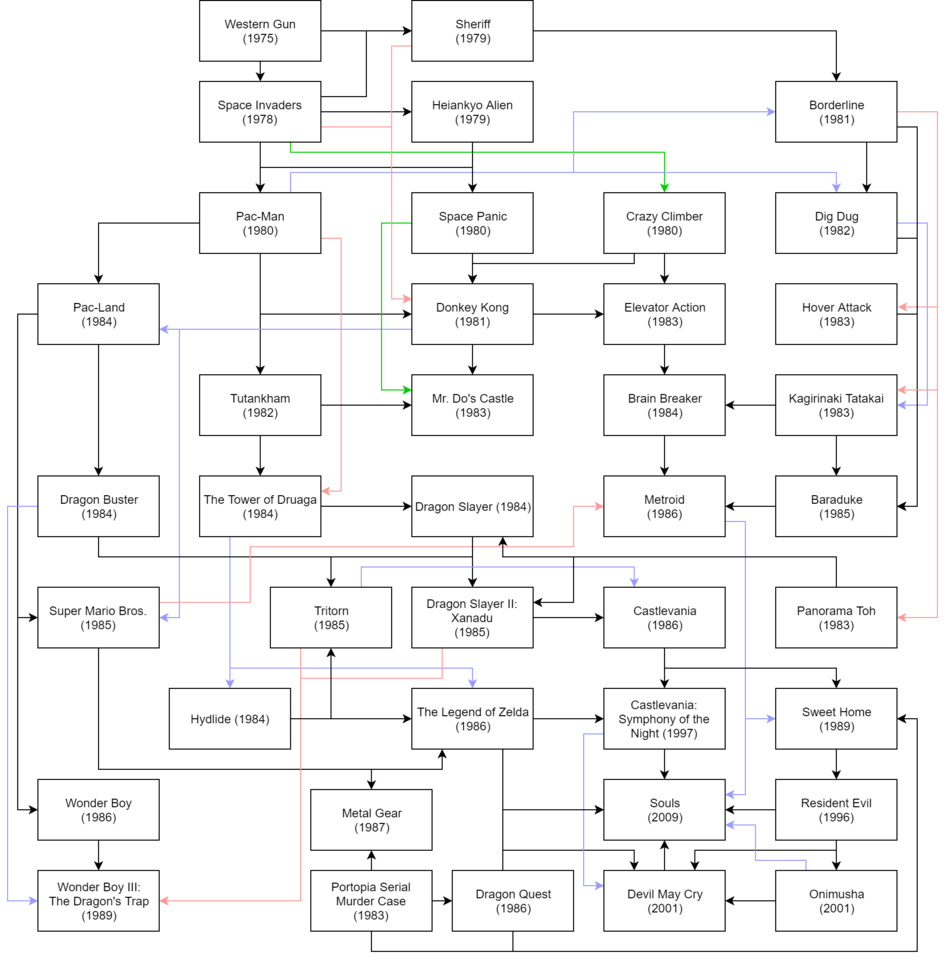 Diagram showing roots of Metroidvania genre
The Metroidvania genre originated from Japan. Some of the underlying elements of Metroidvania gameplay appeared in early titles such as Donkey Kong (1981), Tutankham (1982), Mr. Do's Castle (1983, Arcade), and Portopia Serial Murder Case (1983)
The side-scrolling Metroidvania style began on Japanese computer platforms. In spring 1984, Hiroshi Ishikawa began working on Brain Breaker, a relatively obscure, sci-fi, open-world action-adventure with a Metroidvania style, eventually released in November 1985. In September 1985, Xanadu: Dragon Slayer II, developed by Nihon Falcom's Yoshio Kiya, was released, as a Metroidvania-style open-world action RPG. Xanadu became a hit in Japan, where "Metroidvania" style games were sometimes referred to as "Xanadu" style games. In October 1985, Zainsoft released Tritorn, a side-scrolling action RPG inspired by Hydlide.
In 1986, this style of gameplay was introduced to consoles by the original Metroid, released for the NES in August 1986. The second Castlevania game, Vampire Killer, released for the MSX2 in October 1986, also used a similar open-ended style of gameplay, which was further refined by Castlevania II: Simon's Quest for the NES in 1987, before later Castlevania games reverted back to a more linear style of gameplay. A later milestone for the Metroidvania style was Super Metroid on the SNES in 1994. The game that came to define the Metroidvania style was Castlevania: Symphony of the Night in 1997, taking inspiration from The Legend of Zelda. The term "Metroidvania" was coined shortly after. Later portable Castlevania sequels have been based on the same format.
Log in to comment