Overview
 Blaster Master
 SUNSOFT was founded in 1971 as a sub-division of Japanese Sun Electronics. They first started developing arcade games and had several successful titles in the early 1980s, one example being Arabian. Console development started around 1985 with games for the Famicom being the main focus. It had already gone international with their arcade games when the NES hit the US and Europe, so they didn't have much trouble securing major licenses like Batman and The Addams Family.
Like many other developers at the time, their first Famicom games were ports of their arcade games. The first Famicom game SUNSOFT released was in fact Super Arabian. SUNSOFT did not enjoy a sterling reputation early on, with many of their games being quick cash-ins of popular Japanese licenses and mahjong games. It wasn't until the late 80s and early 90s that SunSoft's games really started to stand out against the competition.
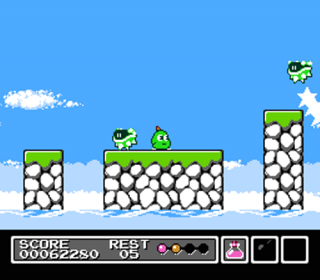 Mr. Gimmick
 SUNSOFT took existing ideas and perfected them. The hardware was pushed to its limits in a lot of their games to produce graphics and sound that were almost unheard of on the NES at the time, and the gameplay and controls were generally tight. This is probably the main reason many of their NES games are now considered classics of the era. Some examples include Blaster Master, Journey to Silius, Mr. Gimmick and Ufouria: The Saga.
SUNSOFT was also one of few companies aside from Nintendo themselves that actually corrected their games for the PAL market, so the sound and graphics in their games are reproduced correctly in the PAL region as well. Usually companies would just release the NTSC version in the PAL region, not bothering to optimize the games to 50hz, making the games run around 20% slower in the PAL region. It wasn't until the N64 that this became standardized.
 Ufouria: The Saga
 But when the company started focusing on developing for the SNES, few of their games stood out as much as their NES games had done, so they didn't garner much interest among audiences. In 1995 they faced bankruptcy and was heavily restructured. A couple of games were later released for the PlayStation and the Game Boy Color.
The company has also shown signs of activity recently with Blaster Master released for Wii's Virtual Console service, and more recently Blaster Master: Overdrive, a re-imagining of the first game, on WiiWare.
Log in to comment