Overview
One of the earliest shooting games, Space Invaders was released by Taito in Japan on June 19, 1978. Gameplay involves attempting to defeat waves of aliens cascading down from the top of the screen with a laser cannon that moves along a fixed horizontal axis. The only goal is to earn as many points as possible. Designer Tomohiro Nishikado was in charge of planning, graphic design, and programming for the game and drew creative inspiration from such diverse sources as Gun Fight, Breakout, The War of the Worlds, and Star Wars. The game’s development cycle lasted for one year, during which Nishikado created custom hardware and software. The game achieved massive popularity upon its release (leading to a temporary shortage of one hundred yen coins in Japan), and helped usher in the golden age of arcade video games (circa 1978-1984).
Space Invaders sold over 400,000 arcade cabinets worldwide and grossed around $3.8 billion in revenue by 1982, equivalent to over $13 billion in 2014, making it the highest-grossing video game of all time.
Gameplay
 Arcade (cabaret/cocktail) version
Gameplay in Space Invaders is relatively simple. The player controls a small ship that can only move laterally across the bottom of the screen and fires vertically. Five rows of eleven aliens each advance slowly from one side of the screen to the other, dropping down one space and reversing direction when they reach either side. The player’s task is to acquire points by eliminating enemies and to destroy all of the aliens before they reach the bottom of the screen and complete their “invasion.” As aliens are destroyed, the speed of the remaining enemies increases, as does the tempo of the music. Once all of the enemies are destroyed, the wave resets and the difficulty increases (a cycle that can continue indefinitely).
The Invaders constantly shoot back at the player as they advance from side to side across the screen. To help avoid their attacks, the player can hide behind a number of destructible barriers or “bunkers” near the bottom of the screen (four in the original version). Occasionally a “mystery ship” will appear near the top of the screen and move quickly from one side to the other while making a distinctive klaxon noise. Destroying it rewards the player with a sizeable point bonus.
Development
While working for the Taito Corporation, designer Nishikado was inspired to create Space Invaders by an early Taito electro-mechanical game called Space Monsters, and by the Atari arcade game Breakout. The game was planned to have tanks, planes, and battleships as enemies, but Nishikado was not happy with their onscreen movements. He considered making the enemies human (which would have been easier to animate), but scrapped the idea since he thought it would be immoral for players to shoot them. After he saw a magazine featuring the 1977 film Star Wars, he decided to use a space theme, and based his alien enemies on the squid-like antagonists from the 1953 movie version of The War of the Worlds.
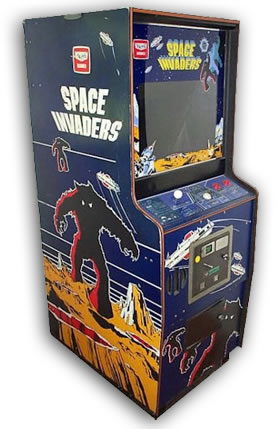 Upright cabinet
Due to the limitations of 1970s microprocessors, Nishikado was forced to design and build his own hardware and development tools. The arcade board he put together contained a variety of both Japanese and American components. It used an Intel 8080 central processing unit (designed by American and Japanese engineers), which could output raster graphics on a CRT monitor, but was slow when it came to drawing sprite graphics, so a dedicated Fujitsu MB14241 video shifter (an early example of a graphics chip) was used to accelerate the drawing of sprite graphics to a bitmap framebuffer. Monaural sound was hosted by a combination of analogue circuitry and a Texas Instruments SN76477 sound chip. The system that he put together is now known as the Taito 8080 arcade system board.
In spite of his efforts, Nishikado was unable to program the game exactly as he wanted. The hardware that he had assembled was not powerful enough to display graphics in color and the enemies moved slower than he had intended. Fortunately he discovered that the more enemies that were removed from play, the faster the processor could render those that remained. Rather than attempt to design the game to compensate for the speed increase, he opted to leave it in as a challenging gameplay mechanic.
It was originally released in Japan by Taito as a cocktail cabinet, with monochrome graphics enhanced by a rainbow-colored cellophane overlay to simulate color graphics. Taito and American licence-holder Bally/Midway then created an upright cabinet that used strips of orange and green cellophane applied to the screen to simulate color graphics, though this version only simulated several colors (compared to Taito's original cocktail version simulating a wider range of colors). Both the Japanese and American upright cabinets also included a painted backdrop of a lunar surface and a starscape, and cabinet art featuring large humanoid creatures that bore little resemblance to the in-game enemies. Nishikado claims that this was due to the artist basing his interpretation on the game’s original title, Space Monsters.
Impact and Legacy
Soon after its release in Japan, Space Invaders became a huge success, completely taking over certain arcades and earning Taito a tidy profit. By the end of 1978, Taito had installed 100,000 machines across the country and grossed over $600 million dollars. An oft-quoted urban legend states that there was a shortage of 100-yen coins—and subsequent production increase—in Japan attributed to the game. By 1980, 300,000 cabinets had been sold in Japan and an additional 60,000 in the United States. By 1981, Space Invaders had made Taito more than $1 billion, and continued to gross an average of $600 million per year, through to 1982, by which time it had grossed $2 billion in quarters (equivalent to $4.6 billion in 2011). This made it the best-selling video game and highest-grossing entertainment product of its time, surpassing the then highest-grossing film Star Wars, which had grossed $486 million in movie tickets.
 Atari 2600 version
The 1980 Atari 2600 version represented the first official licensed port of an arcade game to a home console, and and became the first "killer app" for video game consoles by quadrupling sales of the 2600. It sold over two million units in its first year on sale as a home console game, becoming the first title to sell over a million cartridges. Ports were also released for the Atari 8-bit computer line and the Atari 5200, as well as the Nintendo Entertainment System, Game Boy and SNES. Numerous unofficial clones were made as well, such as the popular computer games Super Invader (1979) and TI Invaders (1981).
Game designer Shigeru Miyamoto considered Space Invaders a game that revolutionized the video game industry; he was never interested in video games before seeing it. Hideo Kojima also described it as the first video game that impressed him and got him interested in video games. Several publications ascribed the expansion of the video game industry from a novelty into a global industry to the success of the game. Edge magazine attributed the shift of video games from bars and arcades to more mainstream locations like restaurants and department stores to Space Invaders. Its popularity was such that it was the first game where an arcade machine's owner could make up for the cost of the machine in under one month, or in some places within one week.
Technology journalist Jason Whittaker credited the game's success to ending the video game crash of 1977, which had earlier been caused by Pong clones flooding the market, and beginning the golden age of video arcade games.According to The Observer, the home console versions were popular and encouraged users to learn programming; many who later became industry leaders. 1UP stated that Space Invaders showed that video games could compete against the major entertainment media at the time: movies, music, and television IGN attributed the launch of the arcade phenomenon in North America in part to Space Invaders. Electronic Games credited the game's success as the impetus behind video gaming becoming a rapidly growing hobby and as "the single most popular coin-operated attraction of all time." Game Informer considered it, along with Pac-Man, one of the most popular arcade games that tapped into popular culture and generated excitement during the golden age of arcades.IGN listed it as one of the "Top 10 Most Influential Games" in 2007, citing the source of inspiration to video game designers and the impact it had on the shooting genre. 1UP ranked it at No. 3 in its list of "The 60 Most Influential Games of All Time," stating that, in contrast to earlier arcade games which "were attempts to simulate already-existing things," Space Invaders was "the first video game as a video game, instead of merely a playable electronic representation of something else." In 2008, Guinness World Records listed it as the top-rated arcade game in technical, creative, and cultural impact.
As one of the earliest shooting games, it set precedents and helped pave the way for future titles and for the shooting genre. Space Invaders popularized a more interactive style of gameplay with the enemies responding to the player controlled cannon's movement, and was the first video game to popularize the concept of achieving a high score, being the first to save the player's score. While earlier shooting games allowed the player to shoot at targets, Space Invaders was the first in which targets could fire back at the player. It was also the first game where players were given multiple lives, had to repel hordes of enemies, could take cover from enemy fire, and use destructible barriers,in addition to being the first game to use a continuous background soundtrack, with four simple diatonic descending bass notes repeating in a loop, which was dynamic and changed pace during stages, like a heartbeat sound that increases pace as enemies approached.
It also introduced the concept of a difficulty curve, with the aliens moving faster as the player kills more of them, making the game more difficult as it progresses. The game's concept of scaling difficulty became the basis for modern single-player video gaming.
Cited by influential creators like Shigeru Miyamoto and Hideo Kojima as a major inspiration, Space Invaders revolutionized the industry following the video game crash of 1977 (brought on by a glut of Pong clones on the market and the departure of manufacturers like RCA and Fairchild). Proving that video games were capable of competing with movies, music and television, Space Invaders has since become recognized as one of the most influential games ever released. It was one of the first games to utilize the concept of a “high score,” and was the first to save the player’s score. It was the first shooter that allowed enemies to shoot back at the player, the first to give the player multiple lives and provide destructible cover against enemy fire. Its success effectively launched an entire genre of space shooters, including Atari’s Asteroids, Williams’ Defender, and Namco’s Galaxian series.
It moved the gaming industry away from Pong-inspired sports games grounded in real-world situations towards action games involving fantastical situations. Whittaker commented that Space Invaders helped action games become the most dominant genre on both arcades and consoles, through to contemporary times. Guinness World Records considered Space Invaders one of the most successful arcade shooting games by 2008. In describing it as a "seminal arcade classic", IGN listed it as the number eight "classic shoot 'em up". Space Invaders set the template for the shoot 'em up genre. Its worldwide success created a demand for a wide variety of science fiction games, inspiring the development of arcade games, such as Atari's Asteroids, Williams Electronic's Defender, and Namco's Galaxian and Galaga, which were modeled after Space Invaders' gameplay and design. This influence extends to most shooting games released to the present day, including first-person shooters such as Wolfenstein, Doom, Halo, and Call of Duty. Space Invaders also had an influence on early computer dungeon crawl games such as Dungeons of Daggorath, which used similar heartbeat sounds to indicate player health. Space Invaders' concept of a gradually increasing difficulty level also revolutionized the gaming industry.
Remakes and sequels
Space Invaders '95, one of many sequelsRecent ports and remakes include Space Invaders Anniversary, released in 2003 for the PlayStation 2 and including nine variants of the core game. Space Invaders, Space Invaders Part II and Return of the Invaders were featured in the arcade compilation Taito Legends (released in 2005), and Space Invaders '91, Space Invaders '95, and Space Invaders DX were featured in Taito Legends 2 (released in 2006). A remake of the game called Space Invaders Extreme was released for the PSP and Nintendo DS in 2008 and on Xbox Live Arcade in 2009. A second remake, Space Invaders Infinity Gene, was released in 2009 on PlayStation Network, Xbox Live Arcade, and iOS devices.
Log in to comment