Overview
 Super Nintendo Entertainment System logo
After the worldwide success of the NES, and competitors' introduction of more powerful consoles such as the Genesis and Turbografx-16, Nintendo decided it was time to introduce a new home console: the SNES (Super Nintendo Entertainment System). The machine debuted in Japan on November 21, 1990, and arrived in North America on August 23, 1991. The release in South America, Europe, and Australia happened in 1992, starting at April 11 for UK/Ireland, June 6 for the rest of Europe, July 3 for Australia and Brazil in September.
The SNES was a 16-bit console and a direct competitor to Sega's Genesis. As with the NES, the SNES was the most successful console of its generation in terms of sales. The console triumphed through the support of both Nintendo and third-party developers. The console saw releases from high profile developers such as Capcom, Squaresoft, and Konami. The SNES era is looked back on by many as "the golden era of video games."
Nintendo introduced an arcade system called the Nintendo Super System in the early nineties that could be used to preview upcoming Super Nintendo games. Games that appeared on it included Super Mario World, ActRaiser, Contra III: The Alien Wars, and F-Zero.
Rivalry with Sega
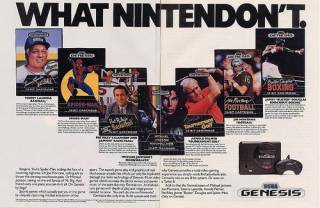 Genesis does what Nintendon't.
Nintendo and Sega maintained a fierce rivalry during the 16-bit era. Sega's Genesis was released before the SNES, and this head start allowed the Genesis to gain a substantial sales lead by the time the SNES came to market. Simultaneously, Sega ran an aggressive marketing campaign that portrayed the SNES and its players as slow and childlike when compared to the speedy and "cool" Genesis. One of the most notorious of these ads touted the Genesis' (non-existant) "Blast Processing," which ostensibly allowed the Genesis to better render high-speed games such as Sonic the Hedgehog . While the Genesis led the SNES in sales throughout most of the 16-bit generation, the SNES eventually overtook it as the generation ended.
History
 The Super Famicom logo in Japan and PAL regions
NEC released the TurboGrafx-16 in 1987 to compete with the incredibly popular NES. Sega released its Genesis the next year. Both of these consoles were based on 16-bit hardware, and were large improvements in sound and graphics over the 8-bit based NES. As Nintendo's dominance in the market began slipping, Nintendo executives began to design a new system (albeit reluctantly at first) as early as 1988.
The SNES was designed by Masayuki Uemura, who also designed the original Famicom. The Super Famicom was originally released in Japan on November 21, 1990 for ¥25,000, or about $210. It was a huge hit, with the initial units shipped selling very quickly. With the Super Famicom being such a success, Nintendo dominated over their rivals. This was partially due to the support of third-party developers, such as Capcom, Konami, Square, Enix, and Tecmo.
The Super Nintendo Entertainment System was released in North America in September 1991. It was a mildly redesigned version of the Super Famicom that originally sold for $199. One of the main selling points for the console was the fact that it was packaged with Super Mario World. Originally, very few titles were shipped upon release, such as Pilotwings, F-Zero, SimCity, and Gradius III, but these titles were all very well-received and showcased the SNES's Mode 7 abilities.
Policies
Nintendo's policies during the NES era were infamous: Nintendo had to approve every game, third-party developers could release only five games per year (and these games couldn't be released on a rival console within two years), and Nintendo controlled the manufacturing and supply of NES cartridges. When Sega began competing with Nintendo, however, these practices ended. Acclaim was the first developer to release their games for both consoles, and many other developers followed suit.
The censored SNES version.Nintendo, however, maintained their strict censorship policy. This was one of the key reasons why the Genesis version of Mortal Kombat sold much better than the SNES version. Nintendo removed all of the gore from the game, including fatalities, while the Genesis version kept these things.
Mortal Kombat's gore also sparked US Senators Herb Kohl and Joe Lieberman to call a Congressional hearing to discuss the effect of violent games on children. This meeting caused the founding of the Interactive Digital Software Association (now known as the Entertainment Software Association) and the Entertainment Software Rating Board (which applies ratings to all games). Because of these companies being founded, Nintendo decided their censorship policies were no longer needed, and Mortal Kombat 2 was released in an uncensored version on the SNES, which caused it to sell better than the Genesis version.
Technical Specifications
- CPU: Custom 65c816 based Ricoh 5A22 running at a selectable 3.58 MHz, 2.66 Mhz or 1.77 Mhz.
- Memory: 128 Kb main RAM, 64 Kb video RAM, 64 Kb audio RAM
- Video: 256 x 224 or 512 x 224 or 256 x 239 or 512 x 239 progressive resolutions, 512 x 448 or 512 x 478 interlaced resolutions, 32,768 colors with 256 colors maximum on screen. (128 sprites max on screen)
- Audio: 2 Sony audio processors (1 8-bit, and 1 16-bit DSP) 8 channels, Sample Rate 32KHz, 16-bit stereo output
- The SNES can also take advantage of custom chips provided by the individual game cartridges, like the "Super FX" co-processor chip that ran at either 10.5Mhz or 21Mhz depending on the game. Examples include Star Fox, Super Mario World 2: Yoshi's Island and Stunt Race FX.
Regional Differences
The main difference between the SNES and the Super Famicom is the console's color scheme. While purple and blue were used on the North American SNES, the Super Famicom as well as the European and Australian SNES had a logo consisting of rounded green, blue, yellow, and red shapes matching the Super Famicom's and PAL SNES' colored A, B, X, and Y buttons. Additionally, each version of the console has its own version of region lockout, with differently shaped cartridges, rendering a Japanese or PAL version of a game useless on a North American console and vice versa.
Hardware Revision
The SNS-101On October 20, 1997 the Super Nintendo received lighter and more streamlined design in the US. Officially called the SNS-101 it was Nintendo's way of selling more hardware at a cheaper $99.99 USD price point. It was targeted at gamers who where not ready to buy expensive next generation hardware and wanted something with a large library of cheaper games.
Pack in games included:
F-Zero extensively uses Mode 7.Mode 7 is one of the SNES's seven different graphics modes, and the most famous of the seven. It was famous for allowing SNES games to display pseudo-3D graphics, giving the illusion of depth. The mode was able to warp the background layer of a game, changing the perspective to make the background appear to be moving. This was used prominently in a variety of games, to various effects. Final Fantasy IV and Final Fantasy VI used it to give the overworld an illusion of movement and size; when the player goes into an airship, the ground below shrinks away as the player gets higher and higher.
One limitation of Mode 7 was that it only allowed the background layer to be scaled and rotated. Individual sprites could not have this effect applied to them. So games like Super Castlevania IV and Super Metroid, where characters appear to have that effect applied to them are actually part of the background layer. In Contra III: The Alien Wars, where massive bosses appear to rotate and twist, they actually are the "background," and the background is actually a sprite that changes with the player's movement.
Enhancement Chips
Star Fox's 3D graphics are powered by the Super FX chip.There were a variety of first and third party enhancement chips included in SNES games. The most famous of these chips is the Super FX chip, used in games such as Star Fox and Stunt Race FX. However, there are numerous other notable chips, including the GB-Z80, DSP, CX4, S-RTC. The Super FX chip actually works to accelerate the graphics, making the SNES capable of more detailed, and even 3D, graphics. Its effects are seen in many games, including Doom and Super Mario World 2: Yoshi's Island.
The GB-Z80 chip was used in the Super Game Boy, and it enabled the SNES to emulate Game Boy hardware effectively. The SNES's processor was not powerful enough on its own. The DSP chip, of which there are several varieties, increases the capabilities of the SNES's Mode 7. The CX4 was a math processor used by Capcom in Mega Man X2 and Mega Man X3, aiding in the formation of trigonometric graphics. The S-RTC was used in one game (Dai Kaiju Monogatari 2) to power a real-time in-game clock.
Launch Titles
Japanese Launch Titles (November 21, 1990)
U.S. Launch Titles (August 23, 1991)
European Launch Titles (April 11, 1992)
Planned CD Add-On and Other Peripherals
Nintendo eventually planned to partner with Sony to develop a CD-based add-on for the console. Sony went on to develop a console referred to as "Play Station," which would play SNES CD releases as well as standard carts. After various disagreements between the two companies, the partnership was dissolved and Nintendo looked to Phillips to produce a similar CD-based add-on for the popular 16-bit console.
The partnership between Nintendo and Phillips wouldn't result in the release of a SNES CD drive, but the deal eventually resulted in Nintendo's characters appearing in a small number of Phillips-produced titles for its own multimedia console, the CD-i. Meanwhile, Sony would reuse the PlayStation name when developing its own CD-based console.
Secret of Mana was said to be originally envisioned as a SNES CD release. Once the project was killed, the game was retooled to run on the standard cartridge format.
| Satellaview |
|---|
Main Article: Satellaview
The SNES had online capabilities by way of the Satellaview add-on. It connected to satellite via a modem and was released in 1995 in Japan only. It allowed the user to download and play games in weekly or daily installments, and only broadcast at certain times. It was pioneering in both downloadable game media and episodic content on consoles and is viewed as a precursor to services such as the Wii's Shop Channel and Xbox Live Marketplace. | |
| Super Game Boy |
|---|
Main Article: Super Game Boy Enhancement
Nintendo released the Super Game Boy, a peripheral that allowed gamers to play Games that where compatible with the Game Boy System in color through the SNES. The color was achieved by having the four shades of green mapped to different colors that the player can choose. The games where displayed at a smaller resolution than a standard SNES game, to make up for this a electronic bezel was placed around the screen. Some games such as Street Fighter II for the Game Boy, had custom bezels for each stage.
The hardware inside the Super Game Boy is the that same as the Game Boy handheld. Inside the cartridge there is a CPU that runs the games. The Super Game Boy uses the SNES to output to the TV, as well as receive inputs from the controller or controllers. | US Super Game Boy |
| SNES Game Genie |
|---|
| Many third-party peripherals were released as well. A new version of the Game Genie was released for use with the SNES. It allowed gamers to use codes to modify the way the game was played, for instance gaining infinite lives or ammo. Unlike the NES era, Nintendo was much more tolerant with unlicensed third-party peripherals. | |
| Capcoms's Fighting Soldier |
|---|
| After a boom of 2D fighters to the SNES, such as Fatal Fury and Street Fighter 2, companies tried to cash in with add-ons to make a more authentic arcade experience. This stemmed from the SNES pad not having six buttons on the face. Capcom's solution was "Capcom's Fighting Soldier". The pad moved the the two shoulder buttons to the face, and spaced them to allow for use of fingers or thumbs. It was designed as an ergonomic fightpad, so as to not exclude console only players. | |
| Championship Joystick |
|---|
| The Championship Joystick was a high-end joystick released in 199* for the SNES. Also released under the name Arcadia, it uses authentic 30mm Happ buttons and bat top joystick. The button layout is nearly identical to American Street Fighter II cabinets. | |
| SNES Mouse |
|---|
Main Article: SNES Mouse
The SNES Mouse was released for use in a few games, most prominently Mario Paint. The mouse was bundled with a Nintendo hard plastic mouse pad. | |
| Super Multi Tap 2 |
|---|
| Super Multi Tap 2 for the SNES was released in 1993. It allowed for three to four players to play on the same screen, for games that supported multi tap. Super Multi Tap 2 featured Bomberman's face,and was bundled with Super Bomberman, or could be bought separately. | |
| Super Advantage |
|---|
| The Super Advantage was a joystick created by ASCII for the SNES. It is a spiritual successor to the NES Advantage, with an updated look and feel. The Super Advantage was released in the 1990's and was geared toward fighting enthusiasts that where accustomed to an arcade setup. The Super Advantage also functions as a turbo controller with sliders controlling the rate. The controller features a unique button layout. | |
| Super Scope |
|---|
| The Super Scope was a gun that was similar to the Zapper, and several games featured the option to use it (such as Super Scope 6 and Yoshi's Safari). In Europe and Australia it was known as the Nintendo scope. The Super Scope was not a light gun, but used a infrared signal. The infrared receiver plugged into the control ports. | |
| ASCII Turbo Controller |
|---|
| A Turbo Controller released for the SNES by ASCII. Each separate buttons had a turbo function, much like the Super Advantage. | |
Log in to comment