


- Name
- Nintendo 3DS
- Abbreviation
- 3DS
- Release Date
- February 26, 2011
- Manufacturer
- Nintendo (Company)
- Launch price
- $249.99
- Install base
- 75,940,000
- Online service
- Yes
- Aliases
- Nintendo 3DS XL,Nintendo 3DS LL,3DS,3DS XL,3DS LL,Nintendo 2DS,2DS
Nintendo 3DS
The Nintendo 3DS is a portable game console produced by Nintendo. The handheld features stereoscopic 3D technology that doesn't require glasses. It was released in Japan on February 26, 2011 and in North America on March 27, 2011.
Platform Images Related Pages
Overview
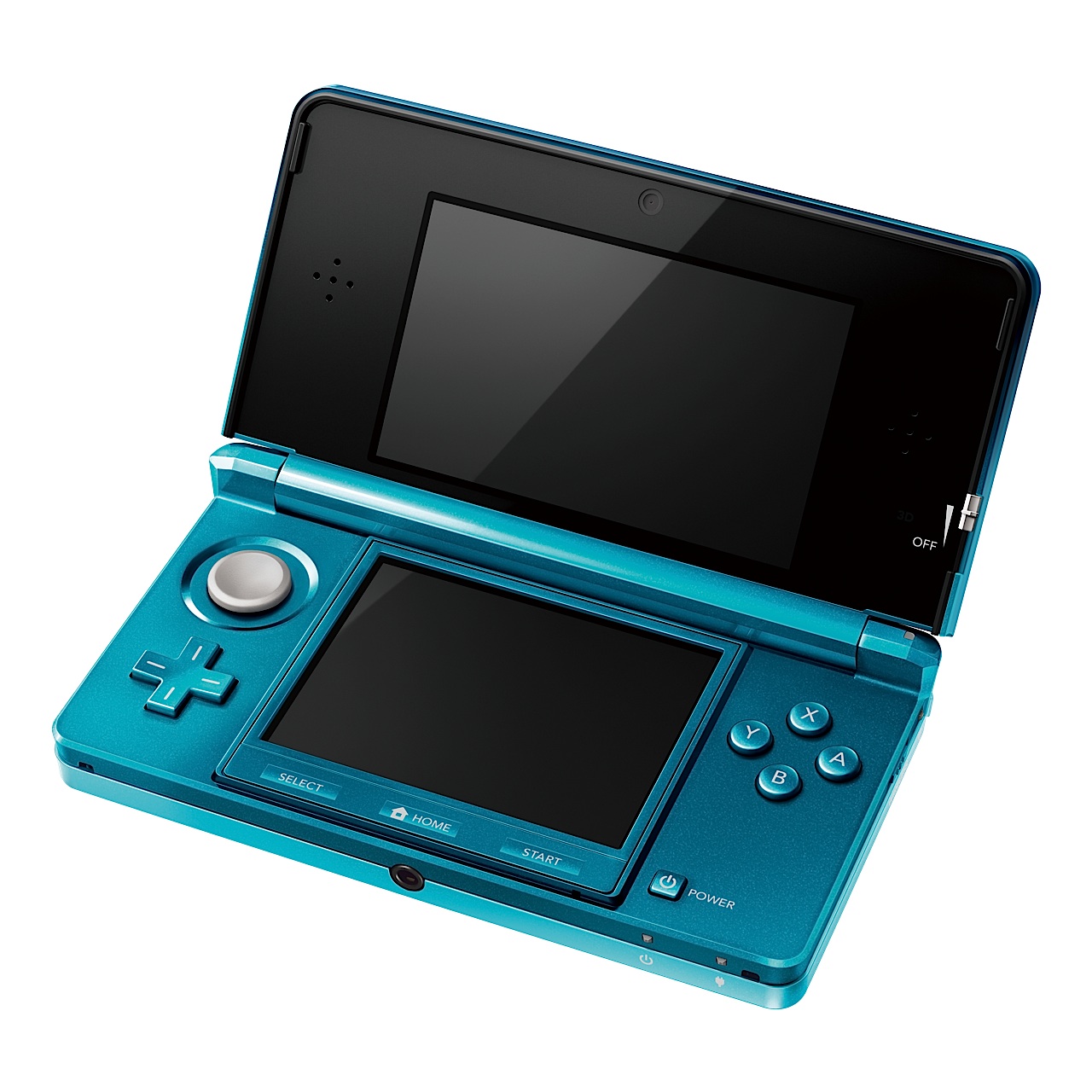 Nintendo (Company) announced the Nintendo 3DS on March 23, 2010. No software was yet revealed; the only details in the announcement were that the system will be available in Japan by the end of March 2011, and that it will display stereoscopic 3D without requiring special glasses, and it is backwards compatible with existing DS and DSi software. The system itself was revealed at Nintendo's E3 2010 (Concept) media briefing by Satoru Iwata (Person).
The 3DS's graphical capabilities are said to be comparable to the Wii (Platform), but the added benefit of modern shaders. This is in addition to stereoscopic 3D, adding a sense of 3-dimensional depth to the image. The 3D can be adjusted with a slider to fit each person's individual eye focus. Much like the volume slider, turning the 3D slider all the way down disables the 3D effect altogether.
The 3DS also features two cameras, allowing the user to take 3D images. The 3DS can also play downloaded 3D movies and can connect wirelessly to the internet to access the Nintendo e-shop and video streaming/download services.
<ins>Note</ins>: Install base in the platform details tab (53.31 million units) reflects the latest officialcumulative Nintendo 3DS platform family LTD numbers minus the latest New Nintendo 3DS/XL LTD numbers (12.81 million units). The Nintendo 2DS sales included in the regular Nintendo 3DS total LTD figure sit at 7.42m units worldwide. The total LTD number of the entire Nintendo 3DS family (including the New Nintendo 3DS/XL) is 66.12 million units.
Sales figures are current as of March 30, 2017.
Nintendo (Company) announced the Nintendo 3DS on March 23, 2010. No software was yet revealed; the only details in the announcement were that the system will be available in Japan by the end of March 2011, and that it will display stereoscopic 3D without requiring special glasses, and it is backwards compatible with existing DS and DSi software. The system itself was revealed at Nintendo's E3 2010 (Concept) media briefing by Satoru Iwata (Person).
The 3DS's graphical capabilities are said to be comparable to the Wii (Platform), but the added benefit of modern shaders. This is in addition to stereoscopic 3D, adding a sense of 3-dimensional depth to the image. The 3D can be adjusted with a slider to fit each person's individual eye focus. Much like the volume slider, turning the 3D slider all the way down disables the 3D effect altogether.
The 3DS also features two cameras, allowing the user to take 3D images. The 3DS can also play downloaded 3D movies and can connect wirelessly to the internet to access the Nintendo e-shop and video streaming/download services.
<ins>Note</ins>: Install base in the platform details tab (53.31 million units) reflects the latest officialcumulative Nintendo 3DS platform family LTD numbers minus the latest New Nintendo 3DS/XL LTD numbers (12.81 million units). The Nintendo 2DS sales included in the regular Nintendo 3DS total LTD figure sit at 7.42m units worldwide. The total LTD number of the entire Nintendo 3DS family (including the New Nintendo 3DS/XL) is 66.12 million units.
Sales figures are current as of March 30, 2017.
Nintendo 3DS
Specs & Features:
- Width: 5.3" (13.4cm), height: 2.9" (7.4cm), depth when folded: 0.8" (2.1cm)
- Weight: ~8 ounces (235g)
- Top Screen: 3.5" parallax barrier LCD screen with 800x240 resolution. 3D capability.
- Bottom Screen: 3" LCD screen with 320x240 resolution. Resistive touch capability.
- Cameras: One inner, two outer (0.3 megapixels)
- Sound: Stereo speakers to the left and right of the top screen
- Sensors: Motion and gyro
- Improved graphical capabilities over the Nintendo DS
- Ability to take 3D photos
- Ability to watch 3D movies
- 3DS Game Card Size: Up to 8GB
- DMP (Digital Media Professionals) Pica 200 GPU
- 128MB RAM, 6MB VRAM
- Battery life: approx. 3~5h (running 3DS software); approx. 5~8h (running DS software)
Controls & Input Methods:
The 3DS features a Circle Pad (analog input), +Control Pad, ABXY face buttons, L/R shoulder buttons, Start/Select buttons, a Home button (system menu), a touch screen (bottom), 3D Depth Slider, one inner camera, two outer cameras, a motion sensor, gyro sensor, wireless switch, power button as well as a retractable Stylus that slides in vertically next to the cartridge slot.
Circle Pad Pro
To support better camera control in select polygonal 3D action games, an optional add-on for the original 3DS, called Circle Pad Pro, was released in Japan alongside Monster Hunter Tri G in December 2011 and alongside Resident Evil: Revelations in January/February 2012 in Europe and North America. It offers an additional Circle Pad on the right and extra ZL/ZR shoulder buttons. The Circle Pad Pro requires one AAA battery to function.
Ports:
- 3DS game card slot (also accepts DS games)
- SD memory card slot
- AC adapter port
- Stereo headphone jack
Wireless:
- Supports IEEE 802.11 networks with WPA/WPA2 security
- Can communicate with other 3DS units automatically and can stay connected all the time.
Nintendo 3DS XL
 During a Nintendo Direct presentation, Nintendo announced the 3DS XL (known as 3DS LL in Japan) which features 90% bigger screens and longer battery life while retaining all the features of the regular 3DS. The Nintendo 3DS XL launched in North America on August 19, 2012 (for US$199,99) and July 28 in both Europe (€199,99/£179.99) and Japan (¥18,900) as well as Australia/New Zealand on August 23, 2012 (for AU$249,95).
- 46% size increase (width: 15.6cm, height: 9.3cm, depth when folded: 2.2cm, weight: 336g)
- 90% bigger screens (top screen: 4.88 inches, bottom screen: 4.18 inches)
- Size of the +Control Pad, face and shoulder buttons has been slightly increased
- battery life increased to between 3.5 to 6.5 hours (3DS software) and 5 to 8 hours (DS software)
- bundled SD Card upgraded from 2GB to a 4GB Card
- Includes an updated Stylus that is not retractable and rests at the side again, akin to DSlite/DSi
- AC power adapter sold separately in Japan and Europe, bundled in North America
- Compatible with DSi/DSiXL/3DS AC adapter
- All user data (including activity log, play coins, NNID/eShop activity) can be transferred from the original 3DS to the 3DS XL, using System Transfer
- DS and Virtual Console games that are selected to run in 1:1 native resolution will look better due to the bigger screen size, fixing a major complaint about the original 3DS
- Nintendo has released a XL version of the Circle Pad Pro.
- Weighs almost 50 percent more than the original model 3DS. (336 grams compared to the original 3DS's 230 grams)
Nintendo 2DS
 Officially revealed by Nintendo on August 28th, 2013 via press release, the 2DS is second revision of the 3DS. The main differences are that the top screen does no longer displays stereoscopic 3D at all, and the system does not have a clamshell design like the 3DS and 3DSXL before it. The 2DS was released on October 12th, 2013 in North America for US$129.99, Europe for €129.99/£109.99, and Australia/New Zealand for AU$149.95 and was released in South Korea, in a bundle with Pokémon X/Y, on December 7th, 2013 for 180,000 won (~US$170).
- Width: 14.4cm (5.7"), Height: 12.7cm (5.0"), Depth: 2.03cm (0.80"), Weight: 260g (9.2oz)
- Can play all 3DS games and DS games.
- Despite not having a 3D screen, it still has two cameras on the rear so it can take 3D photos and videos.
- Both screens are the same size as the original (not XL) 3DS.
- Shares the same software as the 3DS/3DSXL, except the WiFi toggle was put in with the screen brightness controls on the home screen.
- Comes with a 4GB SD card.
- Has a 1300mAh battery, the same as the 3DS, and lasts around 3 to 5.5 hours (3DS software) and 5 to 9 hours (DS Sofware).
- Because of the non-clamshell design, the 2DS has a "sleep mode" switch on the bottom.
New Nintendo 3DS/ New Nintendo 3DS XL
 This fourth model of the Nintendo 3DS was announced by Nintendo president Satoru Iwata in a Nintendo Direct on August 29, 2014.
New Nintendo 3DS comes in both the classic pocket-size of the original Nintendo 3DS and an XL variant. The New Nintendo 3DS adds a variety of buttons, features, refinements.
The New Nintendo 3DS models launch in Japan on October 11, 2014. The New 3DS will retail for 16,000 Yen and the New 3DS LL will retail for 18,800 Yen.
The new models will launch in North America and Europe in 2015.
New Nintendo 3DS will receive exclusive software taking advantage of the new CPU and new control options, notably a New 3DS version of the Wii RPG Xenoblade Chronicles (Game). There will also be future games compatible with the previous Nintendo 3DS models that will be enhanced when played on a New Nintendo 3DS/XL. Existing games will not benefit from these enhancements.
Further details on the New Nintendo 3DS (Platform) platform page.
This fourth model of the Nintendo 3DS was announced by Nintendo president Satoru Iwata in a Nintendo Direct on August 29, 2014.
New Nintendo 3DS comes in both the classic pocket-size of the original Nintendo 3DS and an XL variant. The New Nintendo 3DS adds a variety of buttons, features, refinements.
The New Nintendo 3DS models launch in Japan on October 11, 2014. The New 3DS will retail for 16,000 Yen and the New 3DS LL will retail for 18,800 Yen.
The new models will launch in North America and Europe in 2015.
New Nintendo 3DS will receive exclusive software taking advantage of the new CPU and new control options, notably a New 3DS version of the Wii RPG Xenoblade Chronicles (Game). There will also be future games compatible with the previous Nintendo 3DS models that will be enhanced when played on a New Nintendo 3DS/XL. Existing games will not benefit from these enhancements.
Further details on the New Nintendo 3DS (Platform) platform page.
Firmware Updates:
March 27th, 2011 (1.1.0-1)
- 3D music video (OK Go) auto installed
- Improved network and system stability
June 6th, 2011 (2.0.0-2)
- Removes 3D music video
- Nintendo eShop app
- 3DS internet browser app
- DSi transfer tool
- SpotPass works in Sleep mode
- Improved Nintendo Camera app
- Navigation and system stability improvements
June 15th, 2011 (2.1.0-3)
- System stability improvements
- Automatic firmware updates via Wifi
June 25th, 2011 (2.1.0-4)
- System stability improvements
November 13th, 2011 (2.2.0-X) - On game carts
- Ability to join friend's online games via the Friend's list
- System stability improvements
December 6th, 2011 (3.0.0-5)
- Updates to Nintendo Camera allows 3D video and 3D stop motion
- SpotPass function to StreetPass Mii Plaza
- Accomplishments to StreetPass Mii Plaza
- Find Mii II
- Slideshow for completed Mii Plaza puzzles
- New puzzle panels
- Demos added to Nintendo eShop
- DLC for games
- Download software from eShop while in sleep mode
- Option to save Credit Card info as well as only adding the amount of funds to pay for selected software
- Nintendo 3DS transfer function
- QR function in Nintendo Camera
- Nintendo Zone app installed
December 21st, 2011 (3.0.0-6)
- System stability and performance improvements
- Minor StreetPass Mii Plaza performance improvements
April 24th, 2012 (4.0.0-7)
- Developers are now able to patch retail games
- Added support for folder creation. Folders can store up to 60 items and can be individually named
- eShop presentation revamped, now featuring two horizontally scrolling sections. The upper section features current promotional selections and categories while the new area on the bottom half displays the main catagories (Nintendo 3DS Download Software, Demos, Virtual Console, DSiWare)
- Added functionality to purchase eShop content by scanning QR codes
- Blocks some flash carts
- Enables support for direct image upload to facebook's mobile site
May 14, 2012 (4.1.0-8)
- System Update without Parent Control Pin number
- Blocks some flash carts
Development
 Shigeru Miyamoto (Person) and Iwata's first project together was for a 3D game for the NES in 1986, called 3D Hot Rally. The concept of 3D intrigued them, and they continued experimenting ways to make it a serious way to play over the next 20 years. For every single new console they have made, they have tried to introduce some sort of 3D functionality. Most of these attempts weren't announced due to they not being up to their standards, especially after the commercial flop of the Virtual Boy (Platform) in 1995.
It wasn't until it came time to create the successor to the Nintendo DS that they found a way to utilize it. The 3DS did not actually begin development as a 3D focused console, but instead it was just meant to be a successor to the DS with next-gen graphics, which Miyamoto called "the typical evolution of a game device." However, without a good 'hook' to justify the release of a new console when the DS and its revisions were becoming the most popular game systems ever made, the system was pushed back until they felt it was appropriate.
Miyamoto and Iwata wanted to include 3D in this new console, but they had to make sure it was there from the outset, and not released as an add-on peripheral to the device in order to increase the audience for it from the beginning. By the time the 3DS was being planned, LCD devices that could output autostereostopic images (where 3D images can be displayed without the need for 3D glasses) were already in development, and Nintendo decided to be one of the first to try the technology out.
The developers at Nintendo were astonished by the new technology, with Miyamoto calling it the same feeling when he saw Yoshi (Character) first appear on the 16-bit screen of the Game Boy Advance (Platform) back during its development. Miyamoto also said it alleviates many of the harder parts of developing 3D games, especially Mario games, where a lot of effort has to be made to make the three-dimensional world that Mario traverses to be easily interpreted by the player.
Shigeru Miyamoto (Person) and Iwata's first project together was for a 3D game for the NES in 1986, called 3D Hot Rally. The concept of 3D intrigued them, and they continued experimenting ways to make it a serious way to play over the next 20 years. For every single new console they have made, they have tried to introduce some sort of 3D functionality. Most of these attempts weren't announced due to they not being up to their standards, especially after the commercial flop of the Virtual Boy (Platform) in 1995.
It wasn't until it came time to create the successor to the Nintendo DS that they found a way to utilize it. The 3DS did not actually begin development as a 3D focused console, but instead it was just meant to be a successor to the DS with next-gen graphics, which Miyamoto called "the typical evolution of a game device." However, without a good 'hook' to justify the release of a new console when the DS and its revisions were becoming the most popular game systems ever made, the system was pushed back until they felt it was appropriate.
Miyamoto and Iwata wanted to include 3D in this new console, but they had to make sure it was there from the outset, and not released as an add-on peripheral to the device in order to increase the audience for it from the beginning. By the time the 3DS was being planned, LCD devices that could output autostereostopic images (where 3D images can be displayed without the need for 3D glasses) were already in development, and Nintendo decided to be one of the first to try the technology out.
The developers at Nintendo were astonished by the new technology, with Miyamoto calling it the same feeling when he saw Yoshi (Character) first appear on the 16-bit screen of the Game Boy Advance (Platform) back during its development. Miyamoto also said it alleviates many of the harder parts of developing 3D games, especially Mario games, where a lot of effort has to be made to make the three-dimensional world that Mario traverses to be easily interpreted by the player.
 According to him, they had to use many tricks to make it easy for the player to hit a floating '?' block in previous 3D Mario games, but when they experimented on the 3DS, it became very natural. He said it was the perfect time to bring back their previous franchises that started out in 3D to the 3DS, because it would allow him to create easier to play, yet more difficult sequels to the original games.
To Iwata, the 3DS is a means to bring 3D from being 'about impact', to being 'about depth', to be a serious part of the gameplay and the experience, instead of a simple gimmick. The 3D slider on the 3DS was created by request of Miyamoto and his engineers to have all kinds of people be able to enjoy the 3D graphics without experiencing double vision of blurry images due to their unique spacing between eyes, which has been in problem with many 3D movies, where the 3D is already set to a pre-set certain focus.
According to him, they had to use many tricks to make it easy for the player to hit a floating '?' block in previous 3D Mario games, but when they experimented on the 3DS, it became very natural. He said it was the perfect time to bring back their previous franchises that started out in 3D to the 3DS, because it would allow him to create easier to play, yet more difficult sequels to the original games.
To Iwata, the 3DS is a means to bring 3D from being 'about impact', to being 'about depth', to be a serious part of the gameplay and the experience, instead of a simple gimmick. The 3D slider on the 3DS was created by request of Miyamoto and his engineers to have all kinds of people be able to enjoy the 3D graphics without experiencing double vision of blurry images due to their unique spacing between eyes, which has been in problem with many 3D movies, where the 3D is already set to a pre-set certain focus.
3D and Graphical Capabilities
 Unlike other 3D equipment, the 3DS does not require the use of 3D glasses. This is due to its auto-stereostopic ( parallax barrier) screen, capable of showing two different viewpoints of the same image at the same time. The screen has twice the horizontal pixel density of any other screen, which allows one set of lines aimed at one eye, while the other set is aimed at the other. The 3DS renders a single frame twice, each a different viewpoint, interlaced between each other vertically. Because of this, each eye will see a different frame, and your brain puts both of the frames together as a 3D image.
This results in the game actually running at half the frame rate that it's running internally; to make a 60 fps game on the 3DS, the developer would need to be able to make it run at 120 fps in 2D. However, this does not take up half the power of the console, which is just an urban myth. Several games support two different framerates: 60fps in 2D mode and 30fps in 3D mode while a select few manage to run at 60fps in 3D mode such as Mario Kart 7 (Game) and The Legend of Zelda: A Link Between Worlds. This shows the advanced power of the hardware, which is capable of rendering high end shaders, lighting, shadows, textures, fur, bump mapping, normal mapping, and other effects in real time with ease.
Unlike other 3D equipment, the 3DS does not require the use of 3D glasses. This is due to its auto-stereostopic ( parallax barrier) screen, capable of showing two different viewpoints of the same image at the same time. The screen has twice the horizontal pixel density of any other screen, which allows one set of lines aimed at one eye, while the other set is aimed at the other. The 3DS renders a single frame twice, each a different viewpoint, interlaced between each other vertically. Because of this, each eye will see a different frame, and your brain puts both of the frames together as a 3D image.
This results in the game actually running at half the frame rate that it's running internally; to make a 60 fps game on the 3DS, the developer would need to be able to make it run at 120 fps in 2D. However, this does not take up half the power of the console, which is just an urban myth. Several games support two different framerates: 60fps in 2D mode and 30fps in 3D mode while a select few manage to run at 60fps in 3D mode such as Mario Kart 7 (Game) and The Legend of Zelda: A Link Between Worlds. This shows the advanced power of the hardware, which is capable of rendering high end shaders, lighting, shadows, textures, fur, bump mapping, normal mapping, and other effects in real time with ease.
Other Features
Available on the 3DS eshop is a virtual console library which includes Game Boy, Game Boy Color, Game Gear, and NES games. The 3DS supports Miis, including a Mii Maker feature that allows the 3DS to take a picture of the user or someone in the vicinity such as a friend or family member to use as a guide for Mii creation. Other built in software includes:
- Nintendo 3DS Camera - similar to DSi Camera, but with more features - including the ability to take pictures in 3D using the dual camera lenses on the system's top shell. Also supports the scanning of QR codes.
- Nintendo 3DS Sound - Audio playback application similar to DSi Sound with support for mp3 and AAC types with .m4a, .mp4 and .3gp extensions.
- StreetPass Mii Plaza (Game) - A version of the Mii Plaza which shows the Miis of other 3DS users encountered in StreetPass Mode (See below) and allows for their use in small games like Find Mii (A small RPG) and a Puzzle Game
- Face Raiders (Game) - An Augmented Reality (Concept) Game where photos of the user or friends are placed onto balloons which fly around the environment as the player attempts to shoot them
- AR Games - An app which interacts with the bundled AR Games cards to provide access to various Augmented Reality functions such as placing 3D models of characters such as Mario in the environment or playing a number of advanced AR Games
- Activity Log - Functions similarly to the feature seen on the Wii's Message Board, but is more advanced. In addition to game playing time, also tracks steps with the built-in pedometer (And therefore allows players to earn Coins, a system-level pervasive currency which can be used to unlock content in games) amongst other things
- Game Notes - By pressing the Home Button, the player can pause the game and use this system app to write things down using the touchscreen.
- Notifications - Notifies users of things like StreetPass Data having been shared or new SpotPass (Concept) data being downloaded
- Download Play (Concept) - Allows players to partake in single-card Multiplayer Games from those games which support this feature (Such as Super Street Fighter IV 3D Edition)
- Friends List - While it still uses a variation of the heavily criticized friend code system, players only need to register one single friend code which works on a system wide level instead of codes for every single title like on older systems, making the process far easier than before. It is also possible to directly join a friend's multiplayer session via the "join game" button in the friend list.
- Web Browser - A web browser that can run while a game is suspended in the background, letting players browse the web for tips, etc if they're stuck in a game.
- Miiverse - Nintendo's social "empathy" network made its way onto the 3DS via a firmware update in December 2013. It lets the 3DS access the service's features for games with communities on Miiverse and post drawings, text and (if supported) screenshots from the game. However, the 3DS version of Miiverse does not support messaging between friends.
StreetPass
StreetPass is a functionality built in to the 3DS. If multiple 3DS systems which are powered on or in sleep mode were to come within a certain range of one another, they share data. This data includes the Mii data built-in to the system as part of the 'StreetPass Mii Plaza', allowing them to trade puzzle pieces or fight in the RPG mini-game 'Find Mii'. The feature is also supported by games. Users can choose to opt-in to StreetPass functionality for individual games. A bit of saved data then appears system-level to share it (so you don't need to be in sleep mode within the chosen software). A 3DS system is able to have up to 12 Apps/Games having StreetPass enabled at a time.
SpotPass
SpotPass (Concept) is the ability for the 3DS to seek Wi-Fi signals and automatically download content while in sleep mode. This allows games and the system itself to download updates and share data such as leader-board scores in a whisper-net like manner, free from user input.
Launch Titles
Japan launch titles:
- Combat of Giants: Dinosaurs 3D
- Nintendogs + Cats
- Professor Layton and the Mask of Miracle
- Puzzle Bobble 3D
- Ridge Racer 3D
- Samurai Warriors Chronicle
- Super Street Fighter IV 3D
- Winning Eleven 3D Soccer
USA launch titles:
- Asphalt 3D
- Bust-a-Move Universe
- Combat of Giants: Dinosaurs 3D
- LEGO Star Wars III: The Clone Wars
- Madden NFL Football
- Nintendogs + Cats
- Pilotwings Resort
- Pro Evolution Soccer 2011 3D
- Rayman 3D
- Ridge Racer 3D
- Samurai Warriors: Chronicles
- The Sims 3
- Steel Diver
- Super Monkey Ball 3D
- Super Street Fighter IV 3D
- Tom Clancy's Ghost Recon: Shadow Wars
Europe launch titles:
- Asphalt 3D (Game)
- LEGO Star Wars III: The Clone Wars
- Nintendogs + Cats
- Pilotwings Resort (Game)
- Pro Evolution Soccer 2011 3D
- Rayman 3D
- Ridge Racer 3D (Game)
- Samurai Warriors: Chronicles
- The Sims 3 (Game)
- Super Monkey Ball 3D (Game)
- Super Street Fighter IV 3D
- Tom Clancy's Ghost Recon: Shadow Wars
- Tom Clancy's Splinter Cell 3D
Nintendo 3DS Colors
| Model / Color | Japan | North America | Europe | Australia |
|---|---|---|---|---|
| Cosmo Black | February 26, 2011 (disc.) | March 27, 2011 | March 25, 2011 | March 31, 2011 |
| Aqua Blue | February 26, 2011 (disc.) | March 27, 2011 | March 25, 2011 | March 31, 2011 |
| Flare (JP)/Flame (US)/Metallic Red (EU) | July 14, 2011 | September 9, 2011 | September 30, 2011 | September 22, 2011 |
| Misty/Pearl/Coral/Lavender Pink | October 20, 2011 | December 4, 2011 | December 16, 2011 | November 17, 2011 |
| Ice White | November 3, 2011 (disc.) | - | November 17, 2011 | - |
| Cobalt Blue | March 22, 2012 | - | - | - |
| Midnight Purple | - | May 20, 2012 | - | - |
| Light Blue | March 20, 2013 | - | - | - |
| Gloss Pink | March 20, 2013 | - | - | - |
| Metallic Red (JP) | June 13, 2013 | - | - | - |
| Clear Black | October 10, 2013 | - | - | - |
| Pure White | October 10, 2013 | - | - | - |
- On May 11th, 2012, Nintendo Japan announced that Aqua Blue would be ending production in that territory.
- On September 13, 2013, Nintendo Japan announced that the Cosmo Black launch model and the Ice White model are also being discontinued. These were the last models to ship with 2GB SD Cards. They are being replaced by Clear Black and Pure White models in October 2013.
Nintendo 3DS Special Editions
| Model | Japan | North America | Europe | Australia |
|---|---|---|---|---|
| Monster Hunter Tri-G | December 10, 2011 | - | - | - |
| Chotto Mario (Club Nintendo Contest Limited to 1,000 copies in each region) | Spring 2012 | - | Spring 2012 | - |
| Chotto/Princess Peach (Club Nintendo Contest Limited to 1,000 copies in each region) | Spring 2012 | - | Spring 2012 | - |
| Chotto Super Kinoko/Toad (Club Nintendo Contest Limited to 1,000 copies in each region) | Spring 2012 | - | Spring 2012 | - |
| The Legend of Zelda 25th Anniversary | December 5, 2011 | November 24, 2011 | November 25, 2011 | December 1, 2011 |
| Snake Camoflauge (Konami Style Limited Contest) | March 8, 2012 | - | - | - |
| Kingdom Hearts 3D | March 29, 2012 | - | - | - |
| Gundam SD | December 22, 2011 | - | - | - |
| Dragon Quest Monsters | May 31, 2012 | - | - | - |
| Fire Emblem: Awakening | April 19, 2012 | February 4, 2013 | - | - |
| Monster Hunter 4 | November 7, 2013 | - | - | - |
| Animate x GoHands (contest edition limited to 100 copies) | May 31, 2015 |
Nintendo 3DS LL/XL Colors
| Model / Color | Japan | North America | Europe | Australia / New Zealand |
|---|---|---|---|---|
| White | July 28, 2012 | - | November 16, 2012
(Var. Bundles) / February 8, 2013 (Standalone)||December 6, 2012 (Var. Bundles) / August 15, 2013 (Standalone) | |
| Red x Black | July 28, 2012 | August 19, 2012 | July 28, 2012 | August 23, 2012 |
| Silver x Black | July 28, 2012 | - | July 28, 2012 | August 23, 2012 |
| Blue x Black | October 11, 2012 | August 19, 2012 | July 28, 2012 | August 23, 2012 |
| Pink x White | September 27, 2012 | November 1, 2012 (Var. Bundles, Ltd Ed.) / December 9, 2012 (Standalone, Ltd. Ed.) | - | - |
| Black | November 1, 2012 | August 11, 2013 | March 22, 2013 | - |
| Mint x White | April 18, 2013 | - | - | - |
| Pink | - | - | May 31, 2013 | - |
Nintendo 3DS LL/XL Special Editions
| Model / Color | Japan | North America | Europe | Australia |
|---|---|---|---|---|
| Pikachu Yellow | September 15, 2012 | March 24, 2013 | December 7, 2012 | - |
| Special Charizard Edition (Only available through lottery for a limited time) | December 15, 2012 | - | - | - |
| Culdcept (All Japan Cepter's Cup 2012 Contest Prize) | 2012 | - | - | - |
| New Super Mario Bros. 2 Red x Black | November 15, 2012 | - | - | - |
| Animal Crossing White | November 8, 2012 | June 9, 2013 | June 14, 2013 | - |
| Super Robot Taisen UX | March 14, 2013 | - | - | - |
| Fire Emblem: Awakening | - | - | April 19, 2013 | - |
| Tomodachi Collection | April 18, 2013 | - | - | - |
| Eevee Edition (Only available through lottery for a limited time) | June 3, 2013 | - | - | - |
| Year of Luigi (Mario & Luigi RPG 4: Dream Adventure Bundle) / Luigi Special Edition | July 18, 2013 | - | November 1, 2013 | - |
| Disney Magic Castle My Happy Life Limited Edition 3DS LL / Mickey Edition 3DS XL (White) | August 1, 2013 | April 11, 2014 (Walmart/Nintendo World Store Exclusive) | - | - |
| Monster Hunter 4 3DS LL (Black) | September 14, 2013 | - | - | - |
| Monster Hunter 4 3DS LL (White) | September 14, 2013 | - | - | - |
| One Piece: Unlimited World 3DS LL (Luffy Red) | November 21, 2013 | - | - | - |
| One Piece: Unlimited World 3DS LL (Chopper Pink) | November 21, 2013 | - | - | - |
| Pokémon X/Y Red | - | September 27, 2013 | September 27, 2013 | ? |
| Pokémon X/Y Blue | October 12, 2013 | September 27, 2013 | September 27, 2013 | ? |
| Pokémon X/Y Gold | October 12, 2013 | - | - | - |
| The Legend of Zelda: A Link Between Worlds Limited Edition Bundle | - | November 22, 2013 | November 22, 2013 | November 23, 2013 |
| Dragon Quest Monsters: Iru to Ruka no Fushigina Fushigina Kagi Bundle | February 6, 2014 | - | - | - |
| Mario Special Edition (Mario & Luigi: Dream Team Bundle) | - | December 2, 2013 | - | - |
| Yoshi Special Edition | - | March 14, 2014 | March 14, 2014 | March 15, 2014 |
| Monster Hunter 4 3DS LL (Black x Gold) | March 27, 2014 | - | - | - |
| Pokémon Battle Trozei Limited 3DS LL (Black) (CoroCoro Contest Exclusive: only 5 made) | April 14, 2014 | - | - | - |
| Pokémon Battle Trozei Limited 3DS LL (White) (Pokémon Daisuki Club Contest Exclusive: only 5 made) | April 18, 2014 | - | - | - |
| Persona Q 3DS XL (Blue x Black) | June 5, 2014 | November 25, 2014 (GameStop Exclusive) | - | - |
| Youkai Watch 3DS LL | July 10, 2014 | |||
| <p>Mario White Edition 3DS XL (Asia Set but with NTSC region)</p> | - | - | - | - |
| <p>Super Smash Bros. Special Edition - Red</p> | - | September 19, 2014 | October 3, 2014 (w/ game) | October 4, 2014 |
| <p>Super Smash Bros. Special Edition - Blue</p> | - | September 19, 2014 | - | - |
| <p>NES Retro Style 3DS XL</p> | - | October 10, 2014 (GameStop Exclusive) | - | - |
Nintendo 2DS Colors
| Model / Color | Japan | North America | Europe | Australia |
|---|---|---|---|---|
| Red/White | - | - | October 12, 2013 | October 12, 2013 |
| Blue/Black | - | October 12, 2013 | October 12, 2013 | October 12, 2013 |
| Red/Black | - | October 12, 2013 | - | - |
| Peach Pink | - | <p>April 11, 2014</p><p>(GameStop exclusive)</p> | - | - |
| Pink x White | - | - | May 16, 2014 | - |
| Sea Green | - | June 6, 2014 | - | - |
| Electric Blue | - | October 2014 | ||
| Crimson Red | - | October 2014 | ||
| Transparent Red | - | - | November 7, 2014 | |
| Transparent Blue | - | - | November 7, 2014 |
Louvre Audio Tour
 In April 2012, Nintendo gave 5,000 modified 3DS consoles to the Louvre in Paris. The 3DSs served as a replacement of the museum's previous audio guides that had become outdated. The 3DS serves both as a map and an audio tour. It contains over 35 hours of dialog in several different languages explaining the different works of art in the museum. It has since been released as a fully featured product on the eShop and was even made available in physical retail format exclusively at the Louvre's gift shop.
The Louvre’s managing director Hervé Barbaret had this to say about the use of the 3DS at the Louvre
In April 2012, Nintendo gave 5,000 modified 3DS consoles to the Louvre in Paris. The 3DSs served as a replacement of the museum's previous audio guides that had become outdated. The 3DS serves both as a map and an audio tour. It contains over 35 hours of dialog in several different languages explaining the different works of art in the museum. It has since been released as a fully featured product on the eShop and was even made available in physical retail format exclusively at the Louvre's gift shop.
The Louvre’s managing director Hervé Barbaret had this to say about the use of the 3DS at the Louvre
Through this partnership, we wanted to bring together heritage and the innovative world of interactive entertainment through a system many people are already familiar with. We feel that the Nintendo 3DS is perfect to achieve this goal... we believe that the new audio guide is a valuable tool that will help visiting the Louvre a more dynamic and rewarding experience, particularly for those that are not so familiar with a museum environment.
Games view all →]
- 100% Pasukaru Sensei: Perfect Paint Bombers (Game)
- 12-Sai Honto no Kimochi (Game)
- 12-sai. Koi suru Diary (Game)
- 3D Game Collection: 55 in 1 (Game)
- 3D Ryoume de Unou o Kitaeru: Sokudoku Jutsu (Game)
- 4 Elements (Game)
- 7th Dragon III Code: VFD (Game)
- A-Train: City Simulator (Game)
- AKB48+Me (Game)
- AR Games (Game)
- Ace Combat: Assault Horizon Legacy (Game)
- Ace Combat: Assault Horizon Legacy+ (Game)
- Adventure Time: Explore the Dungeon Because I DON’T KNOW! (Game)
- Adventure Time: Finn and Jake Investigations (Game)
- Adventure Time: Hey Ice King! Why’d you steal our garbage?!! (Game)
- Adventure Time: The Secret of the Nameless Kingdom (Game)
- All Kamen Rider: Rider Revolution (Game)
- American Mensa Academy (Game)
- Andro Dunos II (Game)
- Angler's Club: Ultimate Bass Fishing 3D (Game)
- Angry Birds Trilogy (Game)
- Angry Birds: Star Wars (Game)
- Anikids: My Pet School (Game)
- Anikids: My Vet Practice: In the Country (Game)
- Animal Crossing: Happy Home Designer (Game)
- Animal Crossing: New Leaf (Game)
- Animal Hospital (Game)
- Anpanman to Asobo: New Aiueo Kyoushitsu (Game)
- Anpanman to Touch de Wakuwaku Training (Game)
- Ansatsu Kyoshitsu: Assassin Ikusei Keikaku!! (Game)
- Ansatsu Kyoshitsu: Korosensei Daihouimou!! (Game)
- Arcade 3D (Game)
- Are You Smarter Than A 5th Grader (Game)
- Art Academy: Lessons for Everyone! (Game)
- Asonde Shogi ga Tsuyoku-naru! Ginsei Shogi DX (Game)
- Asphalt 3D (Game)
- Assassin's Creed: Lost Legacy (Game)
- Asterix: The Mansions of the Gods (Game)
- Atooi Collection (Game)
- Attack on Titan 2: Future Coordinates (Game)
- Attack on Titan: Humanity in Chains (Game)
- Azada (Game)
- Azito 3D (Game)
- Azure Striker Gunvolt: Striker Pack (Game)
- Balloon Pop 2 (Game)
- Barbie & Her Sisters: Puppy Rescue (Game)
- Barbie Dreamhouse Party (Game)
- Batman: Arkham Origins Blackgate (Game)
- Battleship (Game)
- Ben 10: Galactic Racing (Game)
- Ben 10: Omniverse (Game)
- Ben 10: Omniverse 2 (Game)
- Best of Arcade Games (Game)
- Best of Board Games (Game)
- Beyblade Evolution (Game)
- Beyblade Super Stars (Game)
- Beyblade: Burst God (Game)
- Beyond the Labyrinth (Game)
- Bibi & Tina: Adventures with Horses (Game)
- Big Hero 6: Battle in the Bay (Game)
- Bikkuriman Kanjuku Haou Sanmi Douran Sensouki (Game)
- Bit.Trip Saga (Game)
- BlazBlue: Continuum Shift II (Game)
- BloodRayne: The Shroud (Game)
- Boku no Hero Academia: Battle for All (Game)
- Boku wa Koukuu Kanseikan: Airport Hero 3D - Honolulu (Game)
- Boku wa Koukuu Kanseikan: Airport Hero 3D Haneda with JAL (Game)
- Bokujō Monogatari: Futago no Mura+ (Game)
- Bomberman 3DS (Game)
- Boulder Dash-XL (Game)
- Bowling Bonanza 3D (Game)
- Brain Age: Concentration Training (Game)
- Brain Training 3D (Game)
- Bratz: Fashion Boutique (Game)
- Brave Tank Hero (Game)
- Bravely Default (Game)
- Bravely Default: Flying Fairy (Game)
- Bravely Second: End Layer (Game)
- Bust-A-Move Universe (Game)
- Captain America: Super Soldier (Game)
- Captain Toad: Treasure Tracker (Game)
- Cardfight!! Vanguard: Lock on Victory!! (Game)
- Cardfight!! Vanguard: Ride to Victory!! (Game)
- Cardfight!! Vanguard: Stride to Victory!! (Game)
- Cars 2: The Video Game (Game)
- Cartoon Network: Battle Crashers (Game)
- Cartoon Network: Punch Time Explosion (Game)
- Castlevania: Lords of Shadow - Mirror of Fate (Game)
- Cave Story 3D (Game)
- Centipede: Infestation (Game)
- Chao Illust Club (Game)
- Chibi-Robo! Zip Lash (Game)
- Cho Tousouchuu Atsumare Saikyou no Tousousya Tachi (Game)
- Chocobo Racing 3D (Game)
- Chousoku Henkei Gyrozetter: Albatross no Tsubasa (Game)
- Cho~ricchi! Tamagotchi no Puchi Puchi Omisecchi (Game)
- Chōjin Ultra Baseball Action Card Battle (Game)
- Classic Games Overload: Card & Puzzle Edition (Game)
- Cloudy With a Chance of Meatballs 2 (Game)
- Cocoto Alien Brick Breaker (Game)