Overview
An arcade is simply defined as a place where people can hang out and have fun. However, over time, the word is mostly recognized today as a place to play video games and have fun. This was mainly because designer cabinets with screens inside them would provide games that people can enjoy. They would become known as Video Game Arcade machines.
Throughout the late 20th century, arcade machines were known for having the most cutting-edge technology in gaming, with superior graphics and audio capabilities than both home consoles and personal computers, as well as controls and peripherals not possible (or very expensive) on home machines. In the early 21st century, however, arcades were surpassed by the PC platform in terms of graphics, and by home consoles in terms of popularity. Despite its decline, arcades still have the largest video game library of any platform, with more than 25,000 video game releases according to the MAMEdb online database.
Origins
The arcades had origins in electro-mechanical arcade games. Notable examples included Sega's light-gun shooter Duck Hunt (1968) and first-person flight simulator Jet Rocket (1970), Kasco's first-person racing game Indy 500 (1969) and holographic light-gun shooter Gun Smoke (1975), and Nintendo's FMV shooter Wild Gunman (1974).
The arcade video game industry began in 1971, with Computer Space in August and Galaxy Game in September (for $20,000 at the time, equivalent to over $100,000 today); both games, based on Spacewar, were unsuccessful. The first successful video game was Atari's Pong, which originally retailed for $700 in 1972 (equivalent to about $4000 in 2012 dollars).
Golden Age
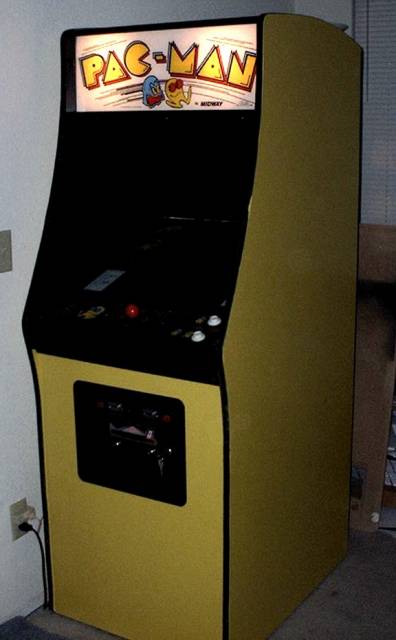 Pac-Man would become a huge hit for Arcade Games.
Video game arcade machines would later start to gain mainstream popularity from the late 1970s and peak during the early 1980s. This period is known as the Golden Age of Arcade Games and began in 1978 with the release of Space Invaders, which became the first blockbuster video game. It put an end to the 1977 video game market crash, caused a national coin shortage in Japan, became a huge success worldwide, and laid the foundations for most shooters and action games released since then.
The next blockbuster video game was Pac-Man in 1980. It would become a huge success, causing the developers to create a sequel Ms. Pac-Man. Both Pac-Man and Ms. Pac-Man would become so huge that people of all ages and genders filled the arcades playing the game, from children who played after school or the weekends, to adults who played during their lunch breaks, and after work.
Pac-Man and Space Invaders each grossed billions of dollars worldwide and remain the highest-grossing video games of all time. These games, along with some others, such as Galaxian, Asteroids, Galaga, Defender, Frogger, Missile Command, and Donkey Kong, kept the arcade scene booming in the early 1980s.
Arcade games had become a multi-billion dollar industry. In North America, arcade video games even grossed higher revenues than both Hollywood and pop music combined, a rare feat that the North American video game industry has never been able to replicate again ever since.
Some of the technological advances that occurred during the this era include RGB colour graphics (from Speed Race Twin to Space Invaders Deluxe and Galaxian), vertical scrolling (Speed Race and Xevious) and side-scrolling (from Bomber to Scramble), isometric projection (Zaxxon), first-person perspective (from Balloon Gun and Wild Gunman to Duck Hunt), third-person perspective (from Fonz to Pole Position and Buck Rogers), vector graphics (from Asteroids to Space Fury), 3D polygon graphics (I, Robot), stereoscopic 3D effect (SubRoc-3D), chiptune soundtrack (from Gun Fight and Space Invaders to Rally-X and Super Locomotive), and stereo sound (Turbo).
Relative Decline and Resurgence
From 1983 onwards, the arcade market began experiencing a decline (though not as severe as the console market crash). By the mid-1980s, the popularity of arcade games declined further with the release of Nintendo's sequel to arcade game Mario Bros, called Super Mario Bros, which became a phenomenon and would put home consoles on the map. The NES's rising popularity slowly began to rival the arcade's dominance over the gaming industry. After Super Mario Bros made a killing on Nintendo's own console, a special arcade version named VS: Super Mario Bros appeared in the arcades. This version had levels that were different and more challenging than the console version. Since then, video game developers released innovative and fun video games in arcades that would create a lasting effect for over a decade in the United States.
In 1985, Yu Suzuki and his Sega AM2 team revitalized the arcade industry with Hang-On, which introduced features that could not be replicated on home systems: advanced graphics (pseudo-3D, "Super Scaler" sprite-scaling), and more importantly, a motion-controlled hydraulic motorbike cabinet, introducing full-body motion control. Suzuki's intention behind the motion controls was to make arcade games more accessible to casual users, and he continued this with hits like Space Harrier and OutRun. This new emphasis on a motion-controlled experience revitalized the arcade game industry in the late 1980's, and would be what kept it alive decades later with dancing games like Konami's Bemani franchise (up until motion controls came to consoles with Nintendo's Wii and then Microsoft's Xbox Kinect).
In 1987 came another game that played a key role in the resurgence of arcades: Double Dragon, which started the golden age of side-scrolling beat 'em up games, a genre that would peak in popularity with Final Fight two years later. Meanwhile, Sega continued pushing the boundaries of sprite-scaling 2.5D graphics with "Super Scaler" arcade games like After Burner and Galaxy Force. At the same time, Taito and Namco released the first gaming hardware specifically designed for 3D graphics in 1988: the Taito Air System (running Top Landing) and Namco System 21 "Polygonizer" (running Winning Run). However, the arcades began experiencing yet another relative decline by the end of the decade.
The Arcade Renaissance
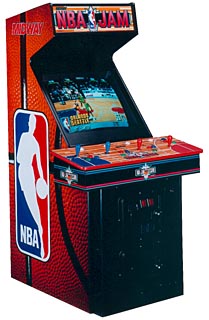 NBA JAM. Just one of many big Arcade hits in the 1990s.
In 1991, the arcade gaming industry experienced a Renaissance with the release of Street Fighter II. It popularized competitive hand-to-hand fighting games and revived the arcade industry to a level of popularity not seen since the days of Pac-Man. The arcades once again dominated the gaming industry, with arcade games once again surpassing the revenues of Hollywood (which led to many video game movies). Many of the best-selling home video games in the early 1990's were also often arcade ports. During this era, developers like Sega, Namco, Midway, Capcom and Konami became household names because of their great arcade games.
3D polygon graphics became increasingly popular during this era due to developers pushing the boundaries of early 3D graphics technology in the arcades, most notably Sega and Namco, with games like Virtua Racing (which popularized 3D polygon graphics), Ridge Racer (which introduced texture-mapped 3D polygons), Daytona USA (which introduced 3D texture filtering), Rave Racer (which introduced hi-res texture mapping), and the Virtua Fighter series (the first game introduced relatively detailed 3D human characters, with the second and third games further pushing the boundaries of 3D graphical realism).
In the 1990's, arcade video games became so big that you had developers making hit games based off of movies, cartoons, comics, and television shows. Sports games using authentic sports licenses were also made and became quite popular. This, along with inflation, would result in prices for play going up. In the late 1980s and early 1990s, most arcade games cost a quarter per play. However, this soon changed to fifty cents, seventy-five cents, and some games were even a full dollar for first play. At the time people didn't mind because the arcade was also known as the place to see and enjoy the latest graphics, audio and controls in video gaming. Even though the console market made a solid foundation in the homes of millions of Americans, most of them knew that the graphics, audio and controls in their chosen console didn't match the superior ones found in the arcade cabinets. Despite ports of popular arcade games hitting consoles, gamers knew they were getting a watered down version of the original.
The Downfall of Arcades in North America
 Street Fighter Alpha. Example of a 2D arcade game perfectly ported to 32-bit consoles.
The success of arcade games began to change for the worse in the late 1990's when 3D and CD-based console gaming start becoming popular. This began with the arrival of the 32-bit consoles, the Saturn and PlayStation. Because of their ability to produce 3D graphics, improved capability in 2D graphics, and the compact disc ability to carry a lot of data, developers were finally able to make good ports of their games to sell on consoles. Business is business, and the developers saw where they could make a lot more money porting near-flawless copies of their games to popular gaming consoles. Because of this, gamers no longer felt they needed to spend money in the arcades to play the latest eye candy, as they could simply go to the store or mall and buy a decent port of the full game for their console.
However, while 32-bit consoles could produce 2D graphics on par with arcades, the arcades still remained competitive in the mid-to-late 1990s by pushing the boundaries of 3D graphics considerably beyond what consoles or PC's were capable of, particularly when it came to powerful arcade machines like Sega's Model 2 (released 1993) and Model 3 (released 1996) or Namco's System 22 (released 1993) and System 23 (released 1997). However, this changed in 1998, when Sega's Dreamcast became the first home system to produce 3D graphics almost on-par with arcade machines at the time, due to being based on the Sega Naomi arcade hardware (though with half the RAM). By the 21st century, console gaming had surpassed arcade gaming in terms of popularity, while PC gaming eventually surpassed arcade gaming in terms of graphical capabilities. As a result, arcades in North America have been on life support in some areas and dead in others.
Continued Relevance in Asia
Your average Japanese Arcade place.Arcades are still popular in Japan, however, as the Japanese see arcades as part of their national tradition. Many Japanese children as well as adults all go to huge and loud arcade places, that usually have sit down machines. As a result, many major and minor developers are still able to make games and turn a profit releasing those games in Japan. Many of these arcade games usually get ported over to the United States and release on the consoles. As of today, many video game developers are now making arcade games using modern PC hardware (whereas before, console and PC hardware were often based on arcade machines), making sure the legacy lives on forever.
In recent years, the economic recession, along with competition from the Wii (which introduced arcade-like motion controls to homes), has affected the Japanese arcade industry, which has been slowly declining after hitting its peak in the mid-2000's. However, consoles have also begun declining in Japan due to the rise of handhelds and mobile gaming (with Japan having the largest handheld and mobile gaming markets in the world).
Arcade machines are currently thriving in other emerging markets in Asia, particularly in South Korea and especially China, where arcades are widespread across the country; in China's case, this may be partly due to a ban on video game consoles by the Chinese government, which did not lift the console ban until 2013.
Due to the arcade's continued relevance in Asia, many technologies continued to be released for arcades before appearing on consoles. Many Japanese arcade machines today offer online multiplayer, allowing players to connect to arcade machines (and sometimes home machines) elsewhere in the world, a feature that has been around since at least the 1990's, a popular example being the Sega Naomi arcade system (which allowed arcade and Dreamcast users to interact over SegaNet) in the late 1990s. Later advances that appeared in arcade gaming before they reached home consoles include the use of various musical peripherals in Bemani games like Beatmania (1997), GuitarFreaks (1998), Dance Dance Revolution (1998), and DrumMania (1999); accurate motion controls in games like Police 911 (2000) and Mazan (2002); magnetic cards and touch controls in games like World Club Champion Football (2002) and Sangokushi Taisen (2005); and multi-touch in games like DJ Max Technika (2008).
In 2012, Square Enix's Taito division as well as Sega released their next-generation arcade machines, Taito Type X3 and Sega RingEdge 2, which are comparable in power to the 2013 consoles PS4 and Xbox One. The first games for the Type X3 and RingEdge 2 were Gunslinger Stratos and Guilty Gear XX Λ Core Plus R, respectively, in 2012.
Arcade Machine Styles
Ms. Pacman a Upright Arcade Cabinet Controlled with a joystick.Arcade cabinets come in many shapes and sizes to best fit the game that they are housing. The most common a style of arcade cabinet in North America is the standard upright cabinet. These cabinets tend to be large and heavy due to there inefficient use of space inside the machine and use of heavy materials such a MDF and metal. Upright cabinets are often six feet tall and take up no more than three feet in width. Normally someone would have to stand to operate the cabinet, or sit on a tall bar stool.The control options for upright arcade cabinets vary from game to game, but commonly contain joysticks, buttons, trackballs, and spinners.
Also common in North America is the counter-top cabinets. This are cabinets that sit on top of something, like a bar or table to raise them up to playing height. Counter-top cabinets are popular because they save needed floor space and are less intrusive than a full sized cabinet. Although any game or control scheme could be made to work on a counter-top cabinet, they are most popular with touch screen trivia games in bars or pubs.
Popular Cocktail Cabinet War Lords.Cocktail Cabinets are low to the ground, table like cabinets. Normally a table will have controls on opposite ends of the table, and in some rare cases on all four sides.The monitor will switch orientation to match the appropriate player, with the expiation of four player games where all four people get there own quarter of screen or share a screen. Table style cabinets have the advantage of being a multi-purpose piece of furniture. The monitor is normally cover with plexiglass to prevent damage to the screen from spilt drinks or food.
Candy Cabs are Japanese sitdown cabinets. They are called candy cabs because the exterior finish resembles hard candy. See MVS section in the Neo Geo page for more information.
PlayChoice-10 was an arcade machine released by Nintendo to capitalize on the popularity of arcades in the 1990's, See PlayChoice-10 for more information.
And finally, there are many "deluxe" arcade cabinets, which are sit-down cabinets with various different shapes and designs, ranging from Hang-On's motion-controlled motorbike and Space Harrier's rotating cockpit to G-Loc's 360-degree rotating cockpit and Ridge Racer's hydraulic-powered replica car.
Log in to comment