Overview

Unreal Tournament 2004 is a multiplayer-focused sci-fi fantasy first-person shooter developed by Epic Games, Digital Extremes, and Psyonix and published by Infogrames for the PC on March 16, 2004.
It is a revamped version of Unreal Tournament 2003, altering many gameplay mechanics while adding a variety of new content (including new weapons, characters, arenas, and game modes). Its most notable feature is its new large-scale vehicular combat system (where some modes allow players to pilot numerous vehicles, including SUVs, tanks, aircraft, and spacecraft). It also revamps the game's HUD and menu system.
The game also features an enhanced single-player campaign with better team management, a dedicated currency system, and bonus post-match fights (or "Challenges"). The story is set in the year 2303, one year after the events of Unreal Tournament 2003 (where Gorge's team of Juggernauts wins the 12th Liandri Grand Tournament, breaking the winning streak of fan-favorite Malcolm). Now in its 13th year, the tournament features a new assortment of teams including the Hellions (a band of human space pirates seeking respectability as mercenaries), Thunder Crash (a classic human mercenary team led by Malcolm), the Iron Skull (a team of Skaarj warriors sent by the Skaarj Empire), and The Corrupt (Liandri cyborgs led by Xan Kriegor, who hasn't participated since his initial defeat).
Some content from the original Unreal Tournament have returned (including some alien races, the Sniper Rifle, and the mission-based Assault game mode). Along with some bonus packs, the game also received a special re-release on September 21, 2004 (known as the Editor's Choice Edition) featuring 11 community-made mods and a bonus disc with video tutorials on modding various aspects of the game. This version was later included in the 2006 compilation Unreal Anthology.
The ECE edition, with the Mega Pack but sans the community-made mods and video tutorials, was digitally re-released by Epic Games themselves in multiple digital storefronts beginning on March 17, 2008. With the closure of GameSpy's servers, Epic Games updated the game in 2014 to manage the multiplayer master server themselves. However, all digital versions were later delisted on December 23, 2022 and the master servers were closed on January 24, 2023, requiring players to manually configure their settings for community-managed master servers.
Game Modes
By default, the game includes 10 game modes and 1 hidden game mode.
- Deathmatch - Standard free-for-all deathmatch. Earn points by killing enemies and lose points by suicide.
- Team Deathmatch - Standard team-based deathmatch. Earn points as a team by killing enemies and lose points as a team by both suicide and killing with friendly fire.
- Capture the Flag - Objective mode where teams earn points by taking their opposing team's flag and bringing it to their own flag post with their own flag intact.
- Double Domination - Objective mode where teams fight for control over two neutral control points. When a team takes control of both zones, a ten-second countdown timer starts. If the team manages to maintain control of both zones when the timer elapses, then that team earns a point and both zones reset (after a brief respite).
- Bombing Run - Round-based objective mode where teams fight over possession of a "ball" and attempt to throw or carry the ball through the enemy goal. When the ball passes through a team's goal, the other team earns points (7 if carried and 3 if thrown) and the next round begins (with all players reset back to their starting positions). Players in possession of the ball cannot use their weapons (and can discard the ball by either throwing it using Primary Fire or passing it to a teammate using Secondary Fire), and slowly regenerate health.
- Assault - An asymmetrical team-based objective mode, where both teams take turns being Attackers and Defenders. Attackers must complete a series of map-based objectives (from flipping switches to destroying machinery) within a time limit, while Defenders must prevent them from doing so. Each match has two rounds, and if the first-round Attackers complete all of their objectives, the second-round Attackers must complete all of their objectives in a faster time in order to win the match. The Adrenaline system is disabled for this mode.
- Onslaught - A large-scale vehicle-based team-based objective mode, where teams fight for control over a series of neutral "Power Nodes" connecting both bases (each with their own "Power Core"). Teams can only take control of a Power Node by attacking it with weaponry (then staying nearby as it builds) if that node is "connected" to that team's Power Node or Power Core. Players can heal their Power Nodes and speed up the build time of their Power Nodes using the Link Gun's Secondary Fire. Once a team controls all Power Nodes linking their Power Core to the enemy team's, they can attack the enemy Power Core. Once a team's Power Core is destroyed, the other team wins the game.
- Last Man Standing - All players start each match with a limited amount of lives, which deplete as players respawn. Once a player loses all their lives, they can no longer respawn. The last player to have lives remaining wins the game. Players spawn with all weapons (except the Redeemer, Ion Painter, and all Onslaught weapons). As a server-side option, players can restore their health by fragging opponents.
- Mutant - Free-for-all deathmatch with a twist: once a player makes a kill, they become a super-powered "Mutant". Mutants teleport to safety, restore their health, and gain all weapons (except the Redeemer, Ion Painter, and all Onslaught weapons), an abundance of ammo and shields, and the Speed, Booster, and Invisibility effects. Players can only score while they are Mutants (with 2 points for a normal kill, 3 points for a double kill, and 4 points for a multi-kill and above), and other players can only damage Mutants (who is also slowly draining health, which can only be replenished by killing). Once a player kills the Mutant, they become the next Mutant. As a server-side option, the player with the lowest score can be designated the "Bottom Feeder", who can kill other players to score points (1 point per kill). Once that player is no longer the lowest scoring player, then a new player becomes the Bottom Feeder. Mutants get 5 points for killing the Bottom Feeder.
- Invasion - Co-operative wave-based survival mode, where players must work together to eliminate all A.I.-controlled monsters (different from normal bots). Players can only respawn between waves, with the game ending once all players are eliminated. All monsters in this mode are from the original Unreal (each with their original graphics, sounds, A.I. routines), and consist of Razor Flies, Mantas, Skaarj Pupaes, Gasbags, Krall (both standard and elite), Brutes (normal and Behemoth), Skaarj (normal, Ice, and Fire), and the Skaarj Warlord. Server hosts can configure the difficulty and enemy usage of each of the 15 waves, including which wave to start in.
- Vehicle CTF - Unlocked once the player downloads a compatible map (with the VCTF prefix). Capture the Flag with vehicle support. While players with the flag can get into the passenger side of some vehicles, they drop the flag when they enter any other vehicle.
- Instagib CTF - Added in a later patch. Capture the Flag with InstaGib rifles and configurable options (including whether or not to use the Zoom InstaGib rifle, whether or not to let shots propel friendly players far, and whether or not to lower the game's gravity).
Weapons
Along with all 12 weapons from UT2003 (most of which are slightly modified), the game includes four bonus weapons correlating to the Onslaught game mode. These weapons, however, can be included in other modes.
Additional weapons can be included using mods and mutators.
Shield Gun
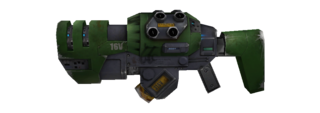
(Weapon Slot 1)
The standard melee weapon for all combatants, the DD280 Riot Control Device combines lethal piston power with a unique rechargeable plasma barrier that can reflect enemy projectiles and energy beams. Unless certain mutators are activated, all players start with this weapon.
- Primary Fire: Deals a close-ranged piston attack, dealing damage and knocking them away. Holding down the Fire button instead causes the piston to charge up, dealing increased damage and knockback when the player releases the Fire button. In addition, players can fire at the ground while jumping to perform an "impact jump" to propel themselves farther up.
- Secondary Fire: Emits a plasma barrier that reflects enemy projectiles and energy beams while the Fire button is held down. Keeping the barrier up costs energy, which automatically recharges over time.
Assault Rifle

(Weapon Slot 2)
The standard weapon for all combatants, the AR770 combines fully-automatic firepower with an underbarreled M355 grenade launcher. Unless certain mutators are activated, all players start with this weapon equipped.
- Primary Fire: Standard weapon fire at a rapid-fire rate.
- Secondary Fire: Launches grenades (at a slow rapid-fire rate) that bounces off of surfaces before detonating (either on its own or after impacting a target). The grenade's trajectory is directly influenced by the player's movement. Players start with a very limited amount of grenades.
Bio-Rifle
(Weapon Slot 3)
The GES BioRifle launches globs of toxic Tarydium waste that stick onto surfaces.
- Primary Fire: Launches simple clumps of sludge in a rapid-fire rate.
- Secondary Fire: Launches simple clumps of sludge. Holding down the Fire button instead slowly charges up the Bio Rifle with additional ammo, launching a much larger wad of sludge when the player releases the Fire button. Larger wads deal additional damage on direct impact and, when impacting other surfaces, burst into smaller clumps of sludge.
While these globs are deadly on direct impact, they also explode shortly after being adhered to surfaces (dealing damage to enemies near it). Players can also expand these globs by firing additional sludge at them.
Mine Layer
(Onslaught Weapon, Weapon Slot 3)
The Spider Mine Layer is used for deploying autonomous mobile proximity mines (known as "spider mines") used both against personnel and vehicles. Each mine remains stationary until it detects an enemy (combatant or vehicle) in its proximity, when it jumps on that enemy and detonates. If the mine hits a wall while deploying or moving, it also detonates.
- Primary Fire: Launches mines in a very slow rapid-fire pace. If the user has eight non-detonated spider mines out, then this function does nothing.
- Secondary Fire: Calls all of the user's deployed spider mines to move to the user's location.
Shock Rifle
(Weapon Slot 4)
The ASMD Shock Rifle is a multi-purpose energy rifle. Along with an accurate burst of energy, it can also fire a large slow-moving projectile.
- Primary Fire: Fires instantaneous beams of energy with pin-point accuracy in a slow rapid-fire rate.
- Secondary Fire: Launches powerful slow-moving energy projectiles (later known as the "Shock Ball" or "Shock Core") in a rapid-fire rate.
As a more-advanced technique, players can shoot the Secondary Fire energy projectiles with the Primary Fire energy blast to cause the unstable projectile to explode, dealing its direct-impact damage to all enemies in its blast radius.
A second version of the Shock Rifle, also known as "Instagib Rifle", is used when either the InstaGib or Zoom InstaGib mutators are enabled. All attacks with them instantly kill enemies. When the regular InstaGib mutator is enabled, their Secondary Fire functionality is disabled. When the Zoom InstaGib mutator is enabled, their Secondary Fire is replaced with a zoomable scope (similar to the Lightning Gun and Sniper Rifle). The Zoom InstaGib version also overpenetrates objects.
Link Gun
(Weapon Slot 5)
The Advanced Plasma Rifle v23 is a multi-purpose plasma rifle. Along with its ability to fire a barrage of plasma projectiles in a very fast rate, users can also emit a constant stream of plasma energy (which can be "linked" with other teammates to deliver a more powerful attack).
- Primary Fire: Fires fast-moving green blasts of plasma in a very fast rapid-fire rate. These projectiles move faster over time.
- Secondary Fire: Expels a constant beam of green plasma energy (with a limited reach) as long as the Fire button is held down. When it is fired at a teammate, it "links" up with that teammate, allowing them to deal additional damage with both functions of the Link Gun.
Minigun
(Weapon Slot 6)
The T23-A 23mm rotary cannon sprays bullets in two firing modes: fast (for a higher rate-of-fire) and slow (for better accuracy and damage). Their ammunition pool is shard with the Assault Rifle.
- Primary Fire: Standard weapon fire at a fast rapid-fire rate.
- Secondary Fire: Alternate weapon fire that sacrifices a fast rapid-fire for better accuracy and bullet damage.
Flak Cannon
(Weapon Slot 7)
The Flechette Cannon (better known as the Flak Cannon) is a handheld cannon that serves as both the game's shotgun (as it launches flechettes at a wide spread) and grenade launcher (as it can also launch a powerful impact grenade projectile).
- Primary Fire: Sprays blasts of flechettes at a slow rapid-fire rate. Each piece can bounce off of a single surface.
- Secondary Fire: Launches a Flak Grenade at a slower rapid-fire rate. These grenades explode on impact, dealing high damage in its blast radius and launching additional flechettes.
Grenade Launcher
(Onslaught Weapon,Weapon Slot 7)
The MGG Grenade Launcher fires a barrage of magnetic remotely-detonated grenades that bounce off of surfaces and can stick onto enemies (both vehicles and combatants) before it settles.
- Primary Fire: Launches grenades in a slow rapid-fire pace. If the user has eight non-detonated MGG grenades out, then this function does nothing.
- Secondary Fire: Detonates all of the user's MGG grenades. Can be held down to detonate grenades shortly after they are launched.
Rocket Launcher
(Weapon Slot 8)
The Tri-barrel Rocket Launcher is a multi-barrel launcher that fires rocket-propelled grenades. While each rocket can be fired consecutively, users can load additional rockets for a three-warhead volley.
- Primary Fire: Launches a slow-moving pinpoint-accurate rocket sequentially in a slow rapid-fire pace.
- Secondary Fire: Same as Primary Fire, but holding down the Fire button slowly loads additional rockets that can be launched simultaneously (either when three rockets are loaded, the player runs out of additional rockets, or the player releases the Fire button), before repeating the process over. Pressing the Primary Fire button while loading rockets instantly launches them in a tight spiral formation (instead of a wide horizontal spread).
Additionally, players can fire homing rockets by keeping their weapon pointed at an opponent, until their cursor is changed, before launching rockets.
AVRiL
(Onslaught Weapon, Weapon Slot 8)
The Anti-Vehicle Rocket Launcher (or AVRiL for short) is a single-shot launcher that fires powerful anti-vehicle rocket-propelled grenades.
- Primary Fire: Launches a powerful slow-moving pinpoint-accurate rocket sequentially in a very slow rapid-fire pace.
- Secondary Fire: Although it does nothing on its own, holding down the Fire button while targeting an enemy vehicle causes the user to zoom in and remain locked on that vehicle. All of the user's AVRiL rockets homes in on that target while locked.
Lightning Gun
(Weapon Slot 9)
The Lightning Gun is a high-power marksman energy rifle that launches an instant-hit lightning bolt with pinpoint accuracy. It also provides a unique multi-level zoomable scope and deals double damage on headshots.
- Primary Fire: Standard firing mode, firing a pinpoint-accurate high-powered shot in a slow rapid-fire rate.
- Secondary Fire: Toggles the scope. Holding down the Fire button when enabling the scope increases its magnification.
Sniper Rifle
(Weapon Slot 9)
Returning from the original Unreal Tournament, the Sniper Rifle is a semi-automatic high-powered marksman rifle with a usable sniper scope. Like the Lightning Gun, it deals double damage on headshots.
- Primary Fire: Standard firing mode, firing a pinpoint-accurate high-powered shot in a slow rapid-fire rate.
- Secondary Fire: Toggles the scope. Holding down the Fire button when enabling the scope increases its magnification.
Redeemer
(Weapon Slot 0)
The Redeemer is a rare handheld single-shot thermonuclear launcher that fires a large slow-moving missile. When the missile strikes a solid surface (or other object), it sends out a gigantic shockwave that instantly pulverizes every enemy in its colossal blast radius. Along with standard fire, players can guide the missile's path using an on-board camera (where it can be detonated mid-air).
- Primary Fire: Standard firing mode.
- Secondary Fire: Same as Primary Fire, only the player is then controlling the missile's trajectory using using an on-board camera. While controlling the missile, they have no control over their character's movement or vision. By pressing either Fire button, the missile can be detonated mid-air.
Missiles launched by this weapon can be shot at by enemy gunfire, causing it to prematurely explode like a standard Rocket Launcher rocket without triggering its payload.
Ion Painter
(Weapon Slot 0)
The Ion Painter is a rare weapon that emits a low-powered laser beam. While it seems harmless at first, locking it down on a particular spot (visible to the sky) marks the location for a destructive VAPOR Ion Cannon blast from an orbiting satellite (that pulverizes enemies in its colossal shockwave).
- Primary Fire: Emits the targeting beam. While it uses no ammunition to emit the beam, it uses ammunition to successfully mark a target.
- Secondary Fire: Toggles the scope.
Target Painter
(Onslaught Weapon, Weapon Slot 0)
An alternate version of the Ion Painter, the Target Painter is a rare weapon that emits a low-powered laser beam. While it seems harmless at first, locking it down on a particular spot (visible to the sky) marks the location for a bombing run from a Phoenix Bomber (that pulverizes enemies in its path).
- Primary Fire: Emits the targeting beam. While it uses no ammunition to emit the beam, it uses ammunition to successfully mark a target.
- Secondary Fire: Toggles the scope.
Translocator
(No Weapon Slot, uses its own Translocator Key with the default as "Q")
The Translocator is a handheld personal teleportation device consisting of a source module (which the user holds) and a destination module (a disc which is launched from the source module). It is a multi-purpose device, allowing players to escape from danger, reach areas impossible by other means, and navigate through difficult areas easier. All players start with this weapon if it is enabled for the match.
- Primary Fire: Launches the Destination Module in an arc. Pressing it again while the Destination Module is out causes it to instantly teleport back to the Source Module.
- Secondary Fire: Attempts to teleport the user to the location of the Destination Module, teleporting the Destination Module back to the Source Module. Each player has a limited amount of "charges" that regenerate (preventing players from spamming it).
While it's used as a utility device, it can also serve as a weapon by telefragging enemies (instantly killing them if done successfully). This is done by having an opponent directly on the location of the Destination Module and then teleporting them.
As a note, teleporting with the Translocator while holding the Flag in Capture the Flag mode causes that player to drop the Flag. In addition, the Destination Module is highly-noticable and can be shot by enemy gunfire. Attempting to teleport to a broken Destination Module causes that player to instantly die.
In addition, the Destination Module has a built-in free-looking camera that can be accessed by pressing the Translocator Key while the Translocator is equipped. Along with surveillance, it can also be used to determine if it was destroyed by an enemy player.
Vehicles
Other than Turrets and the Space Fighters, all vehicles included in the game includes an audible horn that the driver of each vehicle can honk using the Vehicle Horn button.
In multi-seat vehicles, players can switch to a different position using the number bar on the keyboard (with 1 as the driver, 2 as the first passenger seat, 3 as the second passenger seat, and so on).
Base Vehicles
Manta
Single-seat Ground. Base Integrity: 200 HP.
A very lightweight hovercraft, the Manta floats above the ground using dual high-powered fans located at the sides. Although it has weak armor and minimal firepower, its speed and maneuverability allows players to quickly traverse the battlefield.
It is the only Ground vehicle in the game capable of "jumping" using the Jump button (in which it floats higher in the air before gently floating back down) and "crouching" using the Crouch button (in which it floats lower towards the ground). These techniques can be used to easily kill enemy infantry using collision damage.
While the Manta only supports one person, teammates can stand on the vehicles' wings to transport them easily. Known unofficially as "Manta runs", this is exploitable in Vehicle CTF (in which flag carriers can not enter Mantas normally).
- Primary Fire: Fires standard energy blasts in a rapid-fire rate.
- Secondary Fire: Same as the Crouch button.
Scorpion
Single-seat Ground. Base Integrity: 300 HP.
A small, lightweight, and fast combat support vehicle, the Scorpion fires unique tethered plasma cores (similar to bolas) and industrial-grade steel shears on its twin sling arms (used to easily roadkill enemy infantry).
- Primary Fire: Fires a horizontally-aligned bola of magnetically-bonded plasma cores that wraps around enemies, vehicles, or other objects before detonating. These cores are fired from the vehicle's top-mounted turret, is not affected by gravity, and has limited verticality. Can be charged up by holding down the Primary Fire before releasing it, allowing the vehicle to fire a longer string of plasma cores.
- Secondary Fire: Holding it down expands the vehicle's twin sling arms, which cleave through enemy infantry with ease. The sling arms can be permanently destroyed by knocking it against walls and other objects.
Raptor
Single-seat Air. Base Integrity: 300 HP.
The game's standard lightweight aircraft, the Raptor can maneuver around the battlefield with ease. In addition to standard plasma blasts, Raptors have access to anti-vehicular rockets that, while deadly on its own, automatically lock on to enemy Raptors, Mantas, and Cicadas.
At its neutral state, the Raptor hovers in the air in one spot. Controlling it requires use of the Jump button (for climbing up), the Crouch button (for diving down), and basic player movement.
- Primary Fire: Fires standard plasma blasts in a rapid-fire rate.
- Secondary Fire: Fires rockets in a slow rapid-fire rate. Rockets automatically home into Raptors, Mantas, and Cicadas in its path. Its slower cooldown also affects its Primary Fire.
HellBender
Three-seat Ground. Base Integrity: 600 HP.
The game's large off-road light truck (similar to Humvees), the HellBender can support two additional passengers (each with their own unique and powerful weaponry) for easier transportation of multiple team members. The driver themself cannot use any weaponry other than standard vehicle collisions.
- Primary/Secondary Fire (Driver): Same as the Vehicle Horn button. Honks the horn.
- Primary Fire (Side Turret Gunner): Fires shock cores in a rapid-fire rate.
- Secondary Fire (Side Turret Gunner): Fires shock beams in a slow rapid-fire rate. If an airborne shock core is close to the targeting reticule, it'll aim at that and detonate it for a shock blast before redirecting the beam to a nearby shock core and repeating.
- Primary Fire (Rear Turret Gunner): Fires twin pin-point accurate beams. Can be charged up for a more powerful blast.
- Secondary Fire (Rear Turret Gunner): Zoom
Goliath
Two-seat Ground. Base Integrity: 800 HP.
The game's signature tank, the Goliath features a powerful 140mm main cannon in its independently-rotating turret that can devastate infantry and vehicles alike. While the turret can move freely from the slow-turning chassis, its verticality is limited and also has a slow turning speed (requiring careful attention of its position for accurate shots).
In addition, a teammate can help guard the Goliath from enemy infantry using top-mounted machine guns (which is aligned with the chassis instead of the main turret).
- Primary Fire (Driver): Fires the fast-moving tank round in a slow rapid-fire rate.
- Secondary Fire (Driver): Toggles zooming. Holding down the Fire button when enabling the zoom increases its magnification.
- Primary Fire (Minigun Turret Gunner): Fires dual top-mounted machine guns at a rapid-fire rate.
- Secondary Fire (Minigun Turret Gunner): Toggles zooming. Holding down the Fire button when enabling the zoom increases its magnification.
Bonus Pack Vehicles
Cicada
Two-seat Air. Base Integrity: 600 HP.
Designed for easier near-air support, the Cicada features side-mounted rocket pods for bombarding ground targets and under-mounted laser cannons for protection. While it is not as maneuverable as the Raptor (and requires two people for maximum effect), it has heavier armor and improved climbing and diving speeds.
In addition, the Cicada can deploy flares to lure away incoming homing missiles.
- Primary Fire (Pilot): Fires dual rockets from its side-mounted pods at a rapid-fire rate.
- Secondary Fire (Pilot): Emits a targeting laser before firing a rocket at that location. Holding down the Fire button loads up additional rockets for a volley (which fires either after loading up 15 additional rockets or after releasing the Fire button).
- Primary Fire (Turret Gunner): Fires beams from the vehicle's dual under-mounted laser cannons at a rapid-fire rate.
- Secondary Fire (Turret Gunner): Deploys a flare that lures away incoming homing missiles.
SPMA
Two-seat Ground. Base Integrity: 600 HP.
Short for Self-Propelled Mobile Artillery, the SPMA is the game's sole long-range artillery vehicle. Along with standard artillery fire, players can utilize special deployable hovering cameras to improve visibility. A teammate can also utilize the EMP projectile cannon (similar to the HellBender) to protect the vehicle.
- Primary Fire (Driver): Fires high-explosive shells in a slow rapid-fire rate. If the real-time target reticule is enabled, then the shell fragments in the air near the ground (releasing five smaller warheads).
- Secondary Fire (Driver): Fires special camera shells in a slow rapid-fire rate, shown through an on-board camera. If the button is pressed while the shell is in the air, the shell deploys into a hovering camera. While the camera is active, it locks the vehicle into position and displays a real-time target reticule on the ground (which can be affected by the Driver's movement). The camera can be destroyed either through enemy gunfire, by leaving the vehicle position, or by pressing the Fire button again.
- Primary Fire (Side Turret Gunner): Fires shock cores in a rapid-fire rate.
- Secondary Fire (Side Turret Gunner): Fires shock beams in a slow rapid-fire rate. If an airborne shock core is close to the targeting reticule, it'll aim at that and detonate it for a shock blast before redirecting the beam to a nearby shock core and repeating.
Paladin
Single-seat Ground. Base Integrity: 800 HP.
A powerful all-terrain armored vehicle, the Paladin supports offensive tactics with its plasma blasts and defensive tactics with its directional energy shield matrix.
- Primary Fire: Fires a plasma blast. While the energy shield is up, it instead causes the vehicle to shockwave.
- Secondary Fire: Generates a directional energy shield that protects itself (and nearby allies) from enemy attacks. It can be disabled from an overabundance of enemy gunfire, although it automatically recharges.
Special Vehicles
Turrets
Single-seat Immobile. Base Integrity: 450 HP.
The most common player-controlled dedicated turret found in the game is the Energy Turret, which fires beams of energy.
- Primary Fire: Fires accurate beams of energy at a rapid-fire rate.
- Secondary Fire: Toggles zooming. Holding down the Fire button when enabling the zoom increases its magnification.
In addition to the Energy Turret, the game includes four additional turret types used solely in Assault mode (for the base game). These work differently, with the players Forwards and Backwards movement changing the turret's magnification (keeping the zoom mode enabled at all times). These are:
- Minigun Turret (600 HP, only found in AS-Junkyard) - Primary Fire sprays Minigun bullets at a rapid-fire rate. Secondary Fire resets the turret's magnification (or, if already reset, zooms all the way in).
- Link Turret (750 HP, only found in AS-RobotFactory and AS-MotherShip) - Primary Fire fires standard Link Gun blasts in a slower rapid-fire rate. Secondary Fire emits the Link Gun's constant beam. These can only be accessed through special consoles found throughout the map.
- Ion Cannon (2000 HP, only found in AS-RobotFactory) - Primary Fire fires a devastating Ion Blast (which must be charged beforehand. Secondary Fire resets the turret's magnification (or, if already reset, zooms all the way in).
- Mothership Turret (6.5x of Space Fighters, only found in the space battle section of AS-MotherShip) - Primary Fire fires balls of energy at a rapid-fire rate. Secondary Fire emits a projectile shield (similar to the Shield Gun's shield). These can only be accessed through special consoles found throughout the map.
Ion Plasma Tank
Two-seat Ground. Base Integrity: 1400 HP.
A special version of the Goliath, the Ion Plasma Tank is an experimental tank that houses a powerful Ion Cannon instead of a standard 140mm cannon.
In the base game, it only appears on AS-Glacier.
- Primary Fire (Driver): Holding down the button charges up powerful Ion Cannon blasts with a slow rapid-fire rate.
- Secondary Fire (Driver): Deploys a shockwave in a rapid-fire rate, knocking back enemy infantry.
- Primary Fire (Minigun Turret Gunner): Fires dual top-mounted machine guns at a rapid-fire rate.
- Secondary Fire (Minigun Turret Gunner): Toggles zooming. Holding down the Fire button when enabling the zoom increases its magnification.
Leviathan
Five-seat Ground. Base Integrity: 5000 HP.
A superweapon in vehicle form, the Leviathan is a gigantic all-terrain truck that can support four additional passengers (each manning their own anti-vehicular energy turret). It is the only vehicle in the game that can transform. In its standard mobile form, it can deploy deadly rockets from its rear-mounted rocket pack. In its deployed immobile form, it instead fires devastating singularity strikes.
In the base game, it only appears on ONS-RedPlanet.
- Primary Fire (Driver): When the vehicle is in its normal position, it fires rockets (from its rear-mounted rocket pack) at a rapid-fire rate. When the vehicle is deployed, it instead fires devastating singularity strikes in a very slow rapid-fire rate.
- Secondary Fire (Driver): Slowly toggles between its normal mobile mode and its deployed immobile mode (which affects its Primary Fire).
- Primary/Secondary Fire (Turret Gunner): Fires energy blasts in a rapid-fire rate.
Space Fighter
A unique vehicle that only appears in the space battle segment of AS-MotherShip, the Space Fighter is a lightweight vehicle capable of firing laser blasts and missing that home in on locked-on enemies. Each team has their own versions of the Space Fighter (Human for the attacking team and Skaarj for the defending team), which is different in cosmetic.
Unlike the Raptor and Cicada, controlling Space Fighters is more similar to traditional space combat games. Players can no longer control their Yaw movement at-will, with the vehicle instead moving forward towards the player's current direction at all times (with the Forwards and Backwards keys controlling the speed). Strafing works as normal, while holding down the Jump key while strafing causes the vehicle instead to roll. Pressing the Crouch key automatically rolls the vehicle to its default position.
- Primary Fire: Fires laser blasts in a rapid-fire rate.
- Secondary Fire: Fires rockets in a slow rapid-fire rate.
TC-1200
Single-seat Ground. Base Integrity: 300 HP.
A joke vehicle and motorized "toilet car", the TC-1200 handles similar to a Scorpion. However, it has no direct firepower (with its Primary Fire and Secondary Fire buttons disabled) and can only kill infantry through collisions.
In the base game, it is only available with the "Vehicle Arena" mutator after winning single-player mode with Mr. Crow.
Characters
Thunder Crash
New faction.
- Malcolm (unlockable, originally part of the Mercenary faction)
- Aryss
- Jakob
- Tamika
- Othello
- Azure
- Riker
- Annika
Skaarj
New faction.
- ClanLord (unlockable)
- Drekorig
- Skakruk
- Guardian
- Dominator
- Kragesh
- Gaargod
- Gkublok
- Mekkor (added in the ECE Bonus Pack)
- Skrillax (added in the ECE Bonus Pack)
Cybernetic
New faction.
- Xan (unlockable)
- Enigma
- Virus
- Cathode
- Axon
- Matrix
- Cyclops
- Divisor
Hellions
New faction.
- Ophelia
- Baird
- Greith
- Garrett
- Zarina
- Kane
- Rae
- Kaela
- Outlaw
Mercenary
- Brock
- Lauren
- Prism
- Wraith
- Sapphire
- Romulus
- BlackJack
- Torch
- Satin
- Remus
Egyptian
- Diva
- Scarab
- Asp
- Roc
- Memphis
- Horus
- Cleopatra
- Hyena
Juggernaut
- Gorge
- Rylisa
- Cannonball
- Ambrosia
- Frostbite
- Reinha
- Arclite
- Siren
Robot
- Thorax
- Widowmaker
- Cobalt
- Corrosion
- Mandible
- Syzygy
- Rapier
- Renegade
Gen Mo'Kai
- Damarus
- Mokara
- Motig
- Faraleth
- Komek
- Makreth
- Selig
- Nebri
Nightmare
- Abaddon (new addition)
- Brutalis
- Lilith
- Mr. Crow (unlike other characters, clearing the game with Mr. Crow has an additional bonus: unlocking the TC-1200 "toilet car" for use with the "Vehicle Arena" mutator)
- Domina
- Ravage
- Fate
- Harlequin
- Subversa
Necris
New faction. Added in the ECE Bonus Pack.
Metal Guard
New faction. Added in the ECE Bonus Pack.
Campaign Teams
Unlike its predecessor, the game's campaign features opposing teams corresponding to a single faction. They are also grouped by difficulty and have their own team captains (whom the player cannot recruit from the Bloodrites challenge).
Weak
- Super Nova (Mercenary) - Perish (leader), Nemesis, Ariel, Wraith, Faith, Phantom, Nova, Dragon
- Sun Blade (Egyptian) - Cleopatra (leader), Imhotep, Isis, Ramses, Diva, Hyena, Nafiret, Scarab
- Goliath (Juggernaut) - Rampage (leader), Misery, Brutus, Fury, Outrage, Titania, Bullseye, Clangor
Tough
- Black Legion (Nightmare) - Abaddon (leader), Harlequin, Fate, Brutalis, Succubus, Mortis, Domina, Samedi
- Blood Fist (Robot) - Mandible (leader), Thorax, Syzygy, Widowmaker, Cobalt, Rapier, Corrosion, Renegade
- Fire Storm (Gen Mo' Kai) - Makreth (leader), Damarus, Mokara, Komek, Faraleth, Motig, Nebri, Selig
Strong
- Hellions (Hellions) - Zarina (leader), Rae, Garreth, Kaela, Greith, Outlaw, Kane, Baird
- Iron Guard (Mercenary) - Brock (leader), Lauren, Wraith, Mystique, Remus, Satin, Xantares, Prism
- Juggernauts (Juggernaut) - Gorge (leader), Ambrosia, Frostbite, Reinha, Avalanche, Perdition, Sorrow, Jezebel
Godlike
- Thunder Crash (Thunder Crash) - Malcolm (leader), Tamika, Othello, Riker, Annaka, Azure, Aryss, Picard
- Iron Skull Skaarj (Skaarj) - ClanLord (leader), Drekorig, Dominator, Guardian, Gaargod, Gkublok, Skakruk, Kraagesh
- The Corrupt (Cybernetic) - Xan (leader), Enigma, Divisor, Virus, Matrix, Cathode, Cyclops, Axon
Maps
Deathmatch
New Additions
- Albatross (DM-1on1-Albatross, 2 players)
- Corrugation (DM-Corrugation, 4-6 players)
- Curse 4 (DM-Curse4, 4-8 players)
- Deck 17 (DM-Deck17, 4-8 players)
- Desert Isle (DM-DesertIsle, 4-8 players)
- Desolation (DM-1on1-Desolation, 2-3 players)
- Gestalt (DM-Gestalt, 2-8 players)
- Goliath (DM-Goliath, 4-8 players)
- HyperBlast 2 (DM-HyperBlast2, 2-6 players)
- Idoma (DM-1on1-Idoma, 2-3 players)
- Irondust (DM-1on1-Irondust, 2 players)
- The Junkyard (DM-Junkyard, 6-10 players) - Based on DOM-Junkyard.
- Metallurgy (DM-Metallurgy, 6-10 players)
- Morpheus 3 (DM-Morpheus3, 2-8 players)
- Rankin (DM-Rankin, 2-8 players)
- Roughinery (DM-1on1-Roughinery, 2 players)
- Rrajigar (DM-Rrajigar, 2-8 players)
- Spirit (DM-1on1-Spirit, 2 players)
- Squader (DM-1on1-Squader, 2 players)
- Sulphur (DM-Sulphur, 2-6 players)
- Trite (DM-1on1-Trite, 2 players)
From UT2003
Curse 3 does not make a return, and is instead replaced by Curse 4.
- Antalus (DM-Antalus, 4-6 players)
- Asbestos (DM-Asbestos, 4-8 players)
- Compressed (DM-Compressed, 2-6 players)
- Crash (DM-1on1-Crash, 2 players)
- Flux 2 (DM-Flux2, 4-8 players)
- Gael (DM-Gael, 2 players)
- Grendelkeep (DM-DE-Grendelkeep, 2-10 players)
- Hot Iron Injector (DM-Injector, 6-10 players)
- Ice Tomb (DM-Icetomb, 4-10 players)
- Inferno (DM-Inferno, 2-6 players)
- Insidious (DM-Insidious, 2-4 players)
- Iron Deity (DM-IronDeity, 6-10 players)
- Ironic (DM-DE-Ironic, 2-6 players)
- Mixer (DM-1on1-Mixer, 2-8 players)
- Leviathan (DM-Leviathan, 2-4 players)
- Oceanic (DM-Oceanic, 2-4 players)
- Osiris 2 (DM-DE-Osiris2, 6-14 players)
- Phobos Moon 2 (DM-Phobos2, 4-8 players)
- Plunge (DM-Plunge, 3-12 players)
- Rustatorium (DM-Rustatorium, 6-10 players)
- Serpentine (DM-1on1-Serpentine, 2-4 players)
- Tokara Forest (DM-TokaraForest, 8-16 players)
- Training Day (DM-TrainingDay, 2-3 players)
Bonus Pack Maps (Mega)
- Calandras (DM-BP2-Calandras, 2-4 players)
- The Goopgod Cult Refugium (DM-BP2-GoopGod, 6-8 players)
Capture the Flag
New Additions
- Absolute Zero (CTF-AbsoluteZero, 8-16 players)
- Bridge of Fate (CTF-BridgeOfFate, 8-12 players) - Same as BR-BridgeOfFate.
- Colossus (CTF-Colossus, 6-14 players) - Same as BR-Colossus.
- Facing Worlds Classic (CTF-FaceClassic, 6-10 players)
- Grassyknoll (CTF-Grassyknoll, 6-10 players)
- Grendelkeep (CTF-Grendelkeep, 4-10 players) - Based on DM-DE-Grendelkeep.
- January (CTF-January, 8-16 players)
- Joust (CTF-1on1-Joust, 2 players)
- Moon Dragon (CTF-MoonDragon, 8-12 players)
- Smote (CTF-Smote, 6-10 players)
- Twin Tombs (CTF-TwinTombs, 6-10 players) - Based on BE-TwinTombs.
From UT2003
- Avaris (CTF-Avaris, 8-12 players)
- Chrome (CTF-Chrome, 6-8 players)
- Citadel (CTF-Citadel, 6-10 players)
- December (CTF-December, 8-16 players)
- Double Dammage (CTF-DoubleDammage, 10-16 players)
- ElecFields (CTF-DE-ElecFields, 6-10 players) - Same as BR-DE-ElecFields.
- Facing Worlds 3 (CTF-Face3, 6-12 players)
- Geothermal (CTF-Geothermal, 6-10 players)
- LavaGiant 2 (CTF-DE-LavaGiant2, 10-14 players)
- Lost-Faith (CTF-Lostfaith, 6-12 players)
- Magma (CTF-Magma, 6-10 players)
- Maul (CTF-Maul, 4-8 players)
- Orbital 2 (CTF-Orbital2, 8-12 players)
Bonus Pack Maps (Mega)
- Concentrate (CTF-BP2-Concentrate, 4-6 players)
- Pistola (CTF-BP2-Pistola, 8-10 players)
Double Domination
New Additions
- Access (DOM-Access, 6-10 players)
- Aswan (DOM-Aswan, 8-12 players)
- Atlantis (DOM-Atlantis, 4-8 players)
- Conduit (DOM-Conduit, 6-10 players)
- Renascent (DOM-Renascent, 4-8 players)
From UT2003
- Core (DOM-Core, 8-12 players)
- The Junkyard (DOM-Junkyard, 6-10 players)
- Outrigger (DOM-OutRigger, 6-10 players)
- Ruination (DOM-Ruination, 6-10 players)
- Scorched Earth (DOM-ScorchedEarth, 4-8 players)
- Seppuku Gorge (DOM-SeppukuGorge, 8-16 players)
- Sun Temple (DOM-Suntemple, 10 players)
Bombing Run
New Additions
- Bridge of Fate (BR-BridgeOfFate, 8-12 players) - Same as CTF-BridgeOfFate.
- Colossus (BR-Colossus, 6-12 players) - Same as CTF-Colossus.
- Serenity (BR-Serenity, 6-10 players)
From UT2003
- Bifrost Bases (BR-Bifrost, 8 players)
- Canyon (BR-Canyon, 6-10 players)
- Disclosure (BR-Disclosure, 6-10 players)
- ElecFields (BR-DE-ElecFields, 6-10 players) - Same as CTF-DE-ElecFields.
- Ice Fields (BR-IceFields, 8-12 players)
- Skyline (BR-Skyline, 8 players)
- Slaughterhouse (BR-Slaughterhouse, 8-16 players)
- Temple of Anubis (BR-Anubis, 6-10 players)
- Twin Tombs (BR-TwinTombs, 6-10 players)
Assault
Base Maps
- Convoy (AS-Convoy, 6-14 players)
- The Fallen City (AS-FallenCity, 8-16 players)
- Glacier (AS-Glacier, 8-16 players)
- Junkyard Escape (AS-Junkyard, 8-16 players)
- Mothership Assault (AS-MotherShip, 8-12 players)
- Robot Factory (AS-RobotFactory, 10-20 players)
Bonus Pack Maps (Mega)
- Invasion of Acatana (AS-BP2-Acatana, 8-12 players)
- Jumpship (AS-BP2-Jumpship, 8-12 players)
- Outback (AS-BP2-Outback, 8-12 players)
- Sub Rosa (AS-BP2-SubRosa, 6-10 players)
- Thrust (AS-BP2-Thrust, 8-12 players)
Onslaught
With the addition of the ECE Bonus Pack, each non-ECE map also has an alternate variant with the DLC's new vehicles.
Base Maps
- Arctic Stronghold (ONS-ArcticStronghold, 10-18 players)
- Crossfire (ONS-Crossfire, 10-18 players)
- Dawn (ONS-Dawn, 8-16 players)
- Dria (ONS-Dria, 12-24 players)
- Frostbite (ONS-FrostBite, 6-10 players)
- Primeval (ONS-Primeval, 6-10 players)
- Red Planet (ONS-RedPlanet, 12-16 players)
- Severance (ONS-Severance, 10-20 players)
- Torlan (ONS-Torlan, 8-16 players)
Bonus Pack Maps (ECE/Mega)
- Adara Canyon (ONS-Adara, 12-20 players)
- Island Hop (ONS-IslandHop, 8-16 players)
- Tricky (ONS-Tricky, 8-12 players)
- Urban (ONS-Urban, 6-12 players)
Bonus Pack Maps (XP)
- Aridoom (ONS-Aridoom)
- Ascendancy (ONS-Ascendancy)
Mutators
New Additions
- Air Control - Changes the air control of all players to a configurable value.
- BigWheels - Enlarges each player vehicle's wheel size (including hitbox) as they gain frags. Only available in Onslaught.
- Bonus Combos - Allows players to perform two additional Adrenaline Combos (each of which can be disabled by the mutator): Camouflage (Move Right x4, keeping a holographic projection of a static decoration in front of the player), and Pint-sized (Move Left x4, shortening the player's character to half of their normal height at the cost of their crouching ability).
- Game Speed - Changes the overall game speed to a configurable value.
- Lightning Guns - Replaces all Sniper Rifle weapon and ammo pickups with their Lightning Gun counterparts.
- Lightweight Vehicles - Increases the knockback of vehicle collisions by a configurable value. Only available in Onslaught.
- Onslaught Weapons - Replaces every weapon and ammo pickup of certain weapons with another configured by the mutator. Weapons that can replace others include the AVRiL, Grenade Launcher, and Mine Layer.
- Sniper Rifles - Replaces all Lightning Gun weapon and ammo pickups with their Sniper Rifle counterparts.
- Species Statistics - See "Species Statistics" below.
- Stunt Vehicles - Players can make their wheeled vehicles jump by holding down and releasing the Crouch key. Only available in Onslaught.
- Super Berserk - Boosts the firing rate of all weapons, while having all players spawn with the Super Shield Pack.
- UDamage Reward - Players who are fragged while holding the Double Damage powerup drop that powerup with its remaining time intact.
- UT2003 Style - Increases the weapon switch speed while enabling the "Boost Dodge" physics bug (which allowed crafty players to perform a higher jump when performing a Wall Dodge and Double Jump at the same time).
- Vehicle Arena - Replaces every vehicle with the vehicle configured by the mutator (Manta, Scorpion, Raptor, HellBender, Goliath, Cicada, SPMA, and Paladin only). Only available in Onslaught. By clearing the single-player campaign with Mr. Crow, an additional vehicle can be unlocked: the TC-1200 "toilet car".
- Vehicle Pickups - Players who operate a vehicle can pick up weapons, ammo, and other items by driving over them.
- MutBonusVehicles - Added in the ECE Bonus Pack. Alternative way to change official pre-ECE Onslaught maps to their alternate version (with the DLC's new vehicles). Does nothing otherwise.
In addition, the mutator list includes a UTV2004S mutator that is only used for dedicated game servers running the Unreal TV (UTV) 2004 plugin (which allowed other proxy servers to host spectators without degrading the server's performance). This mutator enables spectators to freely roam around the map.
Returning from UT2003
Delayed Spawn and Floaty Cadavers do not return. In addition, the additional Adrenaline Combo mutators are now merged into one (see Bonus Combos). Some mutators have also been updated since UT2003.
- Arena - Replaces every weapon and ammo pickup with the weapon configured by the mutator. All players spawn with that weapon only instead of the default Assault Rifle and Shield Gun.
- BigHead - Enlarges each player's head size (including hitbox) as they gain frags, while shrinking them as they get fragged.
- InstaGib - Removes all weapon and ammo pickups from the game while having all players spawn only with a modified infinite-ammo Shock Rifle (whose shots instantly kill opponents, at the cost of no separate Secondary Fire function). Can be configured to allow Translocators and to allow players to "boost" teammates using the weapon's high knockback. Not available in Assault, Onslaught, and InstaGib CTF.
- LowGrav - Reduces the gravity of all players and objects. Not available in Assault.
- No Adrenaline - Removes all Adrenaline pickups from the arena. Kills no longer grant Adrenaline.
- No SuperWeapons - Removes all Redeemer and Ion Painter pickups from the arena.
- QuadJump - Adds the ability to jump three times in mid-air. Not available in Assault.
- Regeneration - All players regenerate 5 health every few seconds.
- Slow Motion Corpses - Slows down the physics of player corpses.
- UT Classic - See "UT Classic" below.
- Vampire - Players gain health by damaging their opponents.
- Zoom InstaGib - Removes all weapon and ammo pickups from the game while having all players spawn only with a modified infinite-ammo Shock Rifle (whose shots instantly kill opponents). Its shots also overpenetrate targets (allowing multi-kills with a single shot), and its Secondary Fire function is replaced with a scope (similar to the Lightning Gun and Sniper Rifle). Can be configured to allow Translocators and to allow players to "boost" teammates using the weapon's high knockback. Not available in Assault, Onslaught, and InstaGib CTF.
UT Classic
Returning from the PC version of Unreal Tournament 2003, UT Classic is a mutator that modifies the attributes of certain weapons to be more in-line with their original Unreal Tournament counterparts. While most of the weapon updates from the UT2003 version were streamlined into base UT2004, this version provides four weapon updates:
- The Shock Rifle's Primary Fire fires slower and deals more damage.
- The Minigun's Primary Fire and Secondary Fire functions are reversed.
- The Rocket Launcher's Primary Fire and Secondary Fire functions are heavily altered to their UT counterparts. Primary Fire is the same as the base weapon's Secondary Fire (although altered to allow six rockets at once). Secondary Fire is the same, but instead fires the Assault Rifle's grenades (with the rocket ammo type).
- The Lightning Gun weapon and ammo pickups are replaced with their Sniper Rifle counterparts.
Some of the other features from the UT2003 version are now either streamlined in-game (such as some of the HUD options and "shield stacking" prevention), or configurable as a mutator (such as the damage increase and the option to disable certain movement types). One feature that is always enabled is that the screen does not shake when firing any weapon.
Can be configured to disable specific jumping techniques (including Wall Dodging and Dodge Double Jumping), to disable double-jumping in general, to give all weapons +20% damage, and to increase the recharge rate of the Translocator.
Species Statistics
A successor to the Species system from the Xbox version of Unreal Tournament 2003, Species Statistics is a mutator that alters player attributes based on their faction. Only seven factions have altered stats:
- Skaarj: +20% air control. +50% jump height. -30% damage resistance.
- Egyptian: +150% air control. +50% jump and dodge height. +10% run speed. -20% damage resistance.
- Juggernaut: +30% damage resistance. -30% movement acceleration and air control. -20% crouch and walk speed. -10% dodge speed and dodge height.
- Robot / Cybernetic: Weapons deal 20% more damage. +10% movement acceleration. -20% damage resistance and walk speed. -30% crouch speed.
- Gen Mo' Kai: +30% run speed. +20% air control. +10% movement acceleration. -30% damage resistance.
- Nightmare: Weapons deal 30% less damage. Half of all damage they deal is returned as health. Glitched, as dealing damage while overhealed drops their health back to maximum.
Soundtrack
Disc One
| No. | Title | Writer(s) | Length |
|---|
| 1. | "Intro" | Kevin Riepl | 3:12 |
| 2. | "Menu UT2K3" | Kevin Riepl | 1:31 |
| 3. | "Menu UT2K4" | Kevin Riepl | 4:14 |
| 4. | "Menu UT2K4 Version 2" | Kevin Riepl | 1:36 |
| 5. | "Intro UT2K4 Version 2" | Kevin Riepl | 2:05 |
| 6. | "Menu" | Kevin Riepl | 1:55 |
| 7. | "Mercs Entrance" | Kevin Riepl | 1:16 |
| 8. | "Jugs Entrance" | Kevin Riepl | 1:00 |
| 9. | "Level 2" | Starsky Partridge | 5:48 |
| 10. | "Level 3" | Starsky Partridge | 3:09 |
| 11. | "Level 5" | Starsky Partridge | 5:47 |
| 12. | "Level 6" | Starsky Partridge | 5:31 |
| 13. | "Level 7" | Starsky Partridge | 4:48 |
| 14. | "Level 8" | Starsky Partridge | 3:38 |
| 15. | "Level 9" | Starsky Partridge | 4:21 |
| 16. | "Level 11" | Starsky Partridge | 3:35 |
| 17. | "Level 13" | Starsky Partridge | 4:34 |
| 18. | "Level 15" | Starsky Partridge | 3:40 |
| 19. | "Level 16" | Starsky Partridge | 4:16 |
| 20. | "Stage" | Kevin Riepl | 0:53 |
Disc Two
| No. | Title | Writer(s) | Length |
|---|
| 1. | "Absolute Zero" | Kevin Riepl | 2:59 |
| 2. | "Action 1" | Kevin Riepl | 3:08 |
| 3. | "Action 2 Version 2" | Kevin Riepl | 3:34 |
| 4. | "Action 3" | Kevin Riepl | 2:59 |
| 5. | "Assault" | Kevin Riepl | 2:00 |
| 6. | "Atlantis" | Kevin Riepl | 3:03 |
| 7. | "Chemical Burn" | Kevin Riepl | 2:00 |
| 8. | "City" | Kevin Riepl | 4:03 |
| 9. | "Collision Course" | Kevin Riepl | 2:00 |
| 10. | "Conduit" | Kevin Riepl | 3:00 |
| 11. | "Convoy" | Kevin Riepl | 4:05 |
| 12. | "Corrugation Rise" | Kevin Riepl | 3:07 |
| 13. | "DM1" | Kevin Riepl | 2:00 |
| 14. | "From Below Version 2" | Kevin Riepl | 1:59 |
| 15. | "Ghosts of Anubis" | Kevin Riepl | 2:02 |
| 16. | "Glacier" | Kevin Riepl | 3:00 |
| 17. | "Hell" | Kevin Riepl | 2:00 |
| 18. | "HyperBlast Redux" | Kevin Riepl | 3:13 |
| 19. | "Infernal Realm" | Kevin Riepl | 2:00 |
| 20. | "Infiltrate" | Kevin Riepl | 2:00 |
| 21. | "Junkyard" | Kevin Riepl | 4:01 |
| 22. | "Metallurgy" | Kevin Riepl | 3:05 |
| 23. | "Morpheus 3" | Kevin Riepl | 3:02 |
Disc Three
| No. | Title | Writer(s) | Length |
|---|
| 1. | "Pharao's Revenge" | Kevin Riepl | 2:00 |
| 2. | "Rankin" | Kevin Riepl | 3:12 |
| 3. | "Robot Factory" | Kevin Riepl | 4:01 |
| 4. | "Roughinery" | Kevin Riepl | 3:02 |
| 5. | "Serenity" | Kevin Riepl | 3:00 |
| 6. | "Skaarj Assault" | Kevin Riepl | 3:00 |
| 7. | "Sky Scraper" | Kevin Riepl | 2:01 |
| 8. | "Slaughter" | Kevin Riepl | 2:20 |
| 9. | "Sniper Time" | Kevin Riepl | 2:00 |
| 10. | "Sulphur" | Kevin Riepl | 2:58 |
| 11. | "Tomb of Horus" | Kevin Riepl | 2:01 |
| 12. | "WasteLand" | Kevin Riepl | 1:58 |
| 13. | "Onslaught 1" | Will Nevins | 3:48 |
| 14. | "Onslaught 2" | Will Nevins | 3:57 |
| 15. | "Onslaught 3" | Will Nevins | 6:12 |
| 16. | "Onslaught 4" | Will Nevins | 3:21 |
| 17. | "Onslaught 5" | Will Nevins | 4:09 |
| 18. | "Onslaught 6" | Will Nevins | 4:25 |
| 19. | "Onslaught 7" | Will Nevins | 3:24 |
| 20. | "Ending Sequence" | Kevin Riepl | 1:33 |
System Requirements
Windows 98/Me/2000/XP
128MB RAM (256MB RAM or greater recommended)
Pentium III or AMD Athlon 1.0 GHz processor (Pentium® or AMD 1.
System Requirements2GHz or greater recommended)
8X CD-ROM or DVD
5.5GB HDD space
DirectX® version 9.0b
32 MB video card required (64 MB NVIDIA or ATI hardware T&L card recommended)
Useful links
Log in to comment