Overview
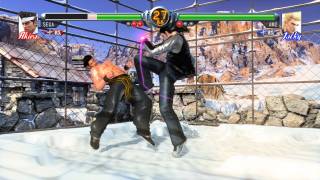
Virtua Fighter 5 is a 3D fighting game developed by Sega-AM2 and released by Sega for arcades (using their PC-based Lindbergh hardware) in Japan on July 2006. It received a limited worldwide release on February 2007, with online features removed.
The fifth main installment of the Virtua Fighter series, Virtua Fighter 5 adds two new playable fighters (Chinese opera dancer Eileen and Mexican luchador El Blaze) and updated gameplay mechanics (such as the addition of the evasion-based "Offensive Move" technique and the "Clash System"). It also continues the series' trend of using one of the most powerful arcade boards at the time to render the most highly-detailed graphics for its time (with this iteration introducing high-definition widescreen resolution, High Dynamic Range, and model self-shadowing).
Along with the online connectivity and custom player data features of Virtua Fighter 4 (now part of Sega's ALL.Net service), the Japanese arcade version of Virtua Fighter 5 featured an enhanced ranking system and two special dedicated machines: "VF Terminal" (which allowed players to manage their card data) and "VF.TV" (which broadcasts competitive matches to a screen for spectators).
The original arcade version of the game received four major updates (or "Versions"), each adding new character costumes, gameplay fixes, and bonus game modes/events: Ver. A (on October 17, 2006), Ver. B (on December 14, 2006), Ver. C (on July 24, 2007), and Ver. D (on February 6, 2008). It also received three major revisions: Virtua Fighter 5 R, Virtua Fighter 5 Final Showdown, and Virtua Fighter 5 Ultimate Showdown (or Virtua Fighter eSports).
The "Ver. B" version was used as a basis for the PlayStation 3 port, which was released in Japan on February 8, 2007, in North America on February 20, 2007, and in Europe on March 23, 2007. The "Ver. C" version was later used as the basis for the Xbox 360 port, which was released in Europe on October 26, 2007, in North America (as Virtua Fighter 5 Online) on October 30, 2007, and in Japan (as Virtua Fighter 5: Live Arena) on December 6, 2007. Both versions of the game feature a dedicated "Quest Mode" (where players fight numerous fake players from fictional arcades to earn costume parts), while the 360 version features online multiplayer (a first for the series).
Gameplay
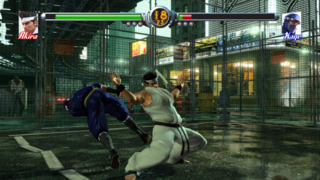
Similar to the previous games in the Virtua Fighter series, Virtua Fighter 5 uses three color-coded buttons: Punch (blue), Kick (red), and Guard (green). Each button, used alongside a joystick combination, performs one of several actions:
- P - Simple punch attacks. These are usually much quicker.
- K - Simple kick attacks. These usually have more range.
- G - Guards against attacks. Guarding while standing blocks most High and Mid attacks and guarding while crouching blocks most Low attacks. It can also be used to initiate basic jumps and cancel certain things, such as attacks, combos, dashes, and alternate stances.
- P+K - Powerful punch attacks.
- K+G - Powerful kick attacks.
- P+G - Grapple/throw attacks. It is also used for escaping throws.
- P+K+G - Special movement commands, such as toggling alternate stances and performing fall recoveries.
Many attacks and other commands are very technical, usually requiring much attention to the character's orientation and position. Players can link these commands together for combos. Each character has a wide array of unique moves and commands, with smaller-build characters relying on quick hits and evasion and larger-build characters relying on strong attacks and throws.
Movement Techniques
Other techniques include dashing (by tapping forward/backward twice for standing dashes and tapping down-forward/down-backward twice for crouching dashes), running (by performing a forward standing dash and holding the stick forward), and jumping (by tapping an upward direction and pressing Guard). Some of these techniques can be cancelled into special attacks.
As a 3D fighting game, characters can walk around the arena by moving away from the camera (by holding upward on the joystick) and moving towards the camera (by double-tapping, then holding, downward on the joystick). By performing a quick tap on either direction, players can perform a special "Defensive Move" technique to dash in either direction and evade most attacks and combos.
Differences from VF4
Some new additions to the game include:
- The "Offensive Move" technique, performed by pressing all three buttons during a Defensive Move, allows the player to initiate an angled forward-dash towards the opponent. When used successfully, it can allow players to attack the opponent's side (or back) uncontested.
- The "Clash System", or "Sousai", is a gameplay mechanic where if one player makes a striking attack while the opponent attempts a throwing attack, both attacks "clash" and leaves both players at an even advantage. Some attacks cannot be clashed.
- "Instant Throws", or "0-Frame Throws", return from Virtua Fighter 3, allowing some character-specific techniques (such as evades) to be cancelled into throws with no start-up time.
- Stages no longer have "open corners" and are no longer destructible.
Game Modes & Events (Arcade)
In addition to standard versus matches, the game includes the following modes:
Arcade / Score Attack
The game's standard single-player Arcade Mode, where players face-off against seven CPU opponents (with a bonus match against Dural at the end). Players are both timed and ranked by score.
Knockout Trial
Added in Ver. B, Knockout Trial is a single-player mode where players face-off against teams of eight computer opponents, with each opponent resembling real-life players (with varying difficulty, play style, and player data) to give the illusion that they are fighting against human opponents. Each team has one "boss" opponent, who is the most difficult and is fought last.
Ver. D revamped the mode into "Knockout Trial 2", which is now pirate-themed. It also includes "mysterious pirate" opponents that can challenge the player.
Bingo Festa
Added in Ver. C, Bingo Festa was a limited-time event where each player had access to a bingo card and earn numbers to fill the card after each match to win prizes. There were three separate types: "Hitori de Bingo!", "Omise de Bingo!", and "Zenkoku Issei Min'na de Bingo!"
Official Open Battle
Added in Ver. D and used for in-store tournaments. Players earn "battle score" by defeating opponents and are ranked for that tournament, with higher-ranked players earning prizes.
Game Modes (Home)
In addition to standard versus matches, the game includes the following modes:
Arcade Modes
In the Home versions of the game, there are two types of Arcade Modes: Normal and Score Attack. Both work pretty much the same: the player chooses a fighter and progresses through the game before a bonus round with Dural. Score Attack, however, always uses the default settings and players are ranked on leaderboards.
Dojo Mode
The game's training mode includes three selectable game modes taking place in the Dojo stage:
- Free Training - Standard practice mode with customizable settings, such as the stage and opponent.
- Command Training - A more in-depth training tool, allowing players to perform every technique in their command list in order. (Though they can skip moves if they find one to be difficult)
- Command Time Attack - Same as Command Training, only that players are timed (with leaderboards for each character) and cannot skip techniques.
VF.TV Mode
Basic "watch mode" where players can watch replays of previous matches, watch exhibition matches between two computer opponents (including Continuous and Random Continuous options), watch promotional material for Virtua Fighter 5, and browse leaderboards.
Character Customization
Players with custom character data can use the Customization Mode (which is also accessible in Quest Mode) to customize their character's appearance, emblem (icons that show up next to your name in matches), and pre-fight quote.
On certain occasions in VS. Mode and Quest Mode, battles turn into Item Battles, which contain a treasure chest. Defeating that opponent earns the player whatever is in the chest, whether it's gold, an item, or a disc orb. Whenever players collect seven disc orbs, they will receive a special item. Players can use gold to buy new clothing items for their character in the Item Shop.
Quest Mode
The main single-player mode in the PS3 and X360 versions of Virtua Fighter 5 is Quest Mode, which builds on the Knockout Trial mode in the arcade version by having players simulate playing in Japanese arcades. Players use their character data to travel through many arcades, defeating rivals and participating in tournaments. There are hundreds of rivals to play against, each varying in difficulty, play style and character data (including appearances, emblems, and pre-fight quotes).
The locations include the Home (which allows you to adjust certain settings and check Quest Mode status), the Event Square (where "official" big tournaments are held), and seven arcades, each with over 130 unique computer players varying in ranking. Each arcade has three free units with an opponent. On some occasions, arenas would have small tournaments with prizes of either gold, an emblem, or an item.
- Sega Arena Coast - Easiest. Mostly beginning players.
- Club Sega Downtown - Mostly beginning and intermediate players.
- Club Sega Bay Area - Mostly intermediate players.
- Sega World Route 101 - Mostly intermediate and advanced players.
- Sega World North - Mostly advanced players.
- Sega Arena East - Wide variety of players.
- Sega World South - Hardest. Mostly elite players.
On certain occasions (when the player has reached certain ranks), the Event Square would announce a big tournament. Unlike tournaments from arenas, the player can retry the same tournament over and over until placed in the top three. Tournaments are single-elimination, and players who lose the semi-finals can battle the other loser for 3rd place. Being in the top three of a tournament allows the player to proceed into future big tournaments.
- Beginner's Try - 8 participants.
- Amateur's Tournament - 8 participants.
- Challenger's Cup - 16 participants.
- Virtua Fighter Championship - 16 participants.
- VF Climax - 16 participants.
- VF Battle Masters - 16 participants.
- Virtua Fighter World Tournament - 32 participants.
- Virtua Fighter World Tournament Finals - 32 participants.
Characters
New Additions
- Eileen - A young opera dancer from China, who fights with the martial art of Kou-ken ("Monkey Fist", or hóuquán).
Returning Characters
- Pai Chan - An action film star from Hong Kong, who fights with the agile martial art of Ensei-ken ("Lost Track Fist", or mízōngquán).
- Lau Chan - A famous chef from China and Pai's father, who fights with his own unique martial art of Koen-ken ("Tiger-Swallow Fist", or hǔyànquán).
- Kage-Maru - A traditional ninja from Japan, who fights with an agile form of jujutsu (known as Hagakure-ryu jujutsu).
- Shun Di - An elderly herbal doctor from China, who fights with the martial art of Sui-ken ("Drunken Fist", or zuìquán).
- Lion Rafale - A wealthy college student from France, who fights with the martial art of Tourou-ken ("Praying Mantis Fist", or tánglángquán).
- Dural - A mysterious metallic gynoid and the game's bonus boss using techniques from all other fighters. Only playable as an unlockable in the console versions
Stages
There are three types of stages in the original release of Virtua Fighter 5: Open, Half Fence, and Full Fence (also known as Open, Fence, and High-Fence). Each vary in size (shown here in meters) and difficulty to get knocked out of the ring.
Each character has their own corresponding stage, which is used when fought against them in basic Arcade modes. In other modes, they are either randomized or player-selectable. The Dojo stage, added in the Home versions, can use all three types of stages and must be unlocked before-hand (by completing Command Time Attack mode with any character).
Open (16x16)
These stages have large-sized squared arenas and no fencing, allowing players to easily ring-out opponents by attacking them (or by having them step out of the arena accidentally).
 River Aurora (Sarah Bryant)
- Island (Jeffry McWild)
- Sanctuary (Dural)
- Waterfalls (Vanessa Lewis)
- River (Shun Di)
- Great Wall (Lau Chan)
- Dojo
Half Fence (12x12)
These stages have average-sized squared arenas and have fencing reaching up to each combatant's hip. Players can knock opponents out of the arena by juggling them.
- Temple Palace (Lion Rafale)
- Deep Mountain (Lei-Fei)
- Shrine (Aoi Umenokouji)
- Statues (Akira Yuki)
- Temple (Kage-Maru)
- Terrace (Brad Burns)
- Dojo
Full Fence (10x10)
These stages have small-sized squared arenas and impenetrable full-size walls, preventing players from knocking opponents out of the arena and allowing special wall-based techniques.
- Abandoned Dojo City (Jacky Bryant)
- Abandoned Dojo (Goh Hinogami)
- Arena (El Blaze)
- Stone Forest (Pai Chan)
- Snow Mountain (Wolf Hawkfield)
- Ruins (Eileen)
- Dojo
Log in to comment